
Illumination characteristic selection system for imaging during an ophthalmic laser procedure and associated methods
a technology of illumination characteristic and imaging system, which is applied in the field of system and method for performing laser ophthalmic surgery, can solve the problems of difficult detection of boundary, negative reflection of image processing, and difficulty in locating desired features, and achieve the effect of partial polarization properties
- Summary
- Abstract
- Description
- Claims
- Application Information
AI Technical Summary
Benefits of technology
Problems solved by technology
Method used
Image

Examples
Embodiment Construction
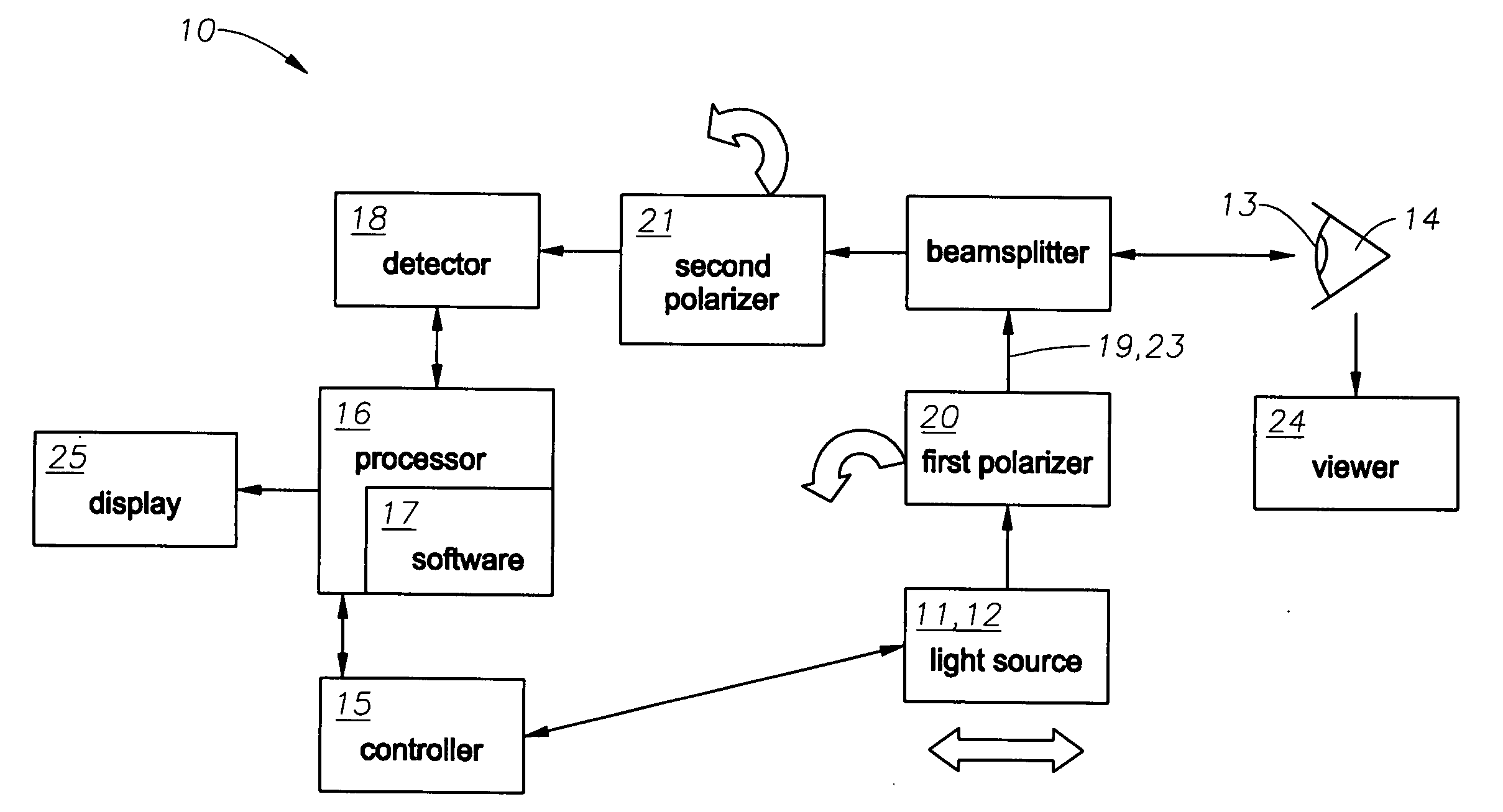
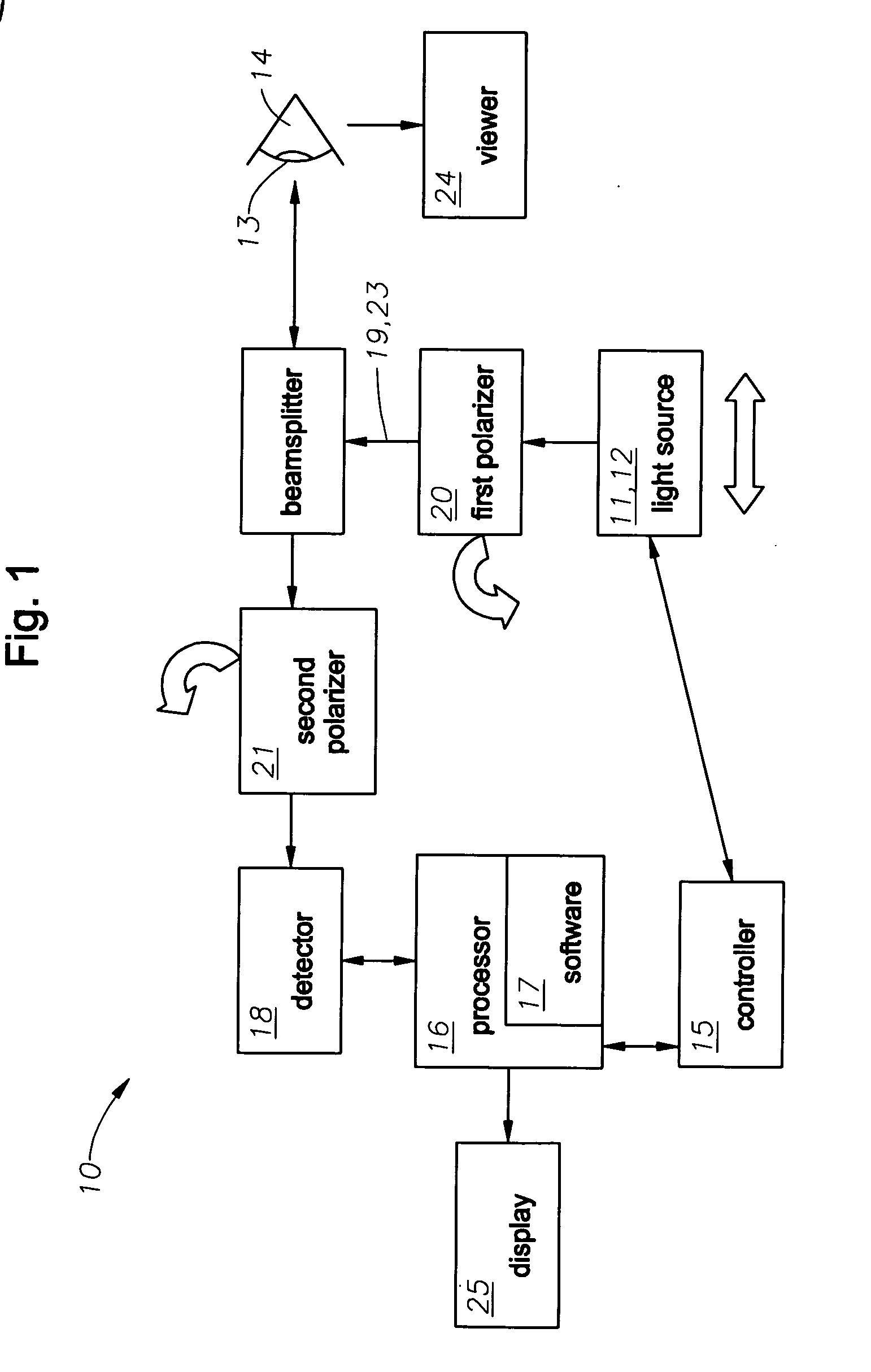
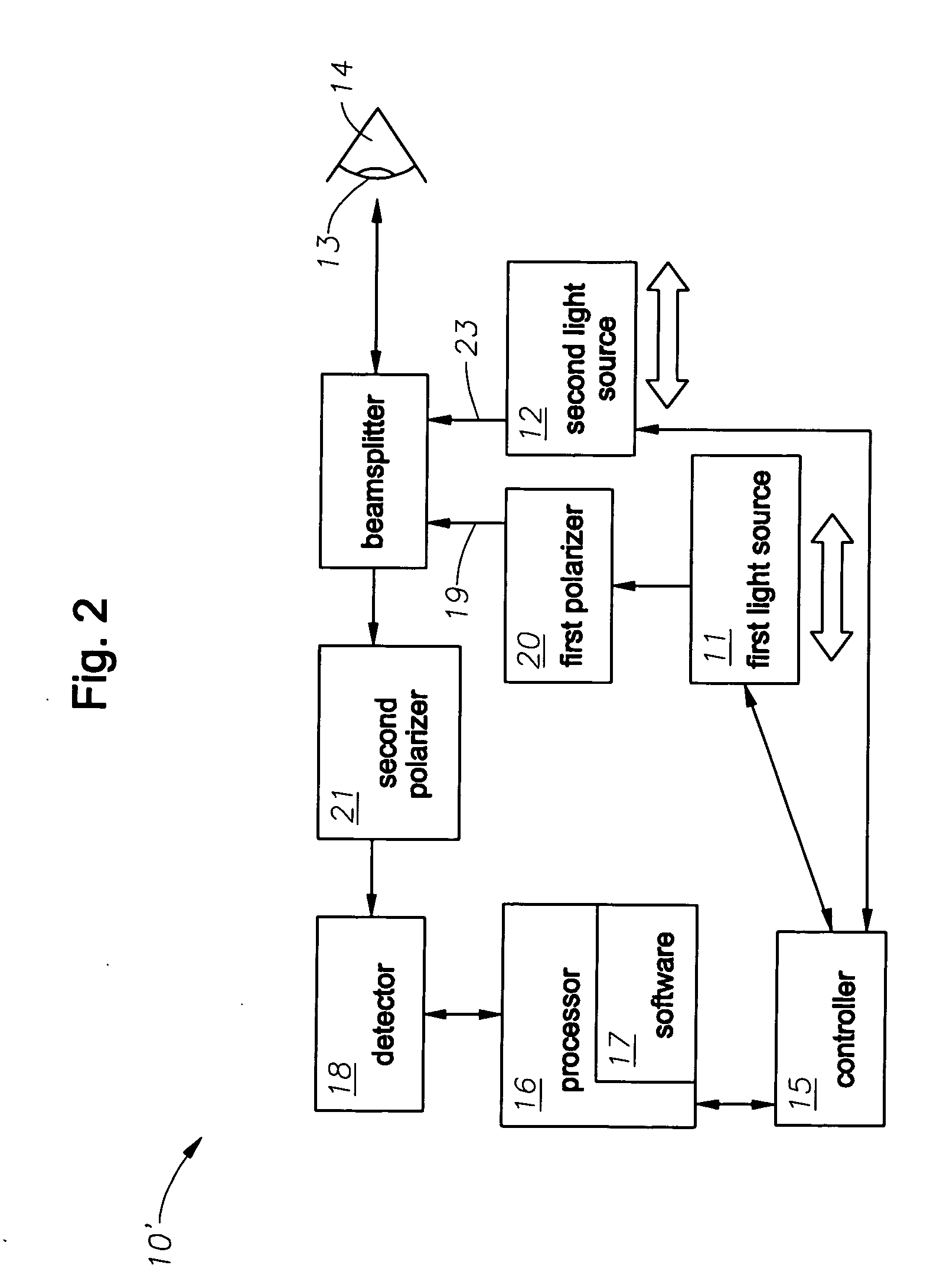
[0009] A detailed description of preferred embodiments of the invention will now be discussed with reference to FIGS. 1 and 2. The system 10 of the present invention can comprise a first and a second light source 11,12 that are positioned to illuminate an object. In the exemplary embodiment, the first 11 and second 12 light source are for illuminating at least a cornea 13 of an eye 14, and, typically, the area around the cornea 13. As shown schematically in FIGS. 1 and 2, the system 10 further includes a controller 15 that is in signal communication with the first 11 and second 12 light source. Signal processing means such as a processor 16 with image processing software 17 resident thereon is in communication with a detector 18, which is positioned to receive light reflected from the eye 14.
[0010] In an embodiment, the first light source 11 is adapted to emit a polarized light beam 19, for which a first polarizer 20 is positioned downstream of the first light source 11, and a seco...
PUM
 Login to View More
 Abstract
Description
Claims
Application Information
 Login to View More