Unlock instant, AI-driven research and patent intelligence for your innovation.

Targeting gli proteins in human cancer by small molecules

a technology of gli protein and human cancer, which is applied in the field of inhibiting tumor growth and tumor survival, can solve the problems of advanced disease, limited understanding of the molecular mechanisms and tumorigenic programs that are activated in response to hh-signaling and gli-activity in human cancer, and disadvantages in approaches, so as to inhibit the activity of a gli protein, inhibit the expression of a gene, and inhibit the signaling of a cell by a gli protein

Active Publication Date: 2007-06-28
RGT UNIV OF CALIFORNIA
View PDF6 Cites 6 Cited by
  • Summary
  • Abstract
  • Description
  • Claims
  • Application Information

AI Technical Summary

Benefits of technology

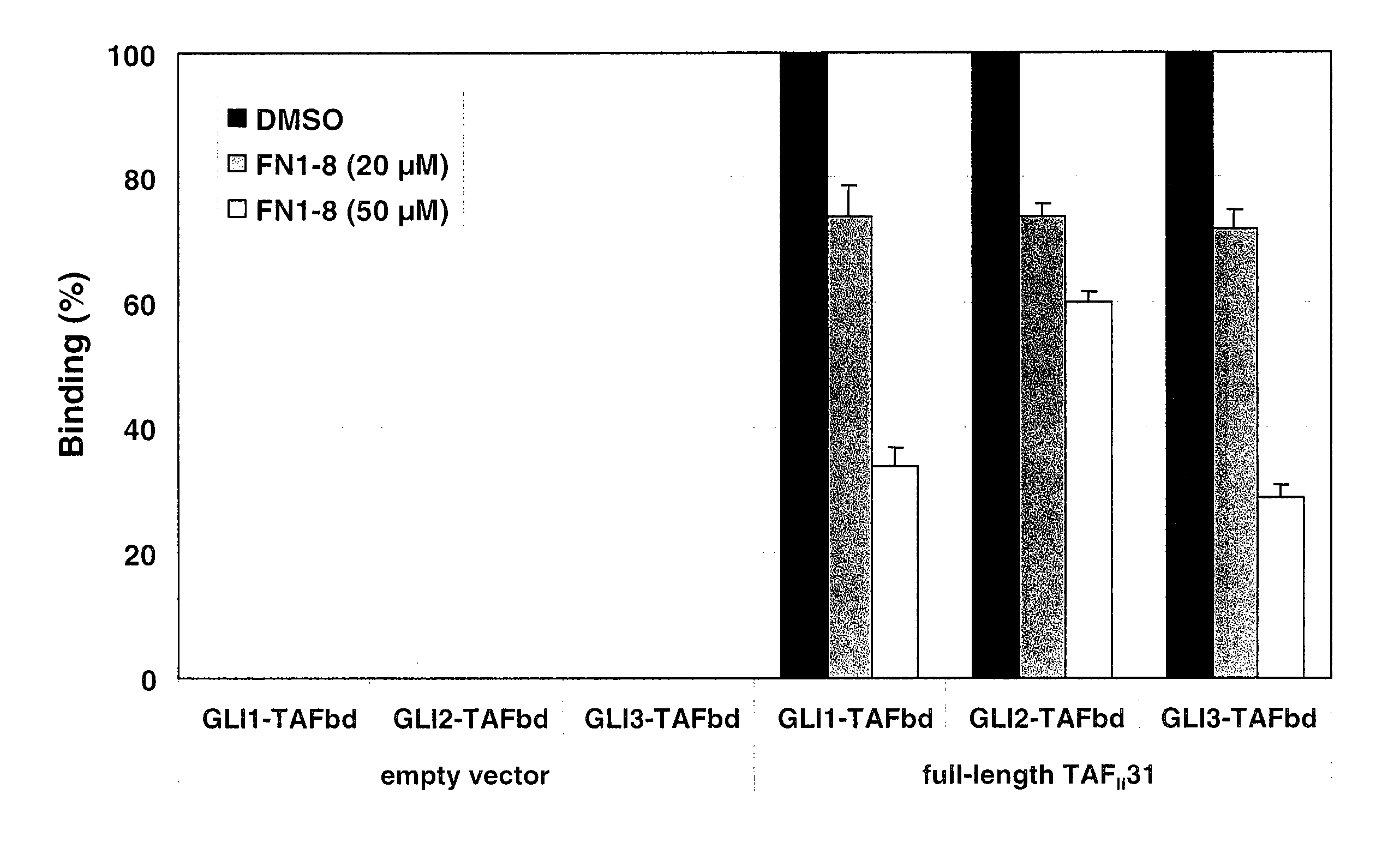
The present invention provides small molecule compounds that can inhibit the activity of the GLI3 protein, which is overexpressed in various cancer cell lines and is involved in the development of cancer. These compounds can induce apoptosis in tumor cells expressing GLI3, but not in normal cells. The invention also provides pharmaceutical compositions and methods for using the small molecule compounds for treating cancer.

Problems solved by technology

Though much is known about Hh-signaling in Drosophila and murine development, understanding of the molecular mechanisms and tumorigenic programs that are activated in response to Hh-signaling and GLI-activity in human cancer is still very limited.
Surgery, chemotherapy, and radiation have been used with generally unsatisfactory results in advanced disease.
However, these approaches have disadvantages.
For example, administration of therapeutically effective amounts of anti Shh antibodies is difficult to achieve and may affect other normal pathway dependent cells in the patient.
Further, because of the wide-spread activity of PKA, administration of forskolin may lead to numerous side effects.

Method used

the structure of the environmentally friendly knitted fabric provided by the present invention; figure 2 Flow chart of the yarn wrapping machine for environmentally friendly knitted fabrics and storage devices; image 3 Is the parameter map of the yarn covering machine
View more

Image

Smart Image Click on the blue labels to locate them in the text.
Viewing Examples
Smart Image
  • Targeting gli proteins in human cancer by small molecules
  • Targeting gli proteins in human cancer by small molecules
  • Targeting gli proteins in human cancer by small molecules

Examples

Experimental program
Comparison scheme
Effect test

example 2

Mimicking the Peptide FDAII of the Gli3 Transcription Activation Domain

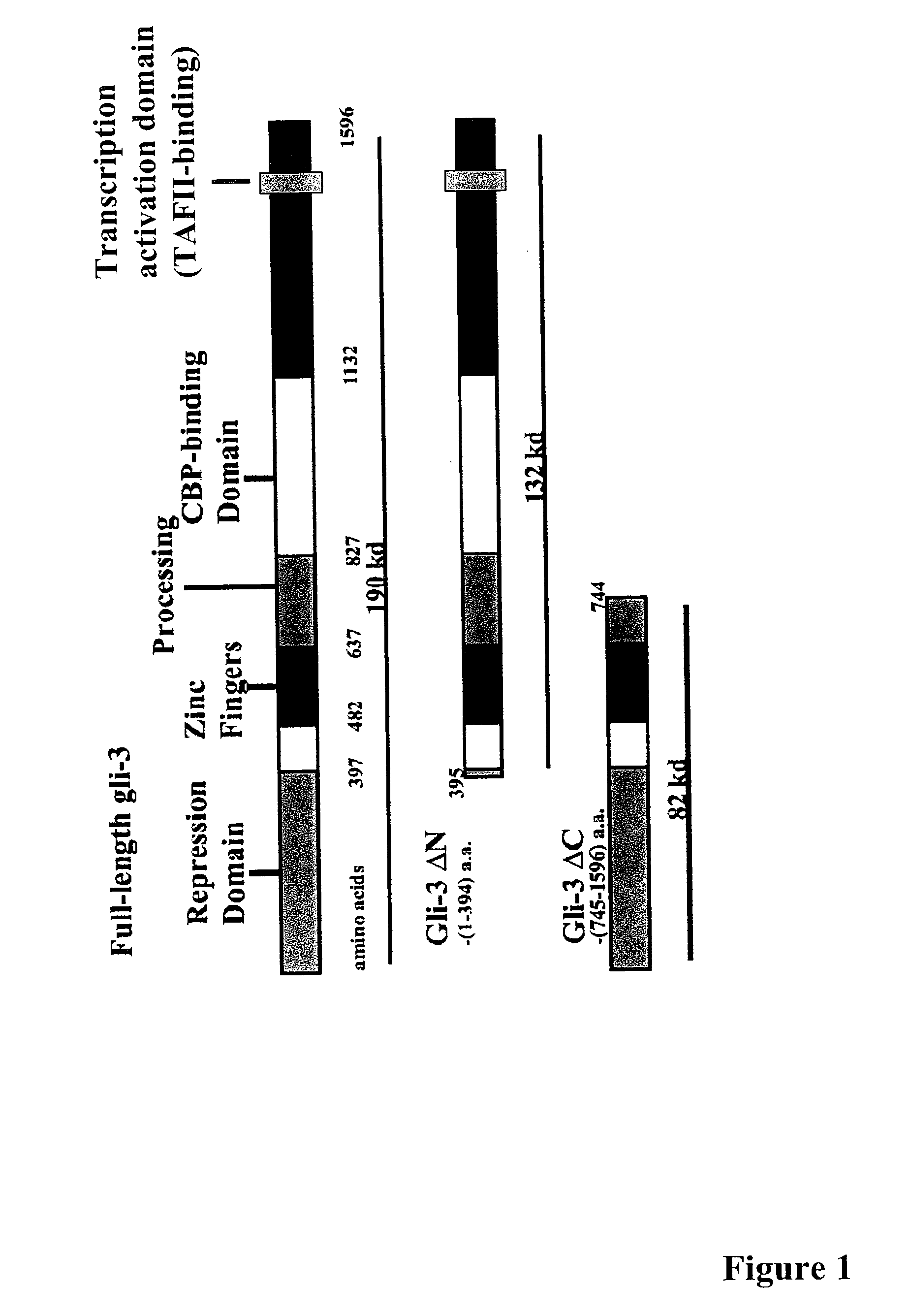
[0296] In order to mimic the FDAII motif of the transcriptional activation domain of GLI3 by small molecules the 3D structure of the FDAII was modeled. As suggested by Yoon et al. (1998, J Biol Chem 273:3496-3501), the FVAIL motif within the GLI1 polypeptide resulted in an α-helix structure. It was plausible to also model an a-helical structure for the FDAII motif of the GLI3 polypeptide. Thus, an α-helical structure of the FDAII motif of the GLI3 polypeptide was generated and rational chemical design was employed to design small molecule compounds mimicking the structure of this motif. Small molecule compounds comprising a pyrazoline structure were designed. FIG. 3 shows a RMS overlay between the small molecule compound FN1-5 (described herein) and the FDAII motif of the GLI3 polypeptide modeled as an α-helix.

example 3

Preparation of Small Molecule Compounds

a) Preparation of ethyl 1,3,5-triphenyl-4,5-dihydropyrazole-4-carboxylate (FN1-1)

[0297]

[0298] A mixture of ethyl cinnamate (7, 2.55 g), benzaldehyde phenylhydrazone (2, 4.21 g), chloramine-T trihydrate (6.45 g), and methanol (45 mL) were heated under refluxing for 22 hours. The reaction mixture was diluted with 50% ethyl acetate in n-hexanes (400 mL), filtered, and evaporated. The residue was purified by column chromatography (silica gel 200 g, eluent: 0 to 10% ethyl acetate gradient in hexanes) and evaporated to give FN1-1 (8, 1.25 g) as colorless crystal. 1H NMR (CDCl3, 400 MHz) δ 7.66-7.64 (m, 1H), 7.46-7.22 (m, 13H), 6.88 (t, J=7.2 Hz, 1H), 4.81 (d, J=4.0 Hz, 1H), 4.70 (d, J=4.0 Hz, 1H), 4.07 (quartet, J=7.2 Hz, 2H), 0.97 (t, J=7.2 Hz, 3H). MS: 371.9 (M+H), 325.5, 297.5.

b) Preparation of 1,3,5-Triphenyl-4,5-dihydropyrazole-4-carboxylic acid (FN1-2)

[0299] A mixture of FN1-1 (53 mg), methanol (0.5 mL), 1,4-dioxane (0.5 mL), and 10% (w / v)...

example 4

Most Cancer Cell Lines Express Gli3

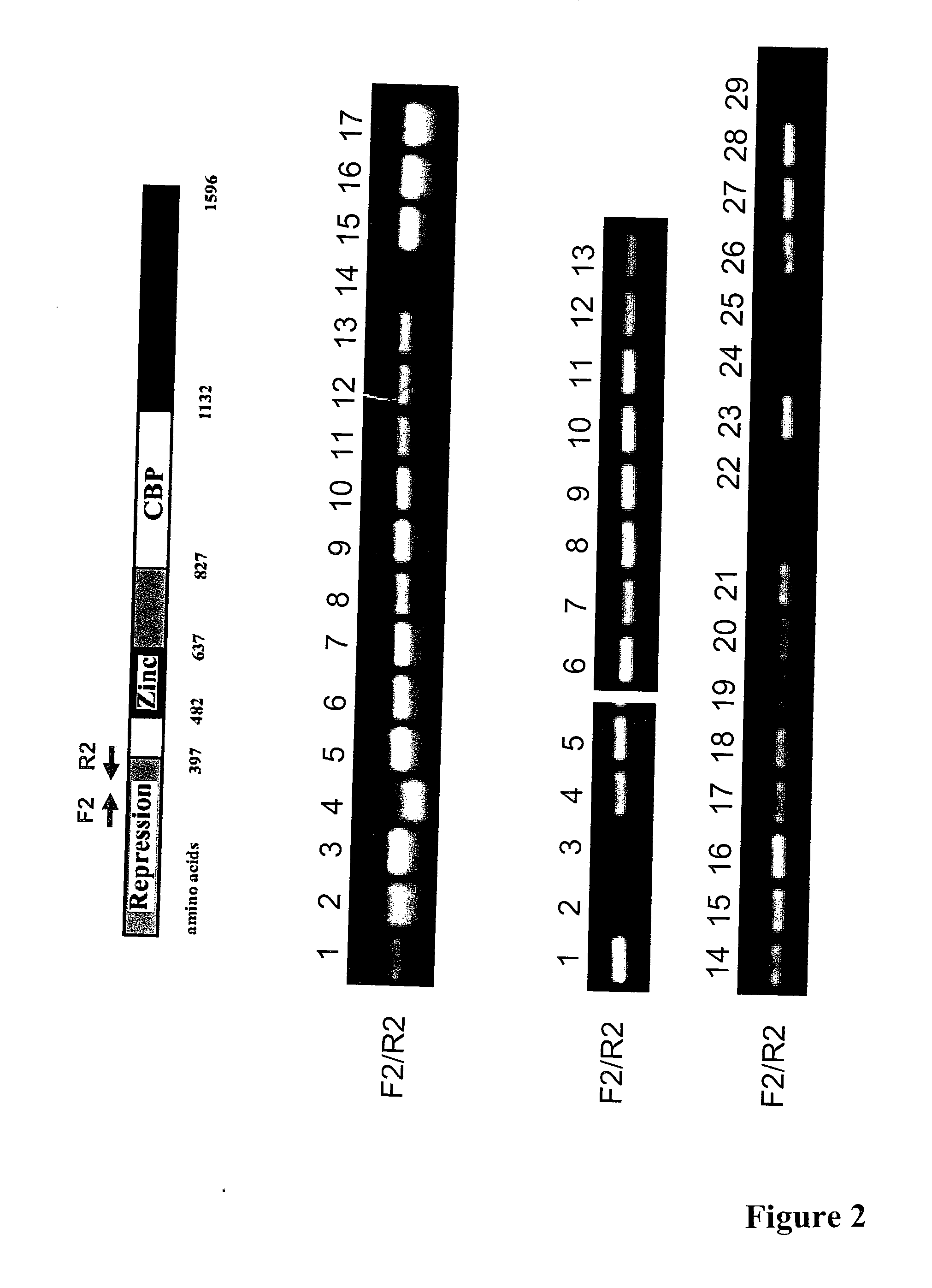
[0319] Several cancer cell lines and primary tissue samples were analyzed by semi-quantitative RT-PCR to investigate expression of Gli3. An exemplary analysis of an RT-PCR detecting Gli3 expression is shown in FIG. 2. The cell lines analyzed and found to express detectable levels of Gli3 MRNA included: normal liver (FIG. 2, middle panel, lane 1); NSCLC: H1703, H460 and A549 (FIG. 2, middle panel, lanes 2, 3, 4); breast cancer: HuL100, BT474 and MCF-7 (FIG. 2, middle panel, lanes 5, 6, 7); mesothelioma: Met5A, H290, REN, H513, H28, and 211H (FIG. 2, middle panel, lanes 8-13); colon cancer: SW480 (FIG. 2, middle panel, lane 15); a pair of primary NSCLC tissue samples (FIG. 2, middle panel, lane 16 and 17 are normal and cancer tissues, respectively). LARK1A did not show detectable expression of Gli3 mRNA (FIG. 2, middle panel, lane 14).

[0320] In another set of similar RT-PCR experiments Gli3 expression was analyzed and detected in colon cancer cell...

the structure of the environmentally friendly knitted fabric provided by the present invention; figure 2 Flow chart of the yarn wrapping machine for environmentally friendly knitted fabrics and storage devices; image 3 Is the parameter map of the yarn covering machine
Login to View More

PUM

PropertyMeasurementUnit
subject weightaaaaaaaaaa
diameteraaaaaaaaaa
temperatureaaaaaaaaaa
Login to View More

Abstract

This invention provides compositions, methods and kits for the diagnosis and treatment of cancers expressing a GLI polypeptide, and in particular a GLI1, GLI2 or GLI3 polypeptide. The invention provides small molecule compounds mimicking the transcriptional activation domain of a GLI polypeptide. The small molecule inhibitors of the invention specifically block the activator function of a GLI polypeptide, but not the repressor function of GLI3.

Description

CROSS-REFERENCES TO RELATED APPLICATIONS [0001] This application claims benefit of U.S. provisional application Ser. No. 60 / 748,968, filed Dec. 9, 2005, and U.S. provisional application Ser. No. 60 / 763,829, filed Jan., 30, 2006, the disclosures of which are incorporated herein in their entireties by reference.FIELD OF THE INVENTION [0002] The present invention relates generally to compositions and methods of inhibiting tumorigenesis, tumor growth and tumor survival. The compositions comprise small molecule compounds inhibiting Hedgehog and GLI signaling pathways. BACKGROUND OF THE INVENTION [0003] Hedgehog (Shh or Hh), WNT, FGF and BMP signaling pathways network together during embryogenesis, tissue regeneration, and carcinogenesis. Aberrant activation of Hh signaling pathways leads to pathological consequences in a variety of human tumors, such as gastric cancer and pancreatic cancer. Hedgehogs are secreted glycoproteins that initiate Hh signal transduction by binding to a transmem...

Claims

the structure of the environmentally friendly knitted fabric provided by the present invention; figure 2 Flow chart of the yarn wrapping machine for environmentally friendly knitted fabrics and storage devices; image 3 Is the parameter map of the yarn covering machine
Login to View More

Application Information

Patent Timeline
no application Login to View More
Patent Type & Authority Applications(United States)
IPC IPC(8): A61K31/415C07D231/06
CPCC07D231/06A61P35/00A61P43/00
Inventor HE, BIAOFUJII, NAOAKIYOU, LIANGXU, ZHIDONGJABLONS, DAVID M.
Owner RGT UNIV OF CALIFORNIA