Process for the preparation of vinyl- or allyl-containing compounds

US20070213549A1Inactive Publication Date: 2007-09-13DAICEL CHEM IND LTD
2 Cites 3 Cited by

Patent Information

Authority / Receiving Office
US · United States
Current Assignee / Owner
Publication Date
2007-09-13
Estimated Expiration
Not applicable · inactive patent

Smart Images

  • Figure 1
    Figure 1
  • Figure 2
    Figure 2
  • Figure 3
    Figure 3
Patent Text Reader

Abstract

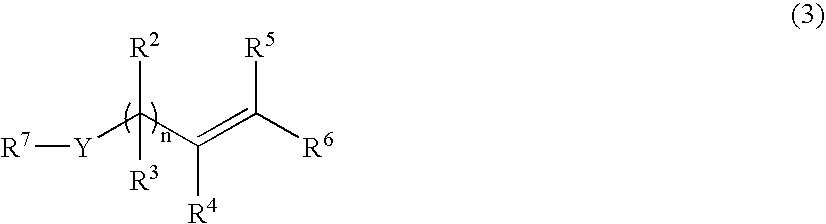
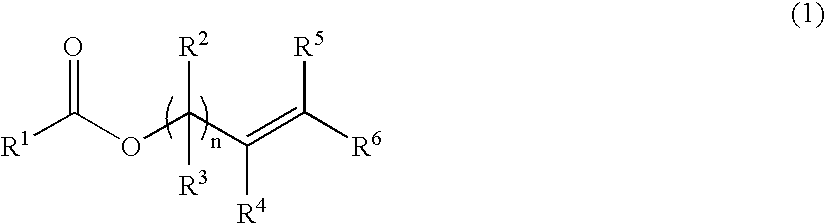
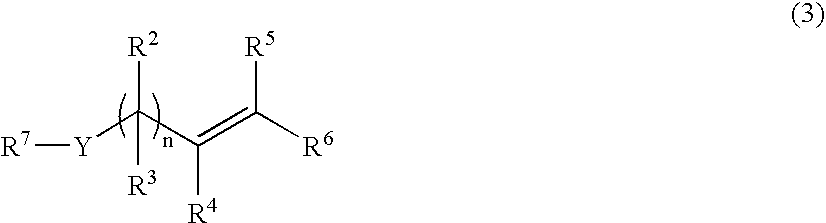
A vinyl- or allyl-containing compound represented by following Formula (3):wherein R2, R3, R4, R5, and R6 each represent hydrogen atom or a nonmetallic atom-containing group; R7 represents a nonmetallic atom-containing group; Y represents a group selected from the group consisting of —Si(R8) (R9) —, —Si(R10) (R11)—O—, the left hand of which is combined with R7, and —NR12—, wherein R8, R9, R10, R11, and R12 each represent hydrogen atom or a nonmetallic atom-containing group; and “n” represents 0 or 1, is prepared by reacting a vinyl or allyl ester compound represented by following Formula (1):wherein R1 represents hydrogen atom or a nonmetallic atom-containing group; R2, R3, R4, R5, R6, and “n” are as defined above, with a compound represented by following Formula (2):R7—Y—H   (2)wherein R7 and Y are as defined above, in the presence of a transition element compound.
Need to check novelty before this filing date? Find Prior Art

Description

BACKGROUND OF THE INVENTION

[0001] 1. Field of the Invention

[0002] The present invention relates to a process for the preparation of vinyl- or allyl-containing compounds. Such vinyl- or allyl-containing compounds are useful typically as semiconductor materials, raw materials for functional polymers, intermediates for the synthetic preparation of fine chemicals such as pharmaceutical preparations and agricultural chemicals, and intermediate materials for organic chemicals.

[0003] 2. Description of the Related Art

[0004] Certain processes have been known as processes for the preparation of vinyl- or allyl-containing silicon compounds or amine compounds such as vinylsilanes, allylsilanes, silyl vinyl ethers, silyl allyl ethers, and allylamines. Allylsilanes or vinylsilanes, for example, have been prepared by reacting chlorosilane with an allyl (or vinyl) magnesium Grignard reagent (J. Org. Chem., 1957, 22, 1200). Chlorosilane used in this process, however, is difficult to handle. In addition,...

Examples

example 1

[0049]In a reactor were placed triethylsilane (Et3SiH) (5 mmol), di-μ-chlorobis(1,5-cyclooctadiene)diiridium(I) [IrCl(cod)]2 (0.05 mmol), vinyl acetate (20 mmol), and toluene (3 ml), and a reaction was conducted at 40° C. in a nitrogen atmosphere for one hour. After the reaction, the reaction mixture was analyzed by gas chromatography to find that vinyltriethylsilane was produced in a yield of 20%, and tetraethylsilane and acetic ester of triethylsilanol were by-produced in yields of 9% and 14%, respectively.

example 2

[0050]In a reactor were placed di-μ-chlorobis(1,5-cyclooctadiene)diiridium(I) [IrCl(cod)]2 (0.05 mmol), vinyl acetate (20 mmol), and toluene (3 ml). The mixture was raised in temperature to 40° C. in a nitrogen atmosphere, triethylsilane (Et3SiH) (5 mmol) was added thereto over one hour, and a reaction was carried out at 40° C. for one hour. After the reaction, the reaction mixture was analyzed by gas chromatography to find that vinyltriethylsilane was produced in a yield of 36% and tetraethylsilane and acetic ester of triethylsilanol were by-produced in yields of 7% and 12%, respectively.

example 3

[0051]A reaction was carried out by the procedure of Example 2, except for using triphenylsilane (Ph3SiH) instead of triethylsilane. After the reaction, the reaction mixture was analyzed by gas chromatography to find that vinyltriphenylsilane was produced in a yield of 38%.