
Measuring apparatus and measuring method
Patent Information
- Authority / Receiving Office
- US · United States
- Current Assignee / Owner
- Publication Date
- 2007-09-27
- Estimated Expiration
- Not applicable · inactive patent
Smart Images
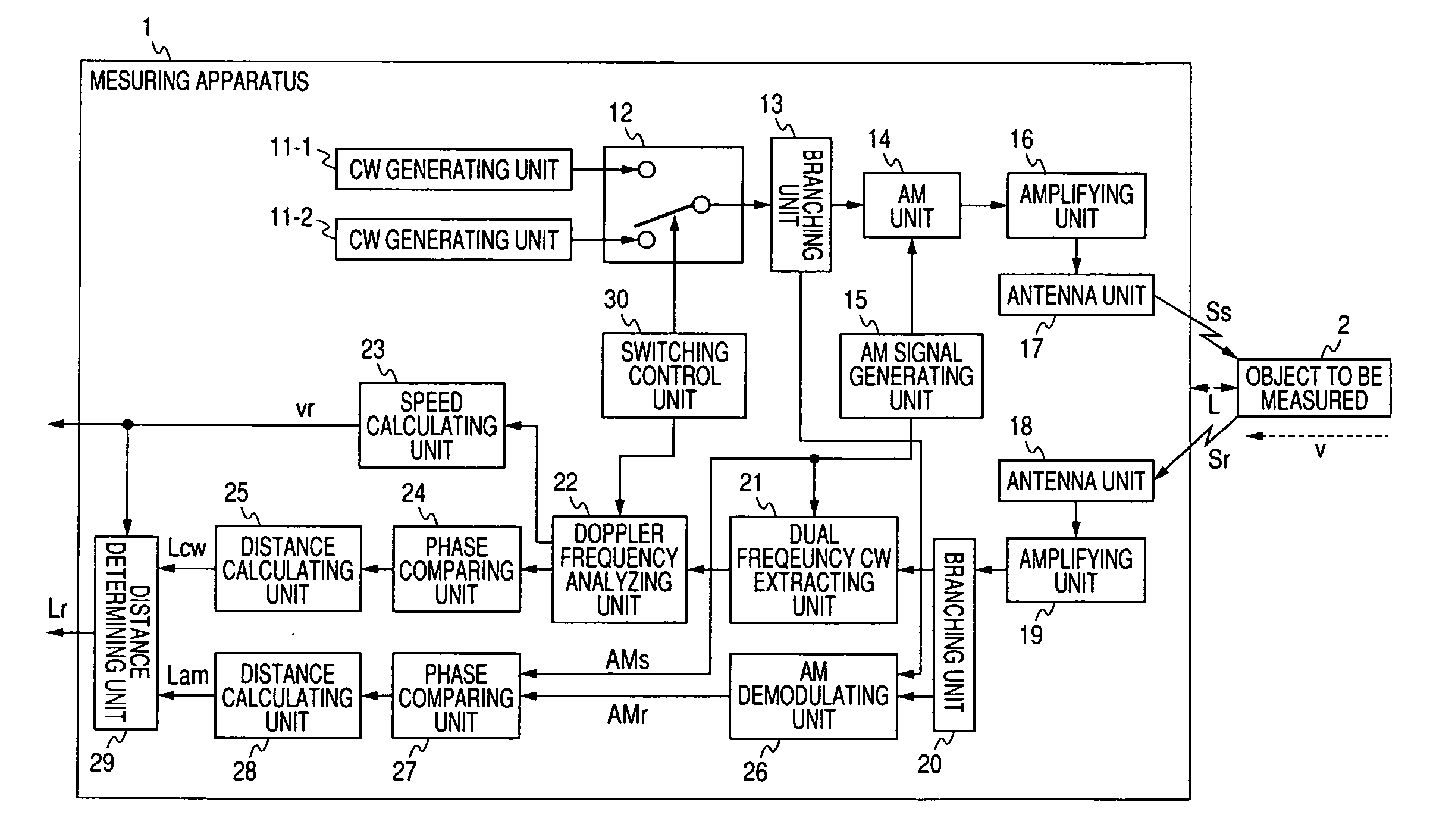
Figure 1 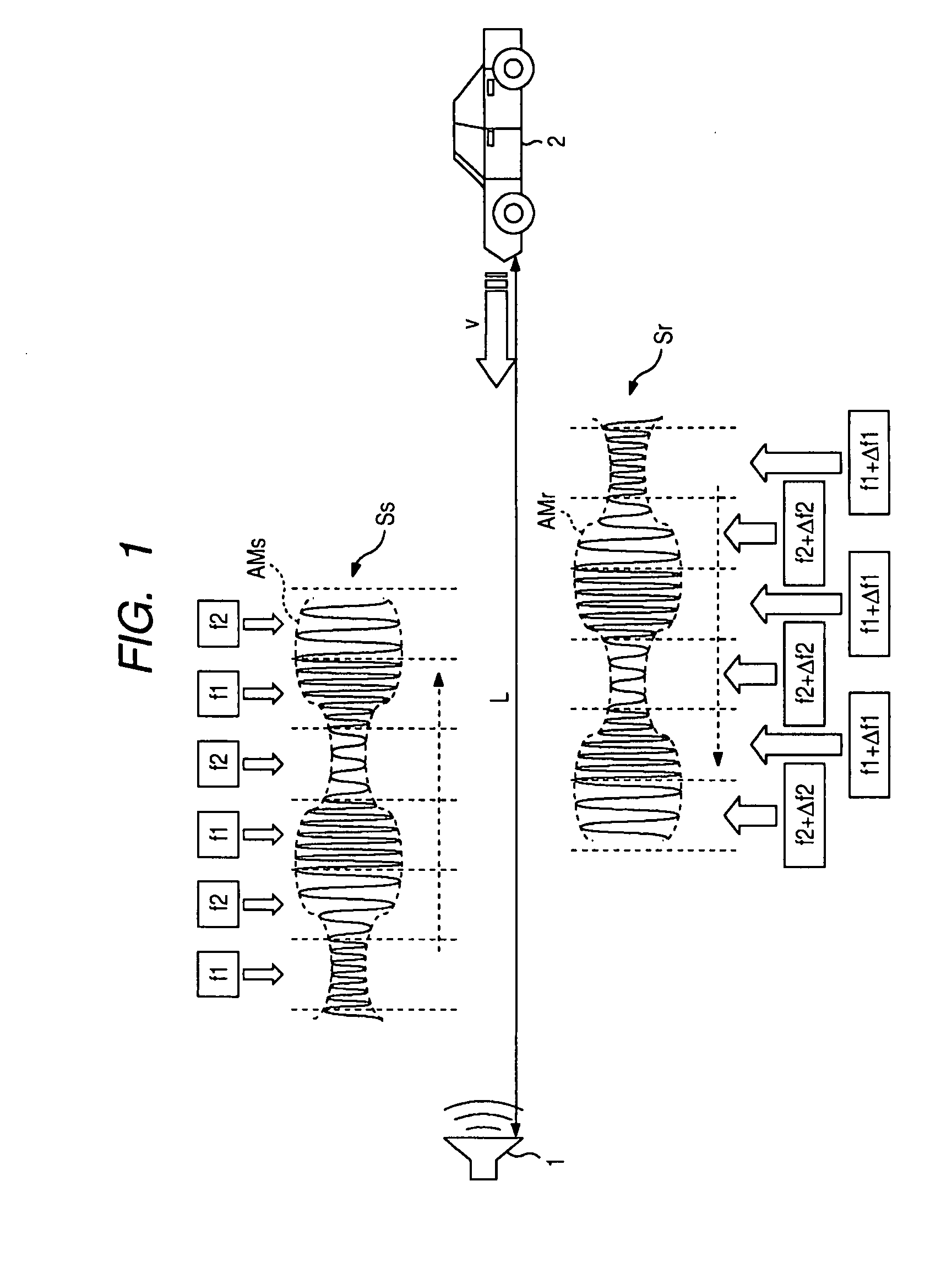
Figure 2 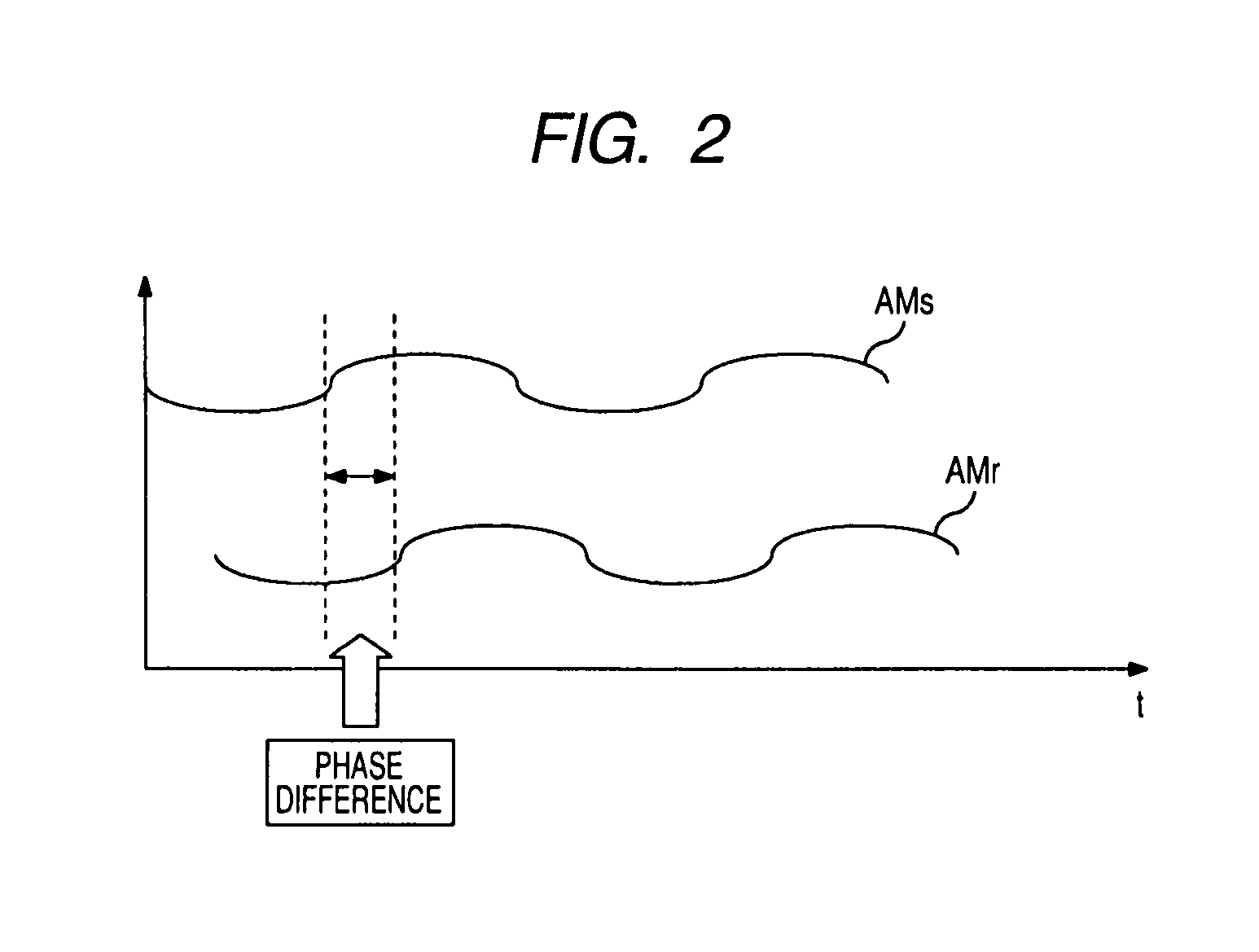
Figure 3
Abstract
Description
BACKGROUND OF THE INVENTION
[0001] 1. Field of the Invention
[0002] The present invention is related to a measuring apparatus and a measuring method, and more particularly to a measuring apparatus and a measuring method for improving the reliability of accurate distance measurement when a dual frequency continuous wave (CW) method is used.
[0003] 2. Background Art
[0004] One example of a conventional sensor uses the dual frequency CW method to measures a relative speed and a distance between a vehicle to which the sensor is attached and another vehicle (see, e.g., Japanese Patent No. 3,203,600 and JP-A-2004-69693). This dual frequency CW method sensor detects a frequency of a Doppler signal and a phase of the Doppler signal produced for a received carrier wave, and uses the detected frequency and phase to measure the relative speed and distance between the vehicle to which the sensor is attached and another vehicle.
[0005] In the dual frequency CW method sensor, the distance cannot be measure...
Examples
Embodiment Construction
[0032]In order to facilitate an understanding of the present invention, an example of a sensor previously invented by the inventors of the present invention is explained at the outset, with reference to FIGS. 1 and 2.
[0033]Referring initially to FIG. 1, distance is measured by using the dual frequency CW method. FIG. 1 shows a measuring apparatus 1 for producing a signal obtained by switching a CW having a frequency f1 and a CW having a frequency f2 based on time division (hereinafter “dual frequency CW”) as a carrier wave. Further, the measuring apparatus 1 modulates the amplitude of the dual frequency CW using an AM signal, and outputs the signal obtained by the amplitude modulation as a transmission signal Ss. Thus, the transmission signal Ss has two frequencies f1 and f2.
[0034]The transmission signal Ss is reflected by an object to be measured 2, and the reflection signal is received by the measuring apparatus 1 as a receipt signal Sr.
[0035]When there is a relative speed v betwe...