Microporous polyolefin membrane, its production method, and battery separator

a technology of microporous polyolefin and polypropylene, which is applied in the direction of membranes, electric/magnetic/electromagnetic heating, and explosives, can solve the problems of poor mechanical strength, high shutdown temperature of microporous membranes composed only of polypropylene, and affecting the performance of microporous membranes, etc., to achieve well-balanced permeability, mechanical properties and meltdown properties

a technology of microporous polyolefin and polypropylene, which is applied in the direction of membranes, electric/magnetic/electromagnetic heating, and explosives, can solve the problems of poor mechanical strength, high shutdown temperature of microporous membranes composed only of polypropylene, and affecting the performance of microporous membranes, etc., to achieve well-balanced permeability, mechanical properties and meltdown properties

US20070264483A1Active Publication Date: 2007-11-15TORAY IND INC

Image

Smart Image Click on the blue labels to locate them in the text.
Viewing Examples
Smart Image
  • Microporous polyolefin membrane, its production method, and battery separator
  • Microporous polyolefin membrane, its production method, and battery separator
  • Microporous polyolefin membrane, its production method, and battery separator

Examples

Experimental program
Comparison scheme
Effect test

example 1

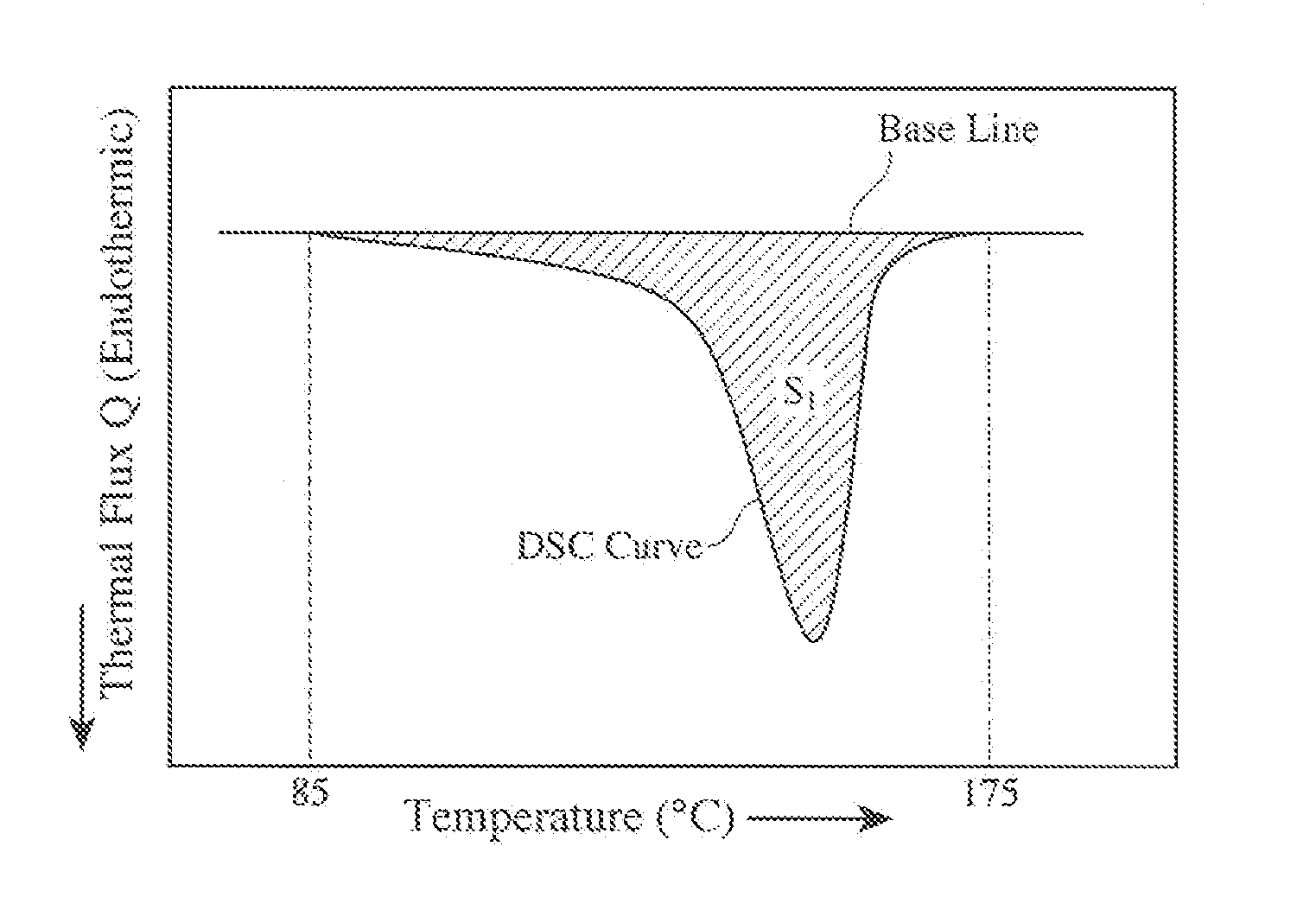
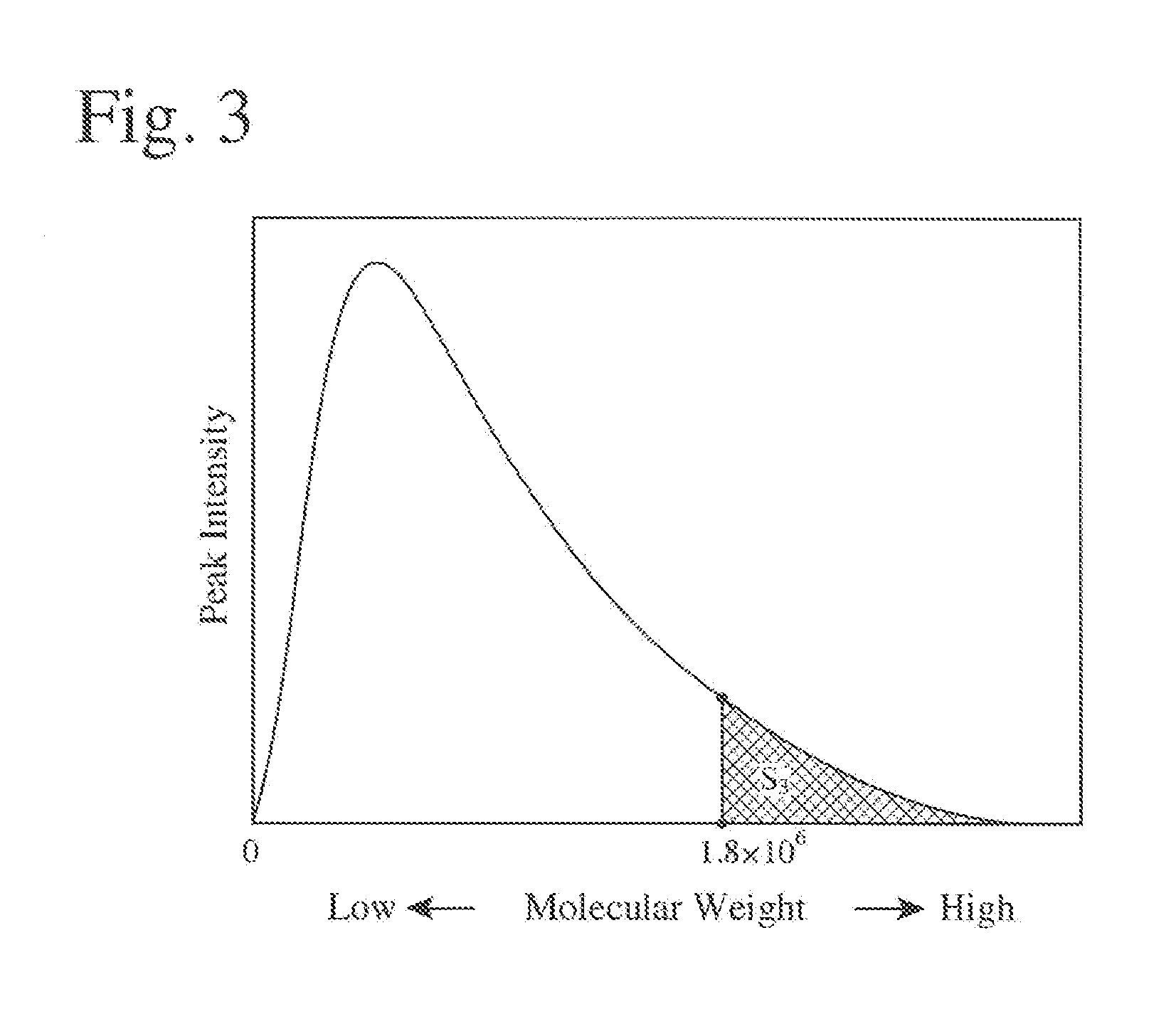
[0099] 100 parts by mass of a polyolefin composition comprising 1% by mass of ultra-high-molecular-weight polyethylene (UHMWPE) having a weight-average molecular weight (Mw) of 2.5×10⁶, 49% by mass of high-density polyethylene (HDPE) having Mw of 3.0×10⁵, and 50% by mass of a propylene homopolymer (PP) having Mw of 2.69×10⁶, Mw / Mn of 3.5, and a heat of fusion of 99.9 J / g, a fraction having a molecular weight of 1.8×10⁶ or more being 57.2% by mass per PP), and 1.0 parts by mass of tetrakis[methylene-3-(3,5-ditertiary-butyl-4-hydroxyphenyl)-propionate]methane as an antioxidant were dry-blended to form a polyolefin composition. Measurement revealed that a polyethylene composition of UHMWPE and HDPE had a melting point of 135° C., and a crystal dispersion temperature of 90° C.

[0100] The Mw and Mw / Mn of UHMWPE and HDPE were measured by a gel permeation chromatography (GPC) method under the following conditions. [0101] Measurement apparatus: GPC-150C available from Waters Corporation, [0...

example 2

[0124] A microporous polyolefin membrane was produced in the same manner as in Example 1, except for using, as the polypropylene, a propylene homopolymer having Mw of 1.82×10⁶, Mw / Mn of 2.6, and a heat of fusion of 107.2 J / g, a fraction having a molecular weight of 1.8×10⁶ or more being 34.9% by mass of the propylene homopolymer.

example 3

[0125] A microporous polyolefin membrane was produced in the same manner as in Example 1, except for using, as the polypropylene, a propylene homopolymer having Mw of 1.40×10⁶, Mw / Mn of 2.6, and a heat of fusion of 111.6 J / g, a fraction having a molecular weight of 1.8×10⁶ or more being 25.3% by mass of the propylene homopolymer.

the structure of the environmentally friendly knitted fabric provided by the present invention; figure 2 Flow chart of the yarn wrapping machine for environmentally friendly knitted fabrics and storage devices; image 3 Is the parameter map of the yarn covering machine
Login to View More

PUM

PropertyMeasurementUnit
Fractionaaaaaaaaaa
Nuclear radiationaaaaaaaaaa
Temperatureaaaaaaaaaa
Login to View More

Abstract

A microporous polyolefin membrane comprising a polyethylene resin, and polypropylene having a weight-average molecular weight of 6×10⁵ or more and a heat of fusion of 90 J / g or more (measured by a differential scanning calorimeter), a fraction having a molecular weight of 1.8×10⁶ or more being 10% or more by mass of the polypropylene.

Description

FIELD OF THE INVENTION [0001] The present invention relates to a microporous polyolefin membrane comprising a polyethylene resin and a sufficient amount of polypropylene and having well-balanced permeability, mechanical properties and meltdown properties, its production method, and a battery separator composed of such microporous polyolefin membrane. BACKGROUND OF THE INVENTION [0002] Microporous polyolefin membranes are widely used for various applications such as battery separators used for lithium secondary batteries, nickel-hydrogen batteries, nickel-cadmium batteries, polymer batteries, etc., electrolytic capacitor separators, various filters such as reverse osmosis filtration membranes, ultrafiltration membranes, microfiltration membranes, etc., moisture-permeable, waterproof clothes, medical materials, etc. When the microporous polyolefin membrane is used for battery separators, particularly lithium ion battery separators, its performance largely affects the properties, produ...

Claims

the structure of the environmentally friendly knitted fabric provided by the present invention; figure 2 Flow chart of the yarn wrapping machine for environmentally friendly knitted fabrics and storage devices; image 3 Is the parameter map of the yarn covering machine
Login to View More

Application Information

Patent Timeline
15 Nov 2007
Publication
US20070264483A1
IPC
C06B21/00; B32B3/26; B29C55/00; H05B6/00
CPC
B29K2023/00; B29K2105/0061; B29K2105/04; B01D67/0025; B01D69/02; B01D67/0027; B01D2325/20; B01D2325/22
Inventors
OZAKI, HIROYUKI; KIMISHIMA, KOTARO