
Aav vectors encoding superoxide dismutase
a superoxide dismutase and vector technology, applied in the field of in vitro models, can solve the problems of motor neuron degeneration, no therapy available to prevent or cure als, and major public health problems of neurodegenerative diseases
Patent Information
- Authority / Receiving Office
- US · United States
- Patent Type
- Applications(United States)
- Current Assignee / Owner
- Publication Date
- 2008-07-31
- Estimated Expiration
- Not applicable · inactive patent
Smart Images
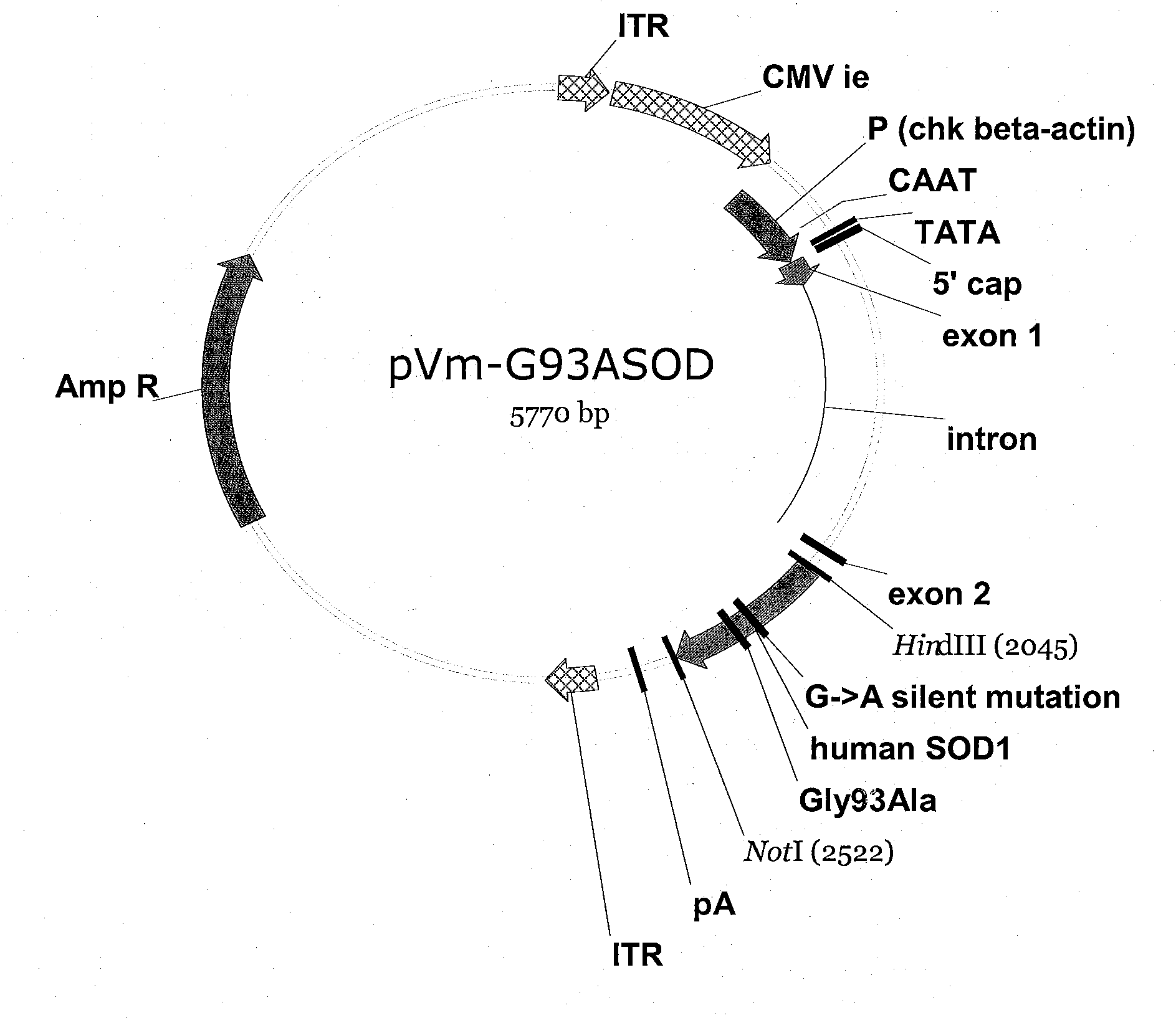
Figure 1 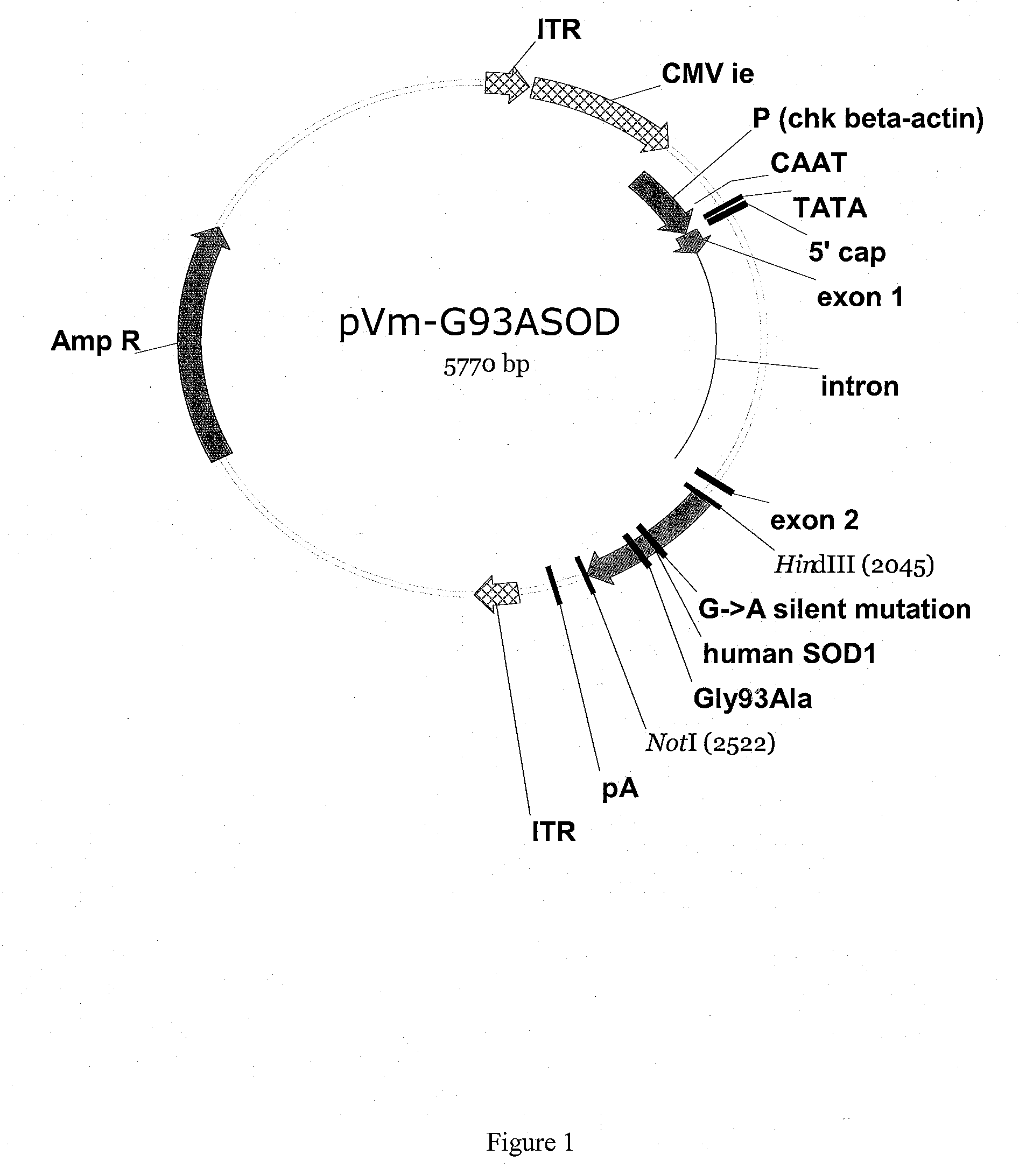
Figure 2 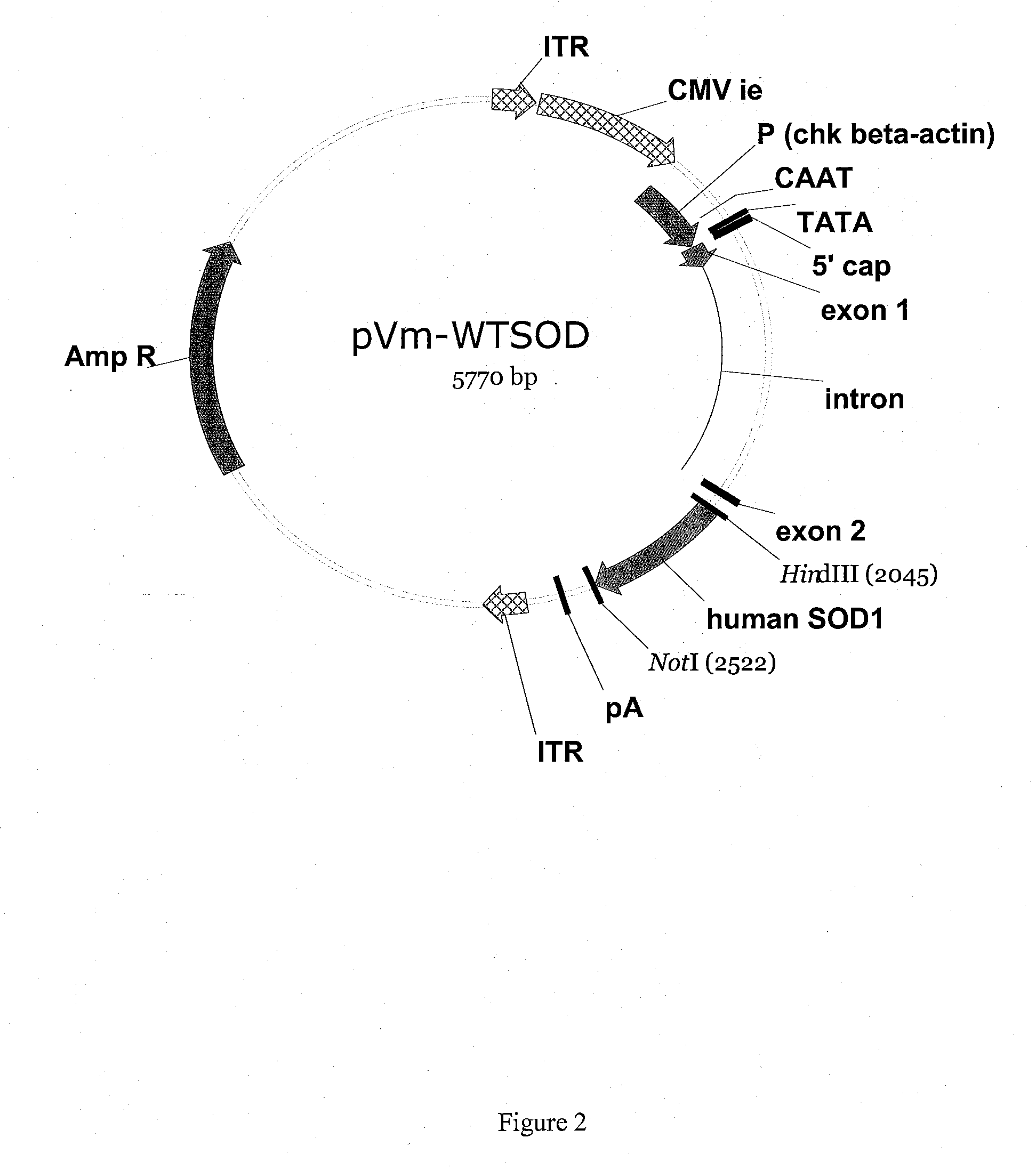
Figure 3
Abstract
Description
[0001] This application claims priority under 35 U.S.C. § 119(e) to U.S. Provisional Application No. 60 / 697,450, filed Jul. 7, 2005, the contents of which are herein incorporated by reference.TECHNICAL FIELD
[0002] The present invention relates to in vitro models for the screening of compounds for efficacy in treatment of amyotrophic lateral sclerosis (ALS). The present invention also relates to gene therapy vectors and methods.BACKGROUND
[0003] Neurodegenerative diseases present major public health issues. For example, amyotrophic lateral sclerosis (ALS) is a relentlessly progressive lethal disease that involves selective annihilation of motor neurons. Further information relating to ALS can be found in the Online Mendelian Inheritance in Man (OMIM) entry #105400, and in Rowland and Shneider (2001) Amyotrophic lateral sclerosis, New Eng. J. Med. 344: 1688-1700, the disclosures of which are hereby incorporated by reference in their entireties.
[0004] Mutations in genes encoding superoxide ...
Examples
example 1
In Vitro Model of ALS in Primary Rat Motor Neural Cultures
[0054]An in vitro model system for ALS is constructed as follows. Two AAV vectors are created by cloning either the human SOD1 wild-type gene (hSOD1wt) or a mutant SOD1 gene (hSOD1-Gly93Ala) gene into an AAV-2-derived vector comprising two AAV inverted terminal repeats (ITRs) such that expression of the SOD gene is directed by the chicken beta actin promoter.
[0055]The resulting rAAV2-SOD1-Gly93Ala vector is then packaged into AAV-2 virions (see e.g. U.S. Pat. Nos. 6,001,650, and 6,004,797) and used to transduce primary rat motor neural cultures. Fluorescence microscopy 3-5 days post-transduction reveals that transduced cells exhibit pathological changes characteristic of ALS, such as abnormal distribution of mutant SOD protein in punctate aggregates in most mutant SOD-expressing motor neurons, extensions of perikaryal cytoplasm and swelling of motor neural processes, apoptotic death of motor neurons and activation of astrocyt...
example 2
Evaluation of an IL-10 Peptide as a Candidate for Treatment of ALS
[0075]The value of the in vitro ALS model system of Example 1 of the invention is illustrated by an assay to evaluate the effect of an IL-10 derived peptide on ALS.
[0076]Oligopeptide manufacture is achieved by solid-phase synthesis methods known to those skilled in the Art. Analysis of the synthesized oligopeptides includes electrospray mass spectrometry, high performance liquid chromatography, and visual appearance of the purified product. The oligopeptide(s) are prepared in water for injection at 1 mg / ml. An example of a proper IL-10-derived peptide (U.S. Pat. No. 6,159,937) and a ‘scrambled’ control peptide are provided in Table 2. Peptide sequences are provided in the conventional N→C terminal direction. Amino acids are named using the three-letter nomenclature.
TABLE 2Human IL-10 peptideAla-Tyr-Met-Thr-Met-Lys-Ile-Arg-Asn(SEQ ID NO. 4)Scrambled′ peptideArg-Ile-Lys-Asn-Met-Ala-Thr-Tyr-Met(SEQ ID NO. 5)
[0077]Althoug...
example 3
Evaluation of GDNF Peptides as a Candidate for Treatment of ALS
[0083]The value of the in vitro ALS model system of Example 1 of the invention is further illustrated by an assay to evaluate the effect of a glial cell derived neurotrophic factor (GDNF) peptide on ALS. Experiments are performed essentially as described in Example 2 except that a peptide derived from GDNF, and a scrambled version thereof are provided rather than IL-10 peptide. If a GDNF peptide shows a positive result in the assay (i.e. if there is a reduction in ALS-like phenotypic characteristics of transduced motor neurons after treatment with the peptide), this peptide can be studied further to confirm its efficacy in the treatment or prevention of ALS.
[0084]In other experiments, 500 different GDNF-derived peptides are synthesized and assayed for activity in reducing ALS-like phenotype in rAAV-SOD1-G93A-transduced motor neurons. The peptides showing the greatest activity are studied further for efficacy in treatment...