The two-component developing method has advantages of having a good chargeability of the toner by the carrier and a longer
operating life, whereas it has disadvantages of making a developing device large and complicated and varying
image quality depending on the durability of the carrier.
Further, the one-component developing method has advantages of making the developing device compact and having a good dot reproducibility, whereas it has disadvantages of generally making a developing roller and a supply roller less durable and making a consumable cost more expensive due to the exchange of developing devices on a regular basis.
Further, the supply of the toner having such a charging property as to be developed on the developing roller is not suitable for high-speed
processing apparatuses, which has presented a problem to the speed-up of the
image formation.
Thus, if developing rollers and magnetic rollers are transversely arranged with respect to photoconductive members, the electrophotographic
processing members themselves have a large width, which hinders the
miniaturization.
Further, it is difficult to refresh the toner on the donor roller, which was not used for development, and a toner adhering state and a
potential difference of the toner on the donor roller vary if a toner consumed region and a toner non-consumed region are present on the donor roller.
Therefore, there has been a demand for technology requiring less control accuracy.
In this device, an alternating-
current voltage is applied to the developing roller, thereby preventing a problem that it is difficult to develop low-density images and
thin line images and a problem that density nonuniformity occurs due to an increase in a toner charge amount and making it easier to scrape off (collect) the toner not having been used for development.
However, an image
fog occurs if the alternating-
current voltage applied to the developing roller for forming a developing
electric field is increased, whereas the effect of scraping off the toner not having been used for development is reduced if the alternating-
current voltage is decreased.
However, the developing device is of the type using the one-component developer and constructed such that the photoconductive member and the supply roller are in contact with the developing roller and, if the developing devices of such a type in which the photoconductive member and the developing roller are in contact are used in a tandem image forming apparatus, a torque variation of a transfer belt might be caused to promote a color drift as a weak point of the tandem image forming apparatus.
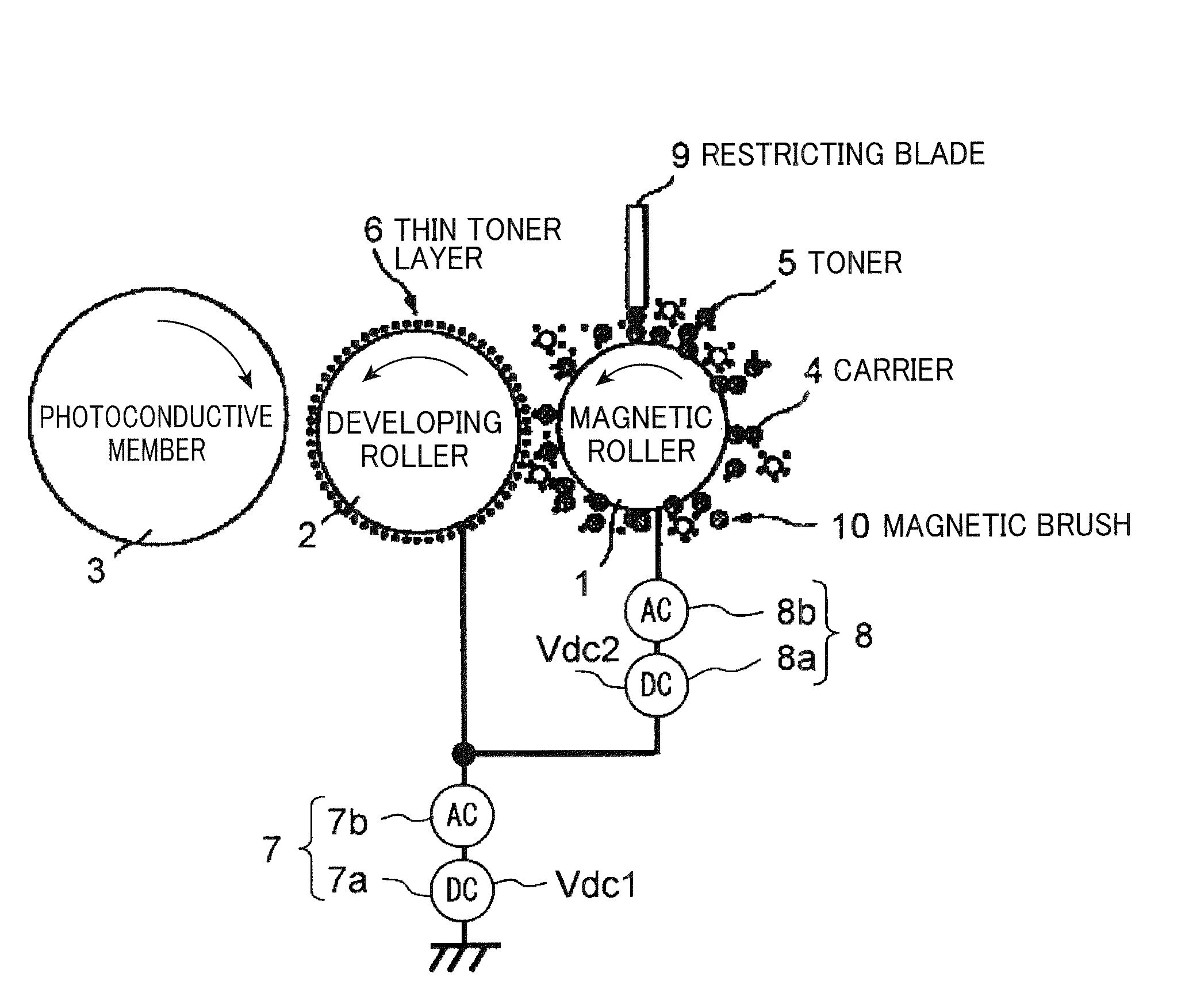
However, since the biases applied to the developing roller and the magnetic roller become a composite bias between the developing roller and the magnetic roller, the bias applicable to suppress a
discharge while maintaining the developability and collectability is restricted in its phase, cycle and waveform, which has hindered the
miniaturization and the higher speed.
This, for example, hinders the toner supply from the developing roller to the photoconductive member and makes it difficult to collect the toner from the developing roller to the magnetic roller.
However, with the technologies of these documents, if a toner particle
diameter is made smaller, the highly charged fine toner has a strong adhering force to the developing roller.
Thus, unless an
electric field generated between the developing roller and a photoconductive member is stronger than the toner adhering force to the developing roller, it has been difficult to develop an image.
Further, unless the surface of the
resin coating formed on the developing roller has a certain
surface roughness, there has been a likelihood of affecting the transfer of the toner to the magnetic roller for toner collection.
With the technologies of the patent literatures described above, it has been difficult to improve the developability on the photoconductive member while coping with the formation of the thin toner layer on the developing roller and the collection of the toner from the developing roller by balancing the bias formed between the developing roller and the photoconductive member and the one formed between the developing roller and the magnetic roller while maintaining good toner adherence to the developing roller in the development process asking for the faster rotation and the smaller
diameter of the photoconductive member and the smaller toner particles.


 Login to View More
  Login to View More