Method of CABAC Coefficient Magnitude and Sign Decoding Suitable for Use on VLIW Data Processors

a data processor and cabac coefficient technology, applied in the field of image transmission system decoding, can solve problems such as computational intensive tasks, and achieve the effect of better decoding

a data processor and cabac coefficient technology, applied in the field of image transmission system decoding, can solve problems such as computational intensive tasks, and achieve the effect of better decoding

US20080266151A1Active Publication Date: 2008-10-30TEXAS INSTR INC

Image

Smart Image Click on the blue labels to locate them in the text.
Viewing Examples
Smart Image
  • Method of CABAC Coefficient Magnitude and Sign Decoding Suitable for Use on VLIW Data Processors
  • Method of CABAC Coefficient Magnitude and Sign Decoding Suitable for Use on VLIW Data Processors
  • Method of CABAC Coefficient Magnitude and Sign Decoding Suitable for Use on VLIW Data Processors

Examples

Experimental program
Comparison scheme
Effect test

Embodiment Construction

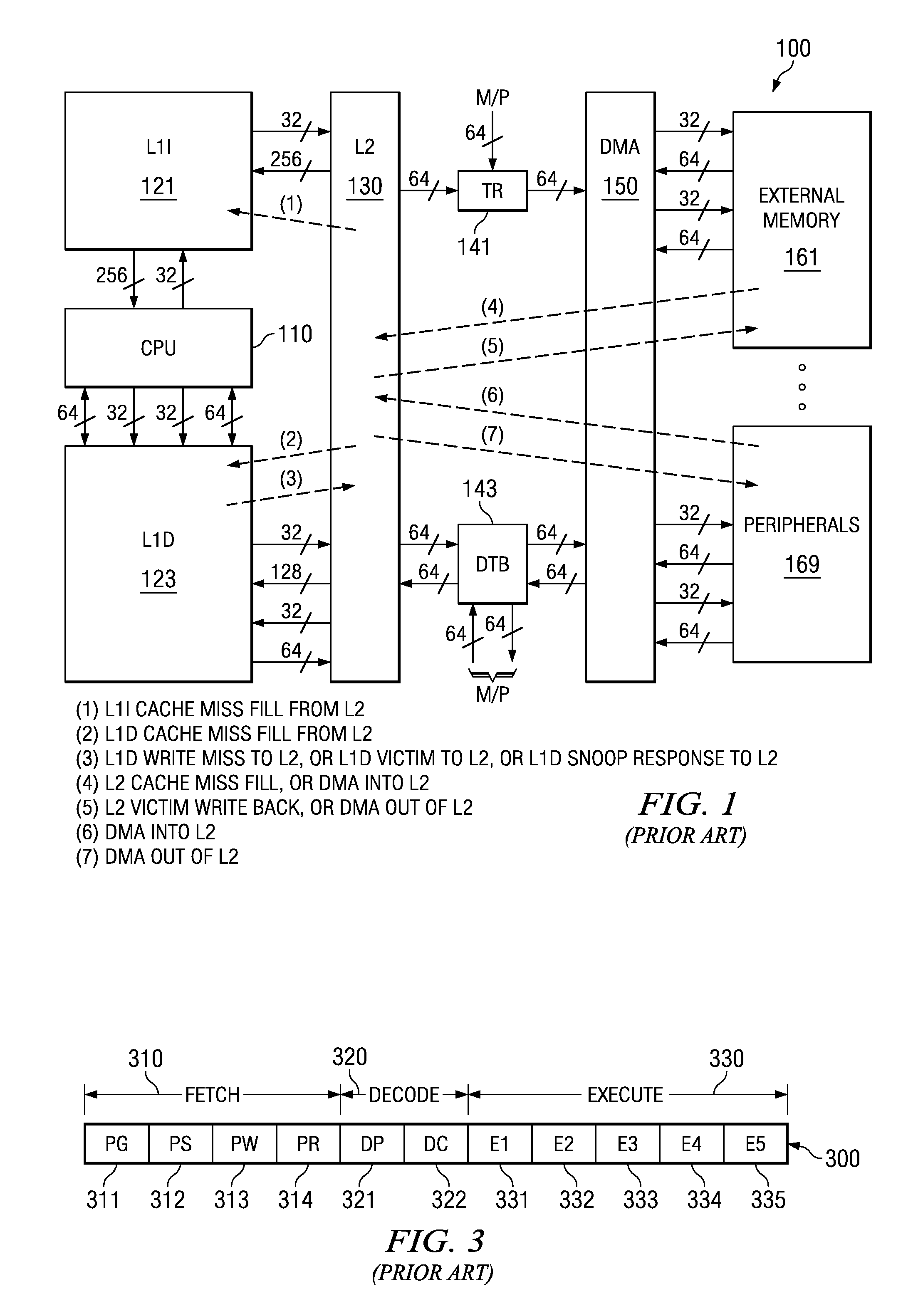
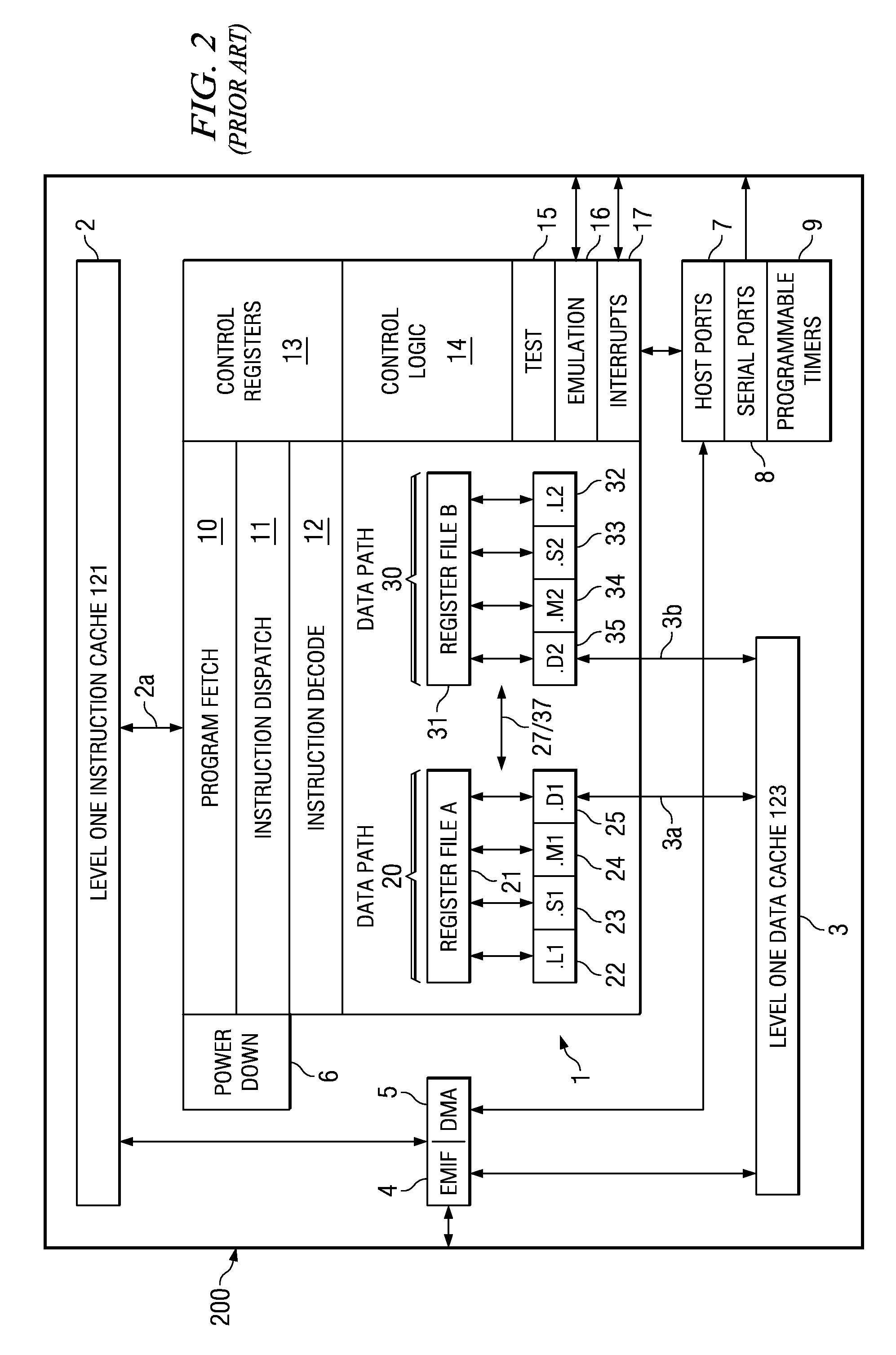
[0032]FIG. 1 illustrates the organization of a typical digital signal processor system 100 to which this invention is applicable (prior art). Digital signal processor system 100 includes central processing unit core 110. Central processing unit core 110 includes the data processing portion of digital signal processor system 100. Central processing unit core 110 could be constructed as known in the art and would typically includes a register file, an integer arithmetic logic unit, an integer multiplier and program flow control units. An example of an appropriate central processing unit core is described below in conjunction with FIGS. 2 to 4.

[0033]Digital signal processor system 100 includes a number of cache memories. FIG. 1 illustrates a pair of first level caches. Level one instruction cache (L1I) 121 stores instructions used by central processing unit core 110. Central processing unit core 110 first attempts to access any instruction from level one instruction cache 121. Level on...

the structure of the environmentally friendly knitted fabric provided by the present invention; figure 2 Flow chart of the yarn wrapping machine for environmentally friendly knitted fabrics and storage devices; image 3 Is the parameter map of the yarn covering machine
Login to View More

PUM

No PUM Login to View More

Abstract

This invention decodes coefficient magnitudes in compressed video data using a selected context and speculatively decodes a coefficient sign. The next context selection depends upon a number of iterations. This invention confirms the speculatively decoded coefficient sign upon completion of the magnitude decode. This invention operates in a loop until reaching the number of significant coefficients within the block. The method exits the loop and decodes an escape code if an iteration count is greater than a predetermined number. An embodiment of this invention collects both a count up and a count down in an escape code decode in one loop. An embodiment of this invention estimates the number of significant coefficients in a block and selects the inventive or a prior art decode.

Description

TECHNICAL FIELD OF THE INVENTION[0001]The technical field of this invention is decoding in image transmission systems such as video conferencing and video compression, and especially Context based Adaptive Binary Arithmetic Coding (CABAC).BACKGROUND OF THE INVENTION[0002]New video conferencing encoding standards such as H.264 employ Context based Adaptive Binary Arithmetic Decoding (CABAC). In CABAC data is encoded based upon the relationship between the most probable next data and other data. The most probable data is encoded in fewer bits than other data. Many types of image data can be transmitted in this form. This application discloses an example of encoding of a significance map, but other data types are feasible.[0003]Image data compression often employs a spatial to frequency transform of blocks of image data known as macroblocks. A Discrete Cosine Transform (DCT) is typically used for this spatial to frequency transform. Most images have more information in the low frequenc...

Claims

the structure of the environmentally friendly knitted fabric provided by the present invention; figure 2 Flow chart of the yarn wrapping machine for environmentally friendly knitted fabrics and storage devices; image 3 Is the parameter map of the yarn covering machine
Login to View More

Application Information

Patent Timeline
30 Oct 2008
Publication
US20080266151A1
IPC
H03M7/00
CPC
H03M7/4006; H04N19/91; H04N19/436; H04N19/423; H04N19/44
Inventors
SANKARAN, JAGADEESH