Safety-critical systems have to be fault tolerant, which means that they have to provide a correct service even in presence of failures.
A major problem in distributed systems is the communication of information between nodes.
The application of shared resources, however, introduces a
mutual exclusion problem and, hence, dedicated communication protocols have to be used to guarantee that each node connected to the
shared medium will get a fair amount of bandwidth for communication.
Chapter 6 “
Algorithm Assessment”: The design of fault-tolerant distributed real-time algorithms is notoriously difficult and error-prone: the combinations of fault arrivals,
interleaving of concurrent events, and variations in real-time durations lead to a case explosion that taxes the intellectual capacity of human designers.
Many of these algorithms, however, either assume a
reliable transmission of messages between the nodes per se or are of a probabilistic nature.
Observation 1 We do not know how to build a perfect dependable computer
system that will always perform its intended behavior.
This is a natural limitation that directly follows from our incomplete knowledge of reality: we simply do not know all external forces that can potentially influence our
physical system.
On the first glance this appears to be a very restricting fact, however, there are physical systems around that perform safety-critical tasks, e.g. automobiles, aeroplanes,
nuclear power plants, and so on.
It shows the complexity of the resulting scientific
conglomerate.
We do not have a method that quantitatively combines all or even bigger parts of the
safety case, let's say the “una in diversitate” is missing.
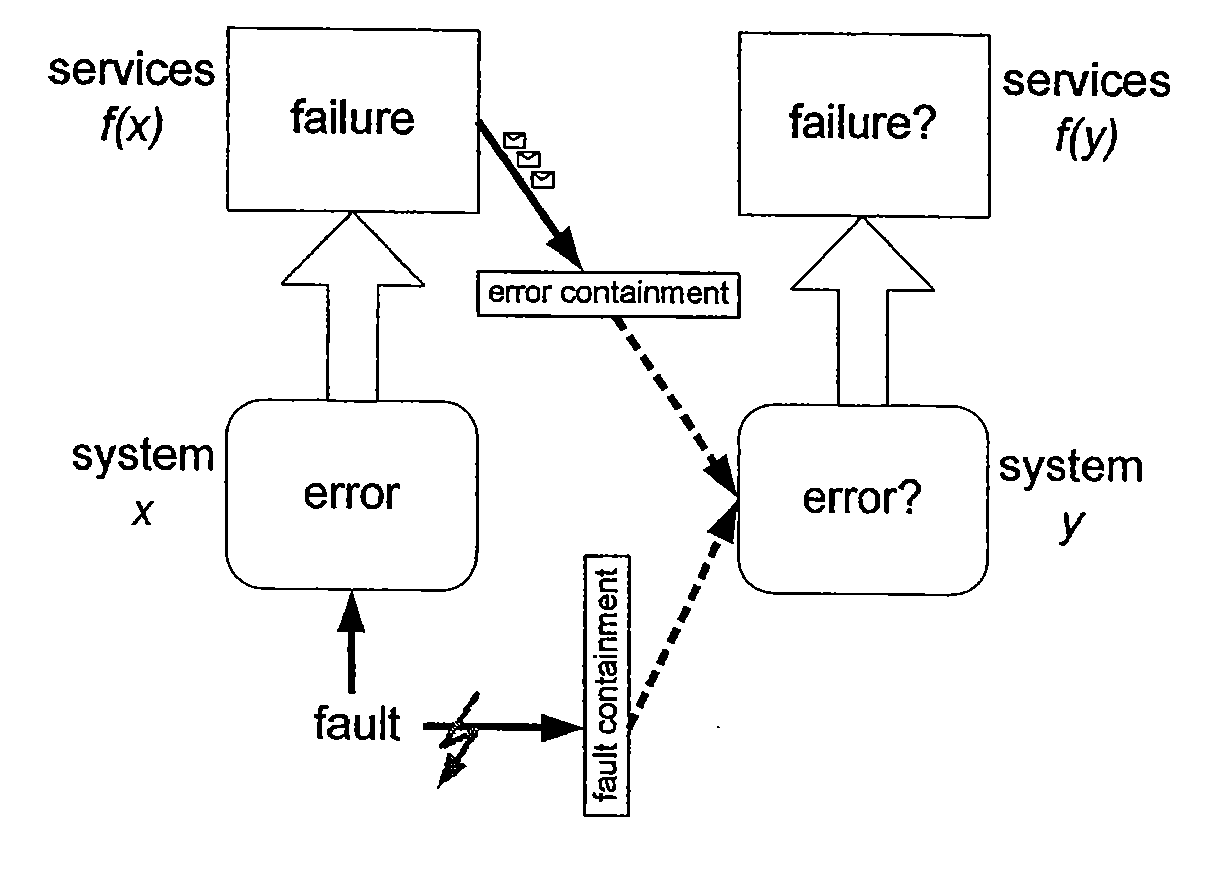
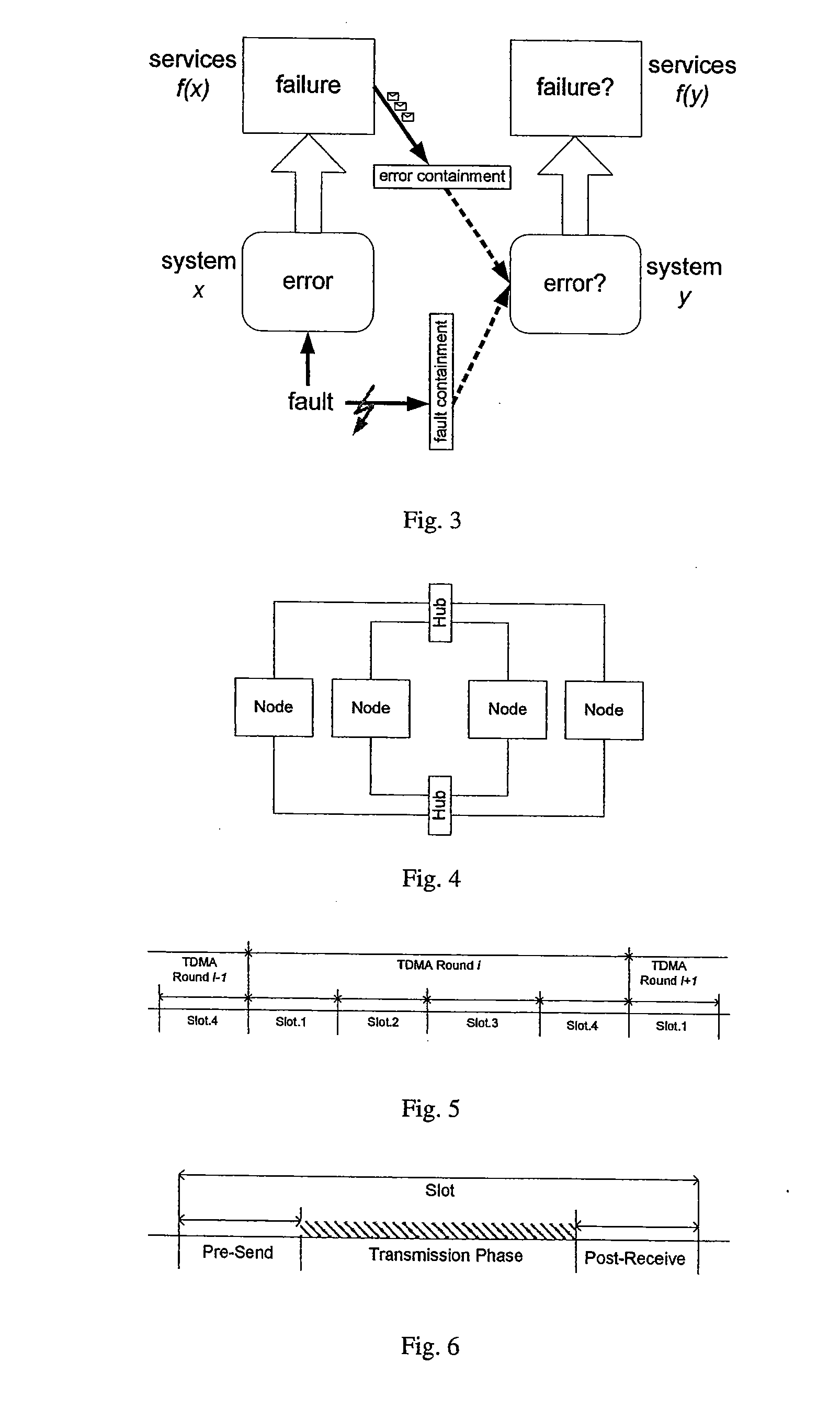
The fault may change the correct state of
system x to an error (state) and this error may lead to a deviation of the actual behavior of the
system x from the specified behavior, i.e., system x exhibits a failure.
Hence, there is no absolute guarantee that the fault
hypothesis will always be satisfied.
However, it seems an
engineering challenge to build a proper mechanism that would not lead to additional requirements and assumptions that make the startup more difficult.
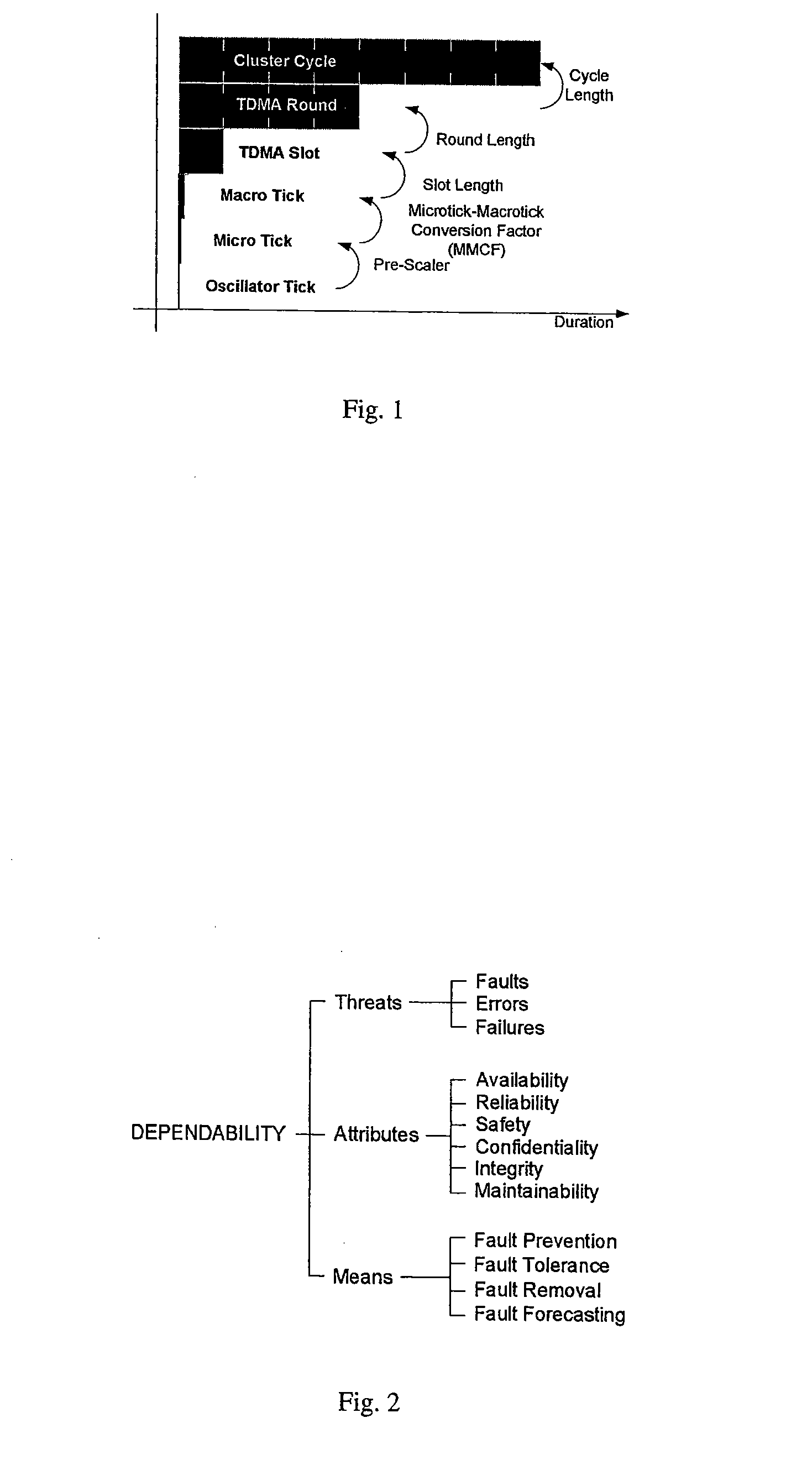
Since the local clocks in a distributed system cannot be synchronized perfectly, there have to be
silence gaps to guarantee non-overlapping transmissions.
Therefore, the node cannot use the complete slot duration for transmission.
However, a fault may cause changes in the i-state, which may lead to a permanent failure of the component.
The design of a fault-tolerant architecture and its corresponding algorithms is a complex procedure that requires an explicit listing of the assumptions on faulty components.
That means a faulty channel / guardian:may
delay a message only for an upper bound in time,may
relay a received message only to a subset of connected nodes, andmay not create correct messages.
Hence, in general, the arbitrary failure of one of the channels cannot be tolerated.
Hence, it is not possible for nreceive to identify the correct value.
Furthermore, in some rare cases the assumption on fault containment regions may not hold anymore.
A faulty guardian, however, may fail to block communication of other cliques, and, thus, relays messages from nodes in various cliques on its channel.
In a distributed system, which solely exchanges messages via a
shared medium, the
impact of a Byzantine-faulty component is limited: the Byzantine-faulty component cannot send different messages to different components (as it would be possible in fully-connected topologies).
Still the Byzantine-faulty component may exhibit its asymmetric behavior in the borderland between digital and analog world, since it is impossible to perfectly synchronize the local clocks in a distributed system [LL84].
Algorithms that are based on the values of the local clocks are inherently vulnerable to a Byzantine-faulty component.
Information Loss Our
system model, which is based on a shared communication medium, causes the manifestation of a particular failure behavior: a faulty component may not only introduce additional faulty information, it can potentially cause a reduction of correct information.
In our case this reduction can be caused by a faulty channel that drops messages but can also be caused by a faulty node that destroys a message of a correct node by sending at an inappropriate point in time.



 Login to View More
  Login to View More