[0017]The present invention seeks to provide a new
authentication system that overcomes some of the disadvantages of prior art systems, from a number of aspects. According to the various embodiments of the present invention, the
system enables a customer to verify the authenticity of the product he has or is going to purchase, in a foolproof, secure and simple manner.
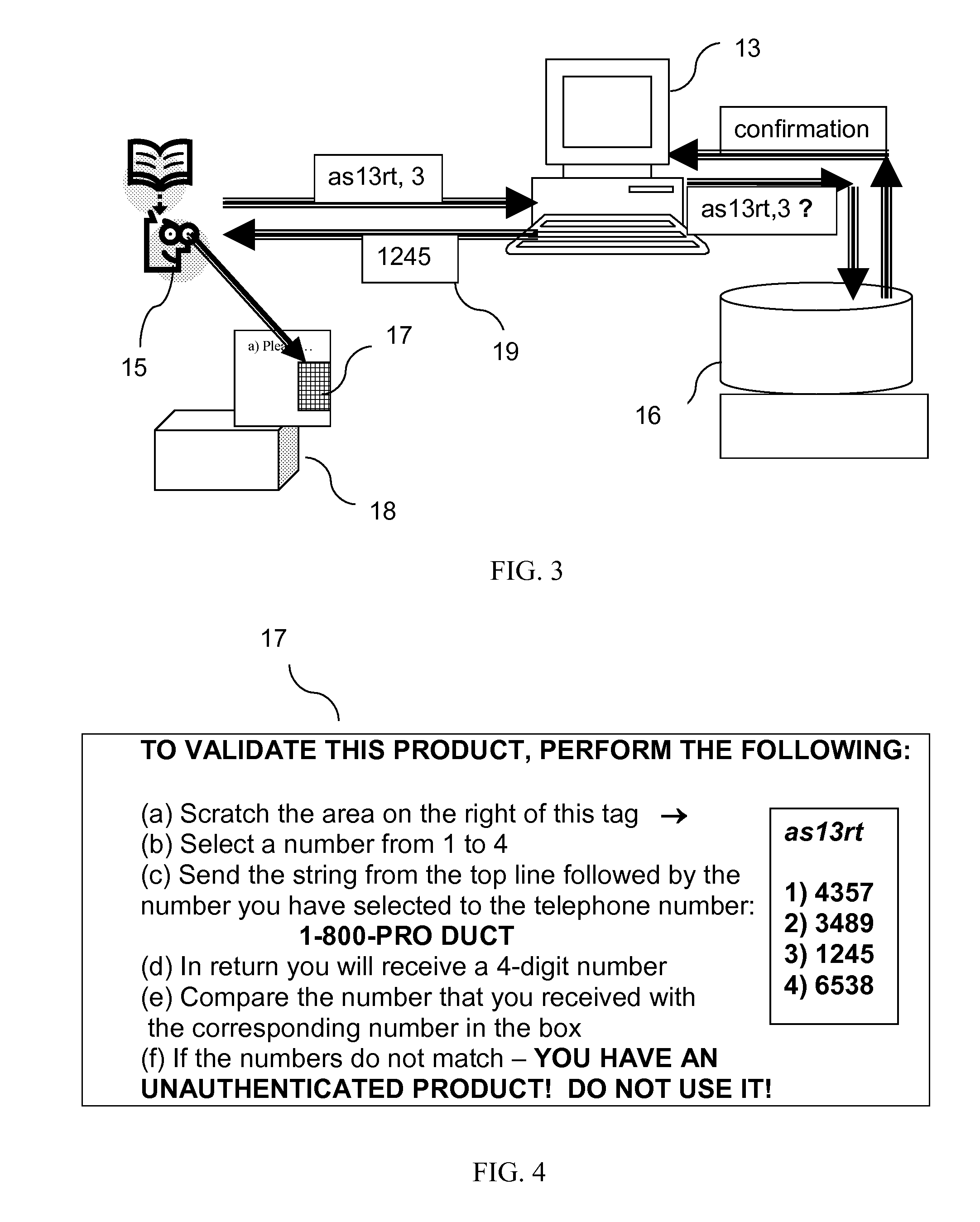
[0019]Therefore, according to this first preferred embodiment of the present invention, the number set preferably comprises at least a pair of character sequences, one of which is a challenge sequence, which the customer sends to the supplier's remote central register of numbers, preferably stored on a remote server, and another is a response sequence, predetermined to be associated with that specific challenge sequence, and stored on the remote central register of numbers. The Remote Checking
System then sends back the response
sequence matching the challenge sequence. If the returned Response sequence matches the second sequence of the number set associated with the product in his hand, the customer knows with high level of probability that his product is authentic. If the response disagrees, the product is likely to be a fake. The Remote Checking
System can also optionally apply checks to the Challenge—the most important one being that the response is only generated once—the first time that that particular Challenge is received, thus thwarting attempts to circumvent the system by the wholesale use of a single authentic number set on numerous counterfeit products.
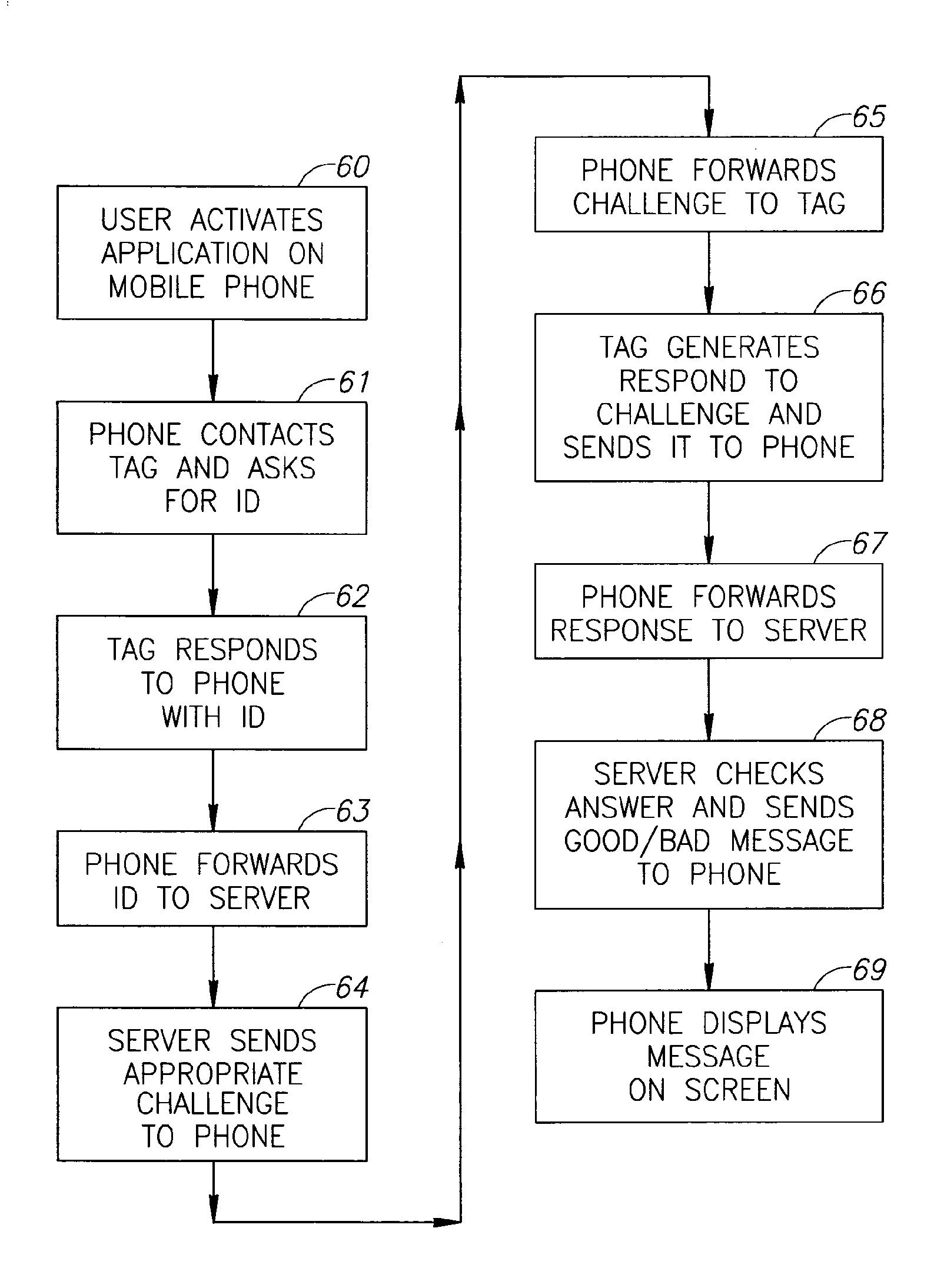
[0026]According to a second preferred embodiment of the present invention, an electronic tag is used for identifying the product being checked. In order to provide the
communication link between the tag and the manufacturer's central register of numbers without the need for a dedicated RFID reader, the product is verified using a regular cellular phone. Attached to the product is a secure electronic tag having a secure signature and
encryption scheme. The system differs from those of the prior art, in which the tag is powered by means of charging generated from its own short-range
communication channel, in that in this invention, the comparatively strong cellular phone transmission
signal is used to charge the tag. The tag then broadcasts its information in one of the standard cellular phone short range communication methods, such as
Bluetooth, NFC, IR, or similar. The cellular phone transmits the information to a server, which can either have full duplex communication with the tag or it can perform the authentication itself. This method thus enables the powering of a
communication device by means of the transmission from a different
communication channel. According to further preferred embodiments, the strong cellular transmission can be used to power more than one short range
communication channel, each having its own antenna for picking up the cellular transmission, such as
Bluetooth and a conventional RFID channel.
[0032]The system of this fourth preferred embodiment can be used for track and trace applications, such that the organization logistics team can determine the exact size, location and status of any item of the stock, spread over numerous locations, yet without compromising the sum total of the organization's stock situation on any one central server.



 Login to View More
  Login to View More