Asymmetric Friedel-Crafts Alkylations Catalyzed By Bifunctional Cinchona Alkaloids
Inactive Publication Date: 2009-08-13
BRANDEIS UNIV
View PDF4 Cites 3 Cited by
Summary
Abstract
Description
Claims
Application Information
AI Technical Summary
This helps you quickly interpret patents by identifying the three key elements:
Problems solved by technology
Method used
Benefits of technology
Problems solved by technology
While high enantioselectivity has been achieved with both chiral metal and organic catalysts, these catalysts are only effective with ethyl 3,3,3-trifluoropyruvate as the electrophile.
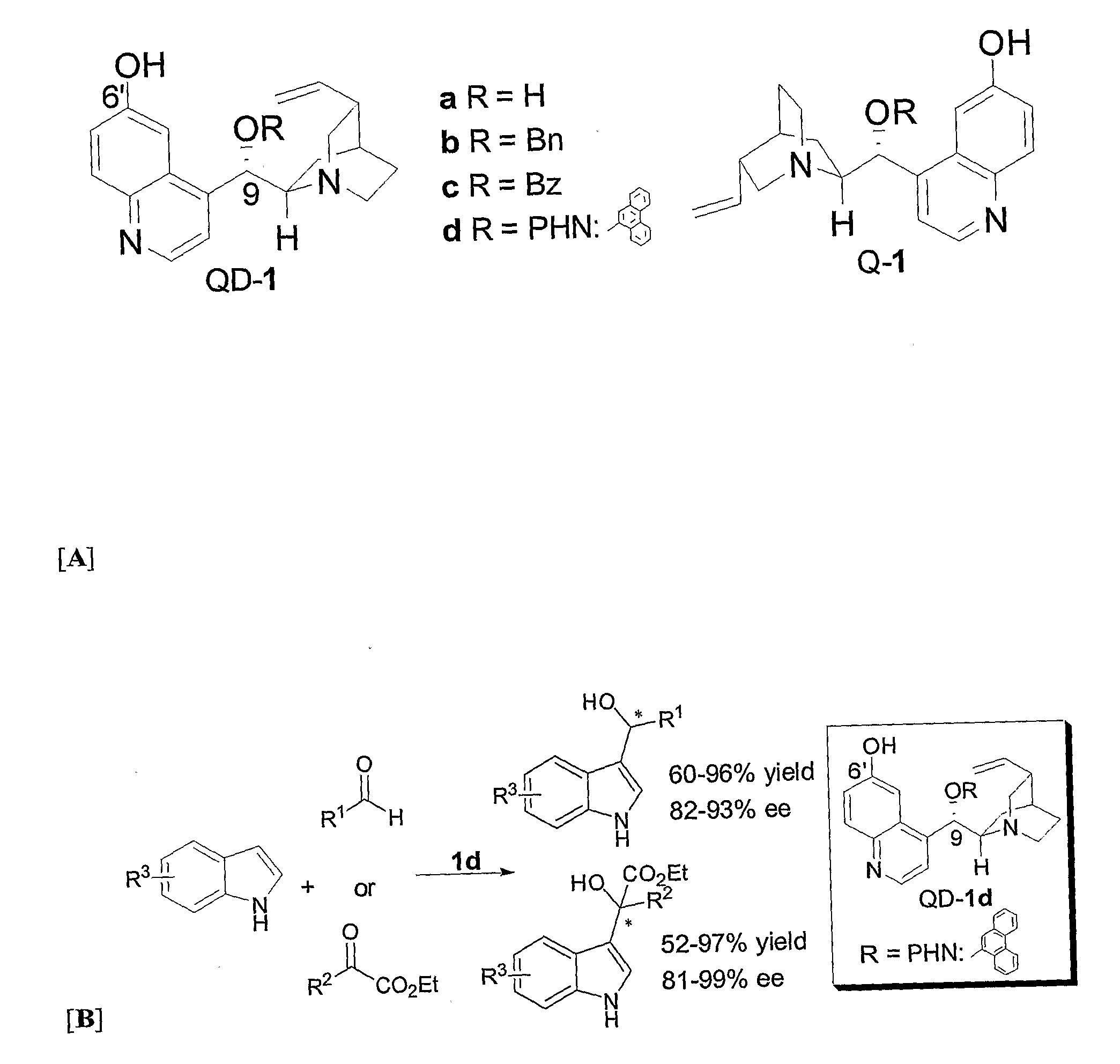
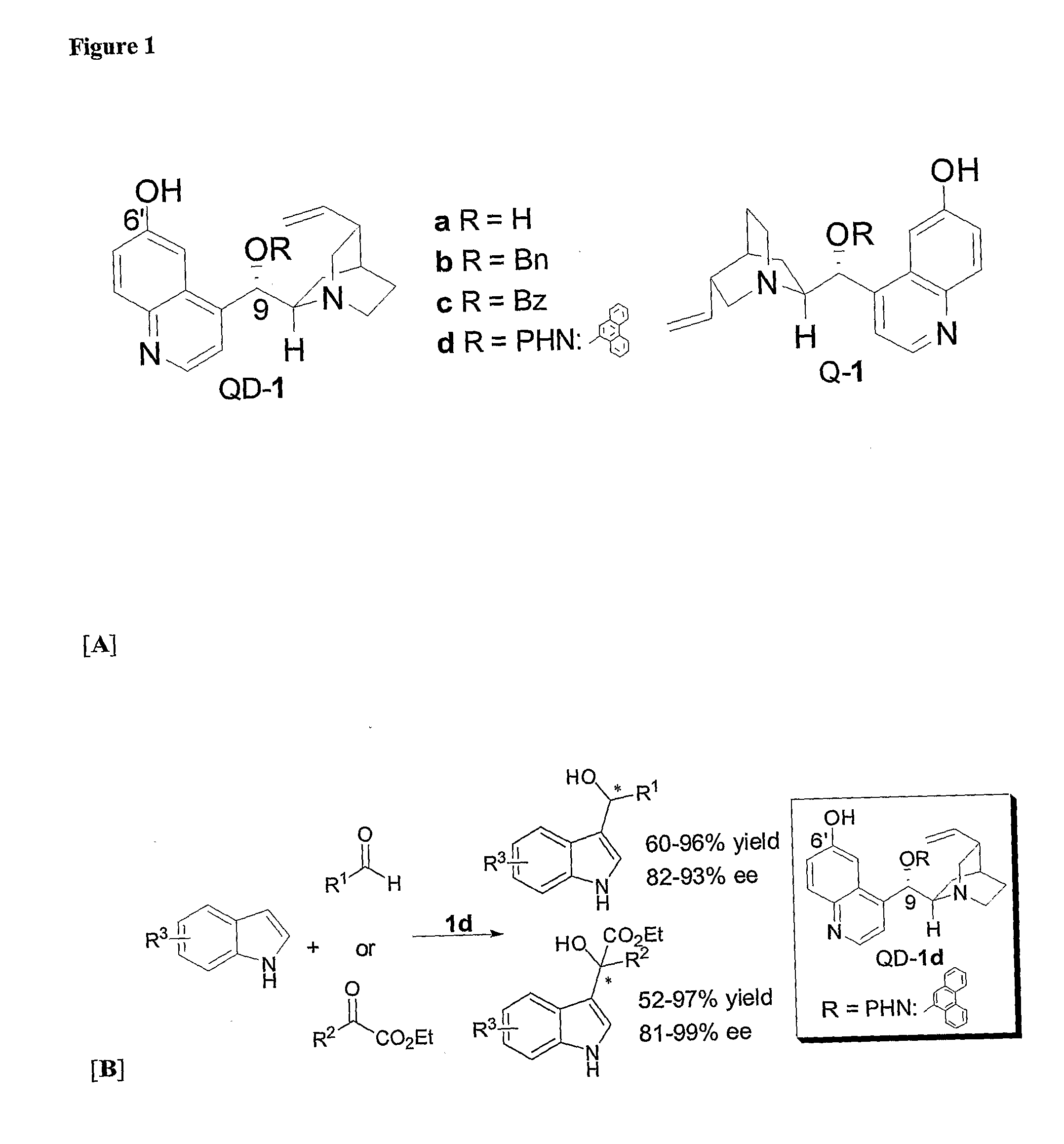
While the high efficiency of 6′-OH cinchona alkaloids in the promotion of mechanistically unrelated C—C bond formations had been demonstrated, it was unknown if the 6′-OH cinchona alkaloids might function as efficient catalysts for enantioselective Friedel-Crafts reactions of indoles with carbonyl compounds.
Method used
the structure of the environmentally friendly knitted fabric provided by the present invention; figure 2 Flow chart of the yarn wrapping machine for environmentally friendly knitted fabrics and storage devices; image 3 Is the parameter map of the yarn covering machine
View more
Image
Smart Image Click on the blue labels to locate them in the text.
Viewing Examples
Smart Image
Click on the blue label to locate the original text in one second.
Reading with bidirectional positioning of images and text.
Smart Image
Examples
Experimental program
Comparison scheme
Effect test
example 1
General Procedure for Friedel-Crafts Addition of Indoles to α-Ketoesters
[0290]At room temperature to the solution of pyruvates 3a-d (0.2 mmol) in Et2O (0.4 mL) was added Q-1d or QD-1d (10 mol %) and followed by addition of indoles (0.4 mmol). Then the mixture was let stand at room temperature for 40-72 hours (as indicated in Table 1, entries 1-10). The reaction mixture was subjected to flash chromatography to afford the desired product 4. For entries 12 and 14 in Table 1, 0.02 mL of Et2O was added to the reaction mixture. For entries 13, 15, 17, 18, these reactions were carried out at 70° C. in 0.02 mL of t-butyl methyl ether (TBME). For entries 16, the reaction was carried out at 70° C. in 0.05 mL of t-butyl methyl ether (TBME). See FIG. 3.
example 2
General Procedure for Friedel-Crafts Addition of Indoles to Aldehydes
[0291]At room temperature to a solution of the aldehyde (5a-d) (0.2 mmol) in TBME (0.02 mL) was added Q-1d or QD-1d (10 mol %) and followed by the addition of the indoles (0.4 mmol). Then the mixture was allowed to stand at room temperature for 4-72 hours (as indicated in Table 2, entries 1-6) or at 70° C. for 40-48 h (entries 7-8, Table 2). The reaction mixture was subjected to flash chromatography to afford the desired product 6. See FIG. 4.
example 3
Data for Products 4 and 6
[0292]
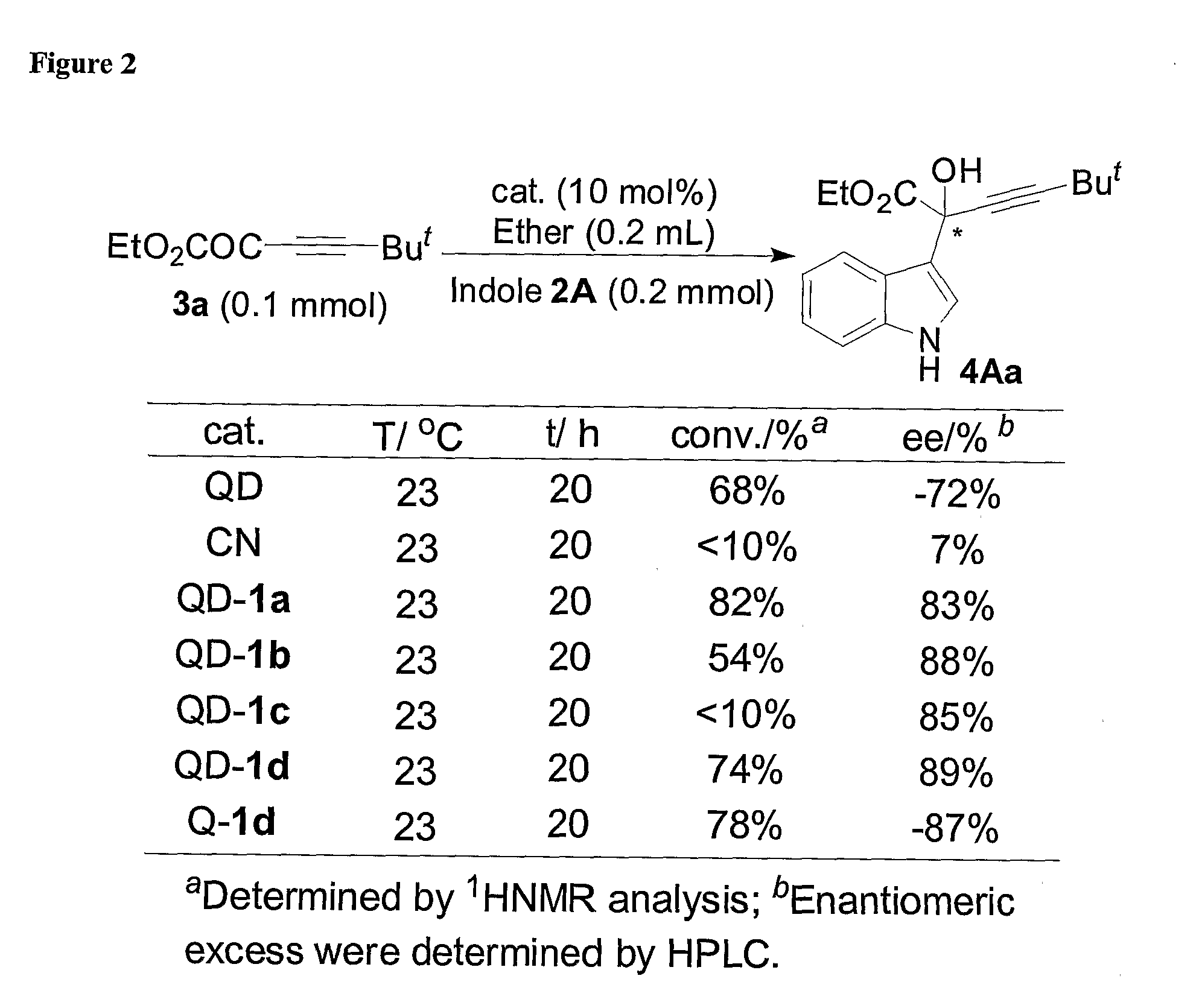
[0293](−)-4Aa was obtained in 89% yield as a foam after flash chromatography (elutionsolvent: Ethyl Acetate / Hexanes=1 / 3) and 87% ee as determined by HPLC analysis [Chiralpak AD, Hexanes:IPA, 75:25, 1.0 mL / min, λ 220 nm, t (minor)=14.2 min, t (major)=7.7 min] from a reaction catalyzed by Q-1d (10 mol %) at room temperature for 63 hours. [α]D25=−1.8 (c 1.0, CHCl3); 1H NMR (400 MHz, CDCl3) δ 8.14 (br, 1H), 7.76 (d, J=8.0 Hz, 1H), 7.44-7.42 (m, 1H), 7.34-7.32 (m, 1H), 7.19 (t, J=7.2 Hz, 1H), 7.11 (t, J=7.2 Hz, 1H), 4.39-4.31 (m, 1H), 4.17-4.09 (m, 1H), 4.07 (s, 1H), 1.29 (s, 9H), 1.21 (t, J=7.2 Hz, 3H); 13C NMR (100 MHz, CDCl3) δ 172.5, 136.8, 124.4, 123.9, 122.2, 120.2, 119.8, 115.7, 111.3, 93.8, 77.2, 68.9, 63.0, 30.7, 27.5, 13.8; IR (CHCl3) ν 3408 (br), 3058, 2970, 2242, 1731, 1619, 1543, 1458, 1255, 1033; HRMS (CI) m / z calcd. for (C18H21NO3+H+): 300.1599, found: 300.1592. (+)-4Aa was obtained as a foam in 96% yield and 88% ee from a reaction catalyzed...
the structure of the environmentally friendly knitted fabric provided by the present invention; figure 2 Flow chart of the yarn wrapping machine for environmentally friendly knitted fabrics and storage devices; image 3 Is the parameter map of the yarn covering machine
Login to View More
PUM
Property
Measurement
Unit
Fraction
aaaaa
aaaaa
Fraction
aaaaa
aaaaa
Fraction
aaaaa
aaaaa
Login to View More
Abstract
In certain embodiments, the present invention relates to methods for asymmetric Friedel-Crafts alkylation catalyzed by bifunctionalcinchona alkaloids. In certain embodiments, the catalyst is a 6′-OH cinchona alkaloid. In certain embodiments, the electrophile is an α-ketoester or aldehyde. In certain embodiments, the nucleophile is an aromatic heterocycle. In certain embodiments, the nucleophile is an aromatic N-containing heterocycle. In certain embodiments, the nucleophile is an indole. In certain embodiments, the methods of the invention are relatively insensitive to concentration, temperature, air and moisture.
Description
RELATED APPLICATIONS[0001]This application claims the benefit of the filing date of U.S. Provisional Patent Application Ser. No. 60 / 742,102, filed Dec. 2, 2005; and U.S. Provisional Patent Application Ser. No. 60 / 781,624, filed Mar. 13, 2006.GOVERNMENT SUPPORT[0002]The invention was made with support provided by the National Institutes of Health (GM-61591); therefore, the government has certain rights in the invention.BACKGROUND OF THE INVENTION[0003]Methods for the preparation and functionalization of indoles are important due to the frequent appearance of indoles in biologically interesting natural and unnatural compounds. Sundberg, R. J. Indoles; Academic Press: London, 1996; Saxton, J. E. Nat. Prod. Rep. 1997, 559; Borschberg, H.-J. Curr. Org. Chem. 2005, 9, 1465; Kleeman, A.; Engel, J.; Kutscher, B.; Reichert, D. Pharmaceutical Substances, 4th ed.; Thieme: New York, 2001; “Friedel-Crafts Alkylation”: Olah, G. A.; Krishnamurty, R.; Prakash, G. K. S. in Comprehensive Organic Synt...
Claims
the structure of the environmentally friendly knitted fabric provided by the present invention; figure 2 Flow chart of the yarn wrapping machine for environmentally friendly knitted fabrics and storage devices; image 3 Is the parameter map of the yarn covering machine
Login to View More
Application Information
Patent Timeline
Application Date:The date an application was filed.
Publication Date:The date a patent or application was officially published.
First Publication Date:The earliest publication date of a patent with the same application number.
Issue Date:Publication date of the patent grant document.
PCT Entry Date:The Entry date of PCT National Phase.
Estimated Expiry Date:The statutory expiry date of a patent right according to the Patent Law, and it is the longest term of protection that the patent right can achieve without the termination of the patent right due to other reasons(Term extension factor has been taken into account ).
Invalid Date:Actual expiry date is based on effective date or publication date of legal transaction data of invalid patent.



 Login to View More