Regulation of GSK-3alpha activity for the treatment or prevention of Alzheimer's disease
a technology of gsk-3alpha activity and alzheimer's disease, applied in the direction of anhydride/acid/halide active ingredients, biocide, drug compositions, etc., to achieve the effects of reducing the processing of amyloid precursor proteins, and preventing, inhibiting or reversing alzheimer's diseas
- Summary
- Abstract
- Description
- Claims
- Application Information
AI Technical Summary
Benefits of technology
Problems solved by technology
Method used
Image

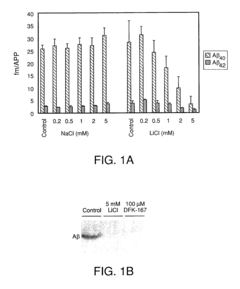
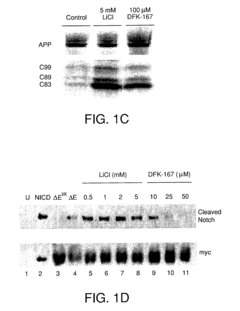
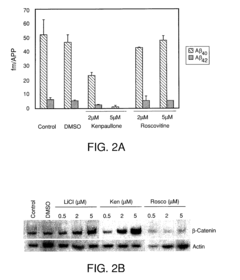
Examples
example 1
Role of GSK-3 and Effect of Lithium on Production of Aβ40 and Aβ42 Peptides
[0095]To investigate the role of GSK-3 in the production of peptides Aβ40 and Aβ42, Chinese hamster ovary (CHO) cells stably expressing APP (CHO-APP695) were treated with lithium chloride (LiCl), which is a direct inhibitor of GSK-3α and 13 (Phiel et al., 2001). CHO695 cells (available commercially, e.g., American Type Culture Collection (ATCC), Manassas, Va.) were maintained in culture in MEMα+5% fetal bovine serum (FBS) (e.g., BioWhittaker, Walkersville, Md.) with added penicillin / streptomycin and glutamine. Stocks of lithium chloride were prepared in sterile water. To quantify the Aβ40 and Aβ42 secretion following treatment with LiCl, the CHO-APP695 cells were plated in 6-well dishes at a density of 5×10⁵ cells per well. LiCl was added to the cells in fresh medium, and media and cells were collected 24 hours later. Aβ determinations from the media were made by sandwich ELISA in femtomoles using the method ...
example 2
Lithium Inhibits Aβ40 and Aβ42 Production at the Level of γ-secretase
[0100]To confirm the effect of lithium on the level of APP peptides, the accumulation of APP processing intermediates was measured in the presence of LiCl. The cleavage of APP by α or β-secretase generates APP C terminal fragments (CTFs), which are then further cleaved by γ-secretase. If γ-secretase is inhibited, for example with a known inhibitor of γ-secretase activity, DFK-167, then APP CTFs accumulate (see, Wolfe et al., 1999).
[0101]The reduction of Aβ was confirmed by the metabolic 35S-methionine labeling of CHO-APP695 cells in either the presence or absence of LiCl. CHO-APP695 cells were maintained, cultured and visualized as described in Example 1, as were the LiCl treatments. Stocks of the γ-secretase inhibitor, DFK-167 (Enzyme Systems Products, Livermore, Calif.) were prepared in DMSO (see, Wolfe et al., J. Med. Chem. 41:6-9 (1998)).
[0102]CHO-APP695 cells were treated with 5 mM LiCl or with the, 100 μM DFK...
example 3
Lithium is Neither an Inhibitor of Notch Processing or γ-Secretase
[0106]The γ-secretase activity is also required for the release of the Notch intracellular domain (NICD) (De Strooper et al., Nature 398:518-522 (1999)). Since lithium inhibits APP processing at the level of γ-secretase, the effects of lithium were examined on Notch processing. ΔE-Notch has been constructed to lack most of its extracellular domain, but it retains the transmembrane domain containing the γ-secretase cleavage site. Thus, it is constitutively cleaved (Schroeter et al., Nature 393:382-386 (1998)).
[0107]CHO-APP695 cells were plated at a density of 1×10⁵ cells per well of 6-well dishes. Cells were transfected with 2 μg of either Notch-ICV or Notch-ΔE as indicated in FIG. 1d, see lanes 4-11. Notch ΔE in pCS2MT and Notch ICV in pCS2MT were kindly provided by R. Kopan (published construct). Notch ΔE V 1744K in pCS2MT was created by site-directed mutagenesis using a QuikChange™ mutagenesis kit (Stratagene, La Jo...
PUM
| Property | Measurement | Unit |
|---|---|---|
| concentrations | aaaaa | aaaaa |
| pH | aaaaa | aaaaa |
| diameter | aaaaa | aaaaa |
Abstract
Description
Claims
Application Information
 Login to View More