
Phase change memory device
- Summary
- Abstract
- Description
- Claims
- Application Information
AI Technical Summary
Benefits of technology
Problems solved by technology
Method used
Image

Examples
Embodiment Construction
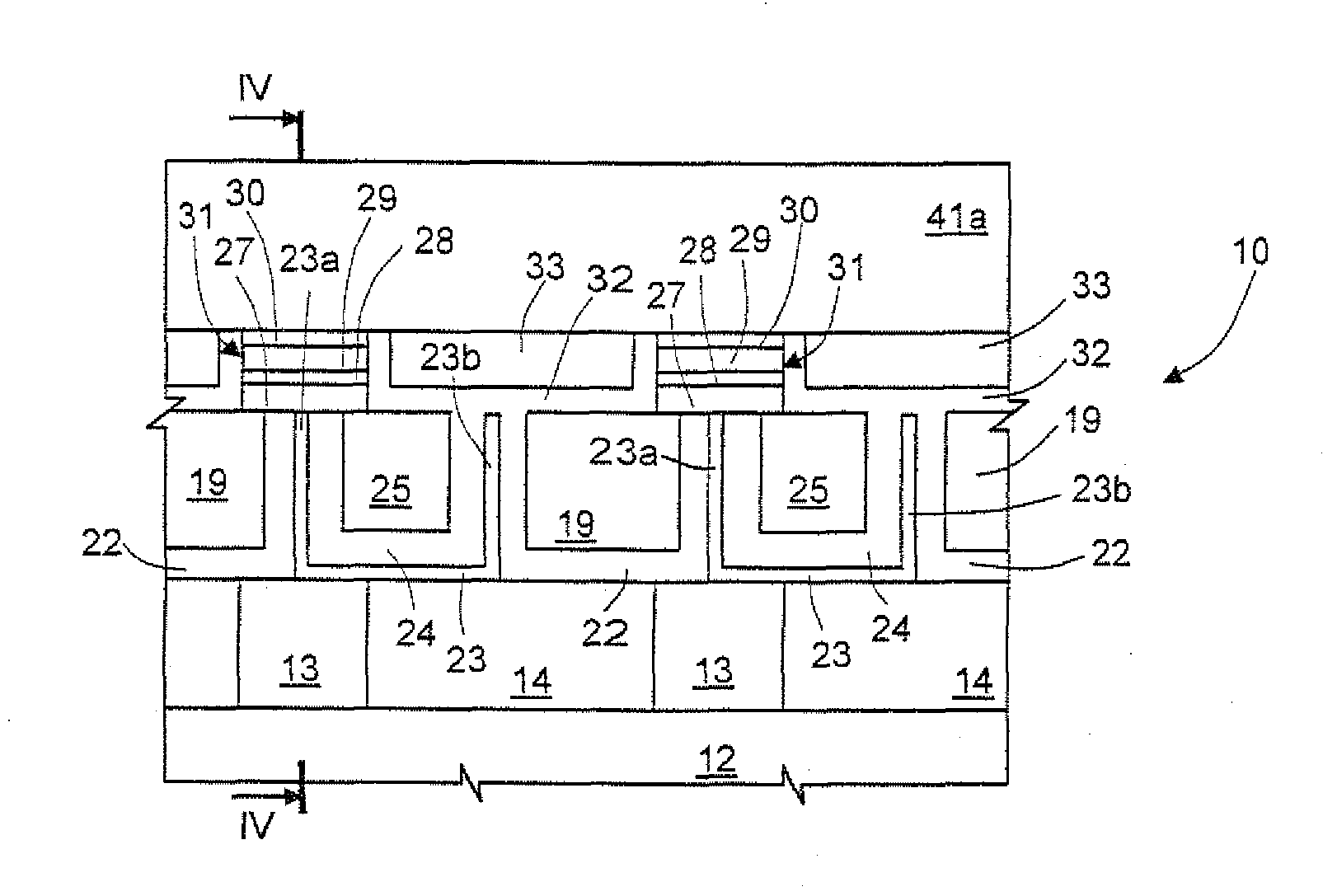
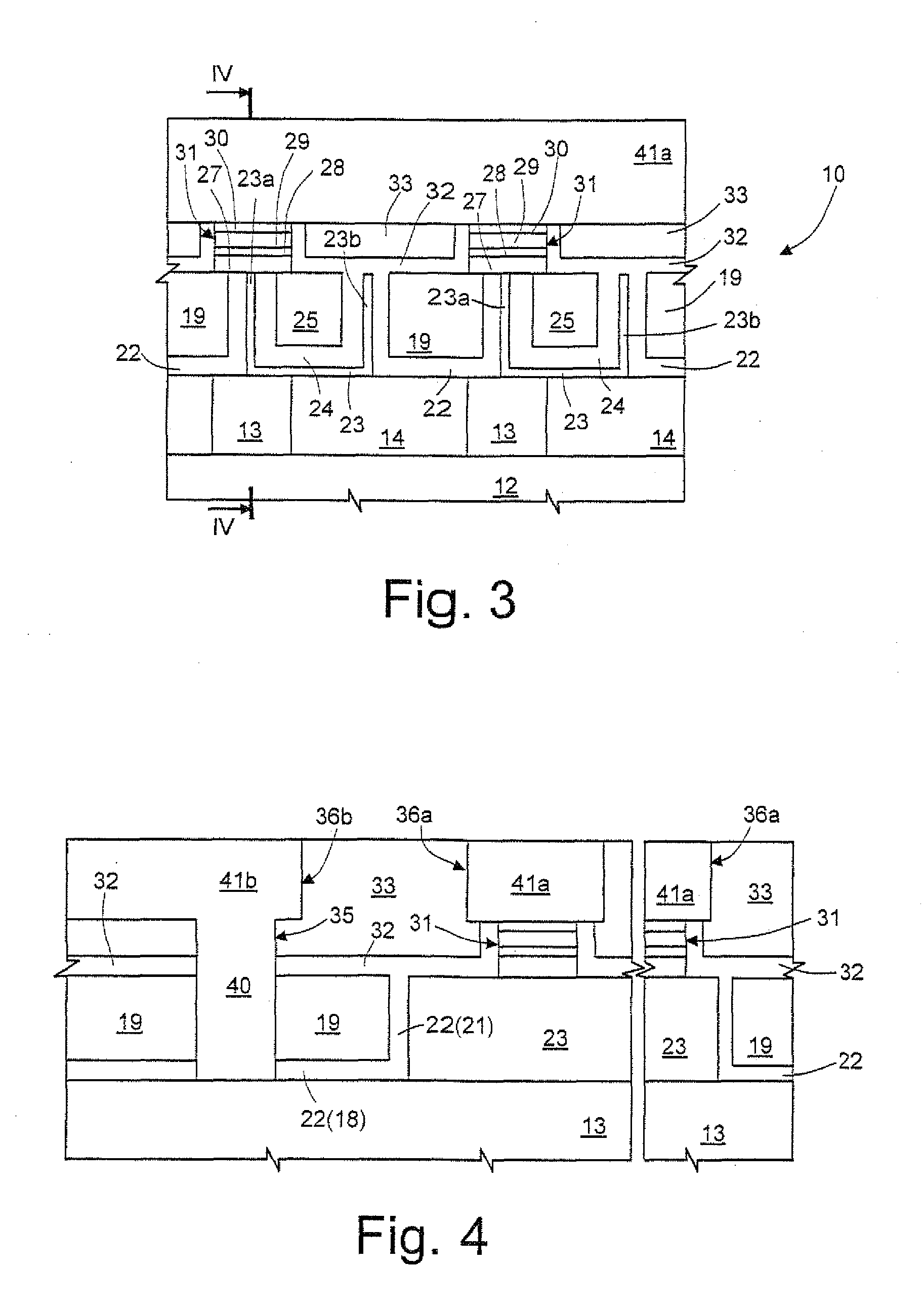
[0047]FIGS. 3 and 4 show an exemplary structure of a phase change memory cell including an ovonic switch.
[0048]In detail, a semiconductor substrate (not shown) is coated with an insulating layer 12. Row lines 13, e.g. of copper, extend on top of the insulating layer 12, insulated from each other by a first dielectric layer 14. A protective region 22 and a first oxide layer 19 encapsulate a heater structure 23 of, e.g., TiSiN, which has a cup-like shape and is internally covered by a sheath layer 24, e.g. of silicon nitride, and filled by a second oxide layer 25.
[0049]The memory cells include PCM / OTS (Ovonic Memory Switch / Ovonic Threshold Switch) stacks or dots 31, each comprising a storage region 27 (e.g., Ge2Sb2Te5), a first barrier region 28 (e.g., TiAlN), a switching region 29 (e.g., As2Se3) and a second barrier region 30 (e.g., TiAlN) extend on and in contact with walls 23a of the heater structures 23. FIG. 3 shows two dots 31 which extend substantially aligned along a column 5 ...
PUM
 Login to View More
 Abstract
Description
Claims
Application Information
 Login to View More