
Equilibrated dynamic mixtures containing stabilized hemiacetals for the controlled release of active alcohols
a technology of stabilized hemiacetals and dynamic mixtures, which is applied in the direction of detergent compounding agents, hair cosmetics, food preparations, etc., can solve problems such as efficient decomposition, and achieve the effect of fine tuning the thermodynamic behavior of dynamic mixtures and altering the organoleptic properties of perfuming ingredients
- Summary
- Abstract
- Description
- Claims
- Application Information
AI Technical Summary
Benefits of technology
Problems solved by technology
Method used
Image

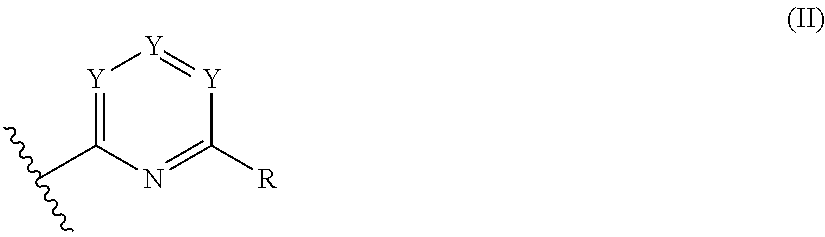
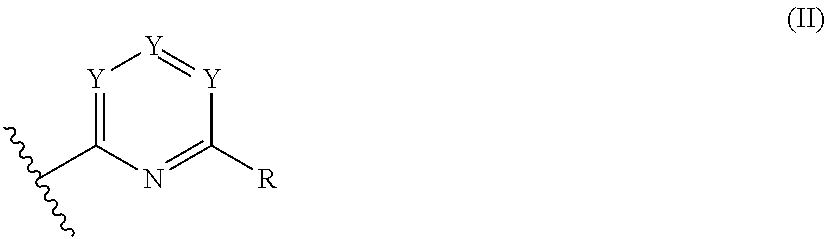
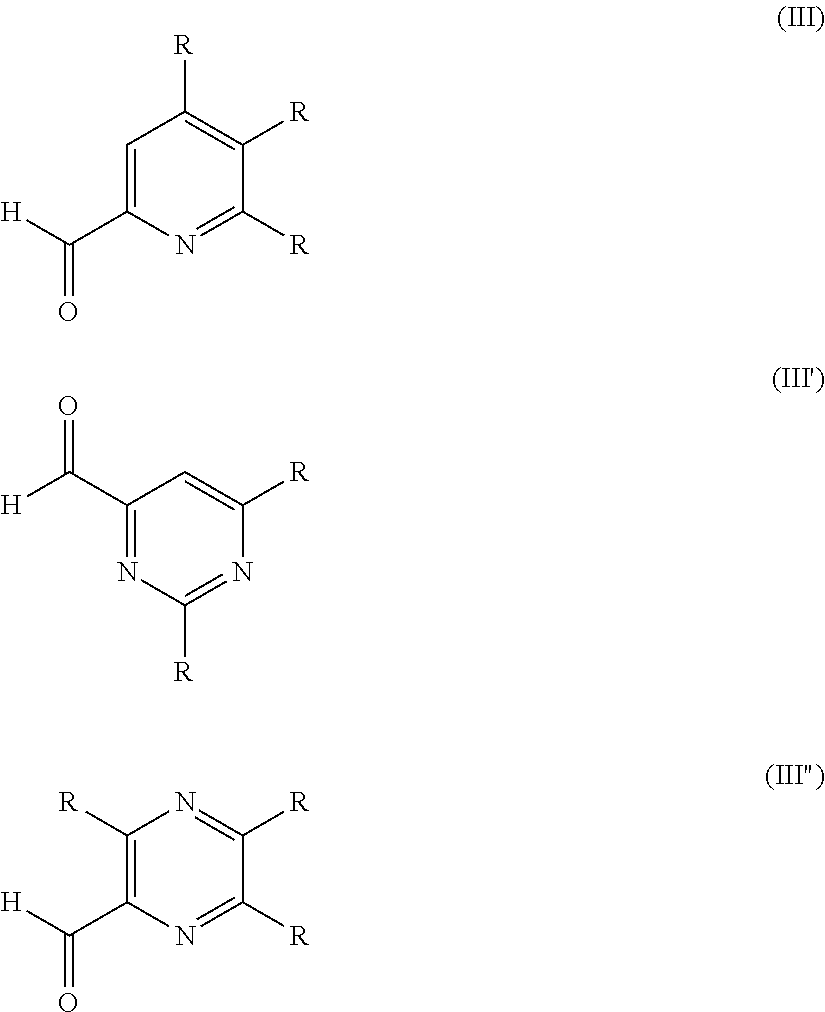
Examples
example 1
Formation of Dynamic Mixtures of Stabilized Hemiacetals in the Absence of a Stabilizing Salt
[0108]Mixtures of an active alcohol (butanol) and an aldehyde (pyridine-2-carboxaldehyde (1), pyridine-2,6-dicarboxaldehyde (2) or 2-phenylpyrimidine-4,6-dicarboxaldehyde (3)) in CDCl3 were prepared at different stoichiometric ratios while keeping the final aldehyde concentration at 0.15 mol / L. The mixtures were then analyzed by NMR spectroscopy. The following compositions were obtained:
AmountAmountAmount ofof mono-of bis-remaininghemiacetalhemiacetalEquivalentsaldehydeformedformedAldehydeof alcohol[%][%][%]2946038317011.0 eq.973—28713036832013.0 eq.946—2703003305614 16.0 eq.8911—2564313175627
[0109]The following compositions were obtained when using geraniol (A) or citronellol (B) instead of butanol as the active alcohol:
Amount ofAmount of mono-Amount of bis-remaininghemiacetalhemiacetalAlde-Equivalentsalcoholformedformedhydeof alcohol[%][%][%]1A: 1.0 eq.946—B: 1.0 eq.973—2A: 2.0 eq.74260B: ...
example 2
Formation of Dynamic Mixtures of Stabilized Hemiacetals Using a Protic Acid as the Stabilizing Salt
[0110]Mixtures of an active alcohol (butanol, (A), 2-methoxyethanol (B), isopropanol (C), citronellol (D), geraniol (E)) and an aldehyde (pyridine-2-carboxaldehyde (1), pyridine-2,6-dicarboxaldehyde (2) or 2-phenylpyrimidine-4,6-dicarboxaldehyde (3)) and 3 molar equivalents of deuterated trifluoroacetic acid (with respect to the aldehyde) in CDCl3 were prepared at different stoichiometric ratios while keeping the final aldehyde concentration at 0.15 mol / L. The mixtures were then analyzed by NMR spectroscopy. The following compositions were obtained:
Amount ofAmount of mono-Amount of bis-remaininghemiacetalhemiacetalAlde-Equivalentsaldehyde orformedformedhydeof alcoholalcohol [%][%][%]1A: 1.0 eq.3268—A: 3.0 eq.1486—B: 1.0 eq.4159—B: 3.0 eq.1882—C: 1.0 eq.5545—C: 3.0 eq.2575—D: 1.0 eq.7525—E: 1.0 eq.4357—2A: 2.0 eq.72622A: 6.0 eq.48547B: 2.0 eq.84511B: 6.0 eq.699223A: 2.0 eq.70300B: 2.0 e...
example 3
Formation of Dynamic Mixtures of Stabilized Hemiacetals Using a Metal Cation as the Stabilizing Salt
[0112]Mixtures of an active alcohol (butanol, (A), 2-methoxyethanol (B), isopropanol (C), citronellol (D), geraniol (E),2-phenylethanol (F), (Z)-3-hexenol (G) or tert-butanol (H)) and an aldehyde (pyridine-2-carboxaldehyde (1), pyridine-2,6-dicarboxaldehyde (2) or oxoacetic acid (4)) and 0.5 molar equivalents of zinc (II) triflate (with respect to the aldehyde) in CD3CN were prepared at different stoichiometric ratios while keeping the final aldehyde concentration at 0.15 mol / L. The mixtures were then analyzed by NMR spectroscopy. The following compositions were obtained:
Amount ofAmount of mono-Amount of bis-remaininghemiacetalhemiacetalAlde-Equivalentsaldehyde orformedformedhydeof alcoholalcohol [%][%][%]1A: 1.0 eq.5941—B: 1.0 eq.6733—C: 1.0 eq.6931—D: 1.0 eq.6139—E: 1.0 eq.6040—F: 1.0 eq.4951—G: 1.0 eq.6436—2A: 2.0 eq.19081A: 6.0 eq.5095B: 2.0 eq.30070B: 6.0 eq.19081C: 2.0 eq.30070D...
PUM
| Property | Measurement | Unit |
|---|---|---|
| pKa | aaaaa | aaaaa |
| pKa | aaaaa | aaaaa |
| pKa | aaaaa | aaaaa |
Abstract
Description
Claims
Application Information
 Login to View More