However, particularly in the aeronautical field, there is a lack of suitable antennas which, in particular, can satisfy the conditions required for mobile use, such as small dimensions and light weight.
Furthermore, directional, wire-free data communication with satellites (for example in the Ku or
Ka band) is subject to extreme requirements for the transmission characteristic of the antenna systems, since interference of adjacent satellites must be reliably precluded.
In aeronautical applications, the weight and the size of the antenna
system are of very major importance, since they reduce the
payload of the aircraft, and cause additional operating costs.
The problem is therefore to provide antenna systems which are as small and light as possible and which nevertheless comply with the regulatory requirements for transmission and reception operation when used on mobile carriers.
This leads to stringent requirements for the angle-dependent antenna characteristic.
However, antennas such as these are unsuitable for mobile use, in particular on aircraft.
However, antenna arrays are subject to the known problem of so-called
grating lobes.
At certain beam angles, this leads to positive interference between the antenna elements, and therefore to undesirable emission of
electromagnetic power in undesired
solid angle ranges.
Since antenna arrays must have a
feed network, this results in the practical problem of finding network and
antenna array topologies which, on the one hand, satisfy the above condition for the maximum distance between the beam centers, and on the other hand occupy as little
physical space as possible.
This so-called geographic
skew cannot be compensated for in mobile applications by rotation of the antenna about an axis at right angles to the
aperture plane, as is possible with stationary terrestrial antennas.
Despite the
aspect ratio, which is in principle poor, an aeronautical antenna
system must therefore be able to comply with the regulatory requirements even in the presence of a geographic
skew, up to a
specific rotation angle of typically about ±35°.
The very high polarization decoupling which is required for operation as a transmitting antenna cannot be achieved with the proposed network of square waveguides.
However, transmission operation that is permitted in accordance with the regulations is impossible since, for example, CFR 25.209 and CFR 25.222 place very stringent requirements on sidelobe suppression.
This greatly restricts the
usable bandwidth.
By virtue of the design, the
antenna element centers are, however, a comparatively long distance apart from one another, as a result of which parasitic sidelobes occur.
The same problem occurs with the arrangements proposed, for example, in U.S. Pat. No. 6,225,960, International Publication No.
However, by virtue of the design, the beam centers are also far more than one
wavelength apart from one another in this case as well, and parasitic sidelobes, which are dependent on the
phase correlation, still occur.


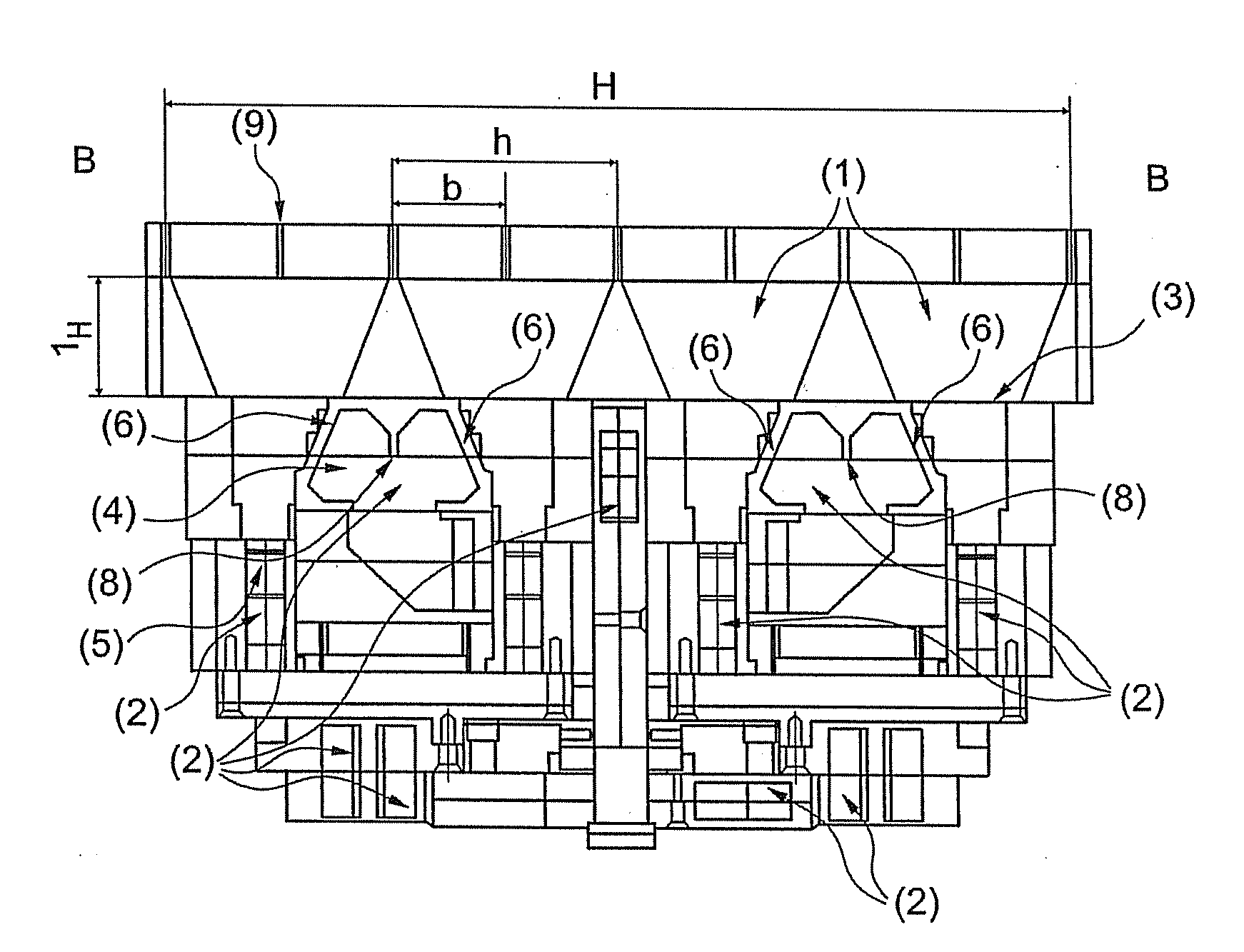
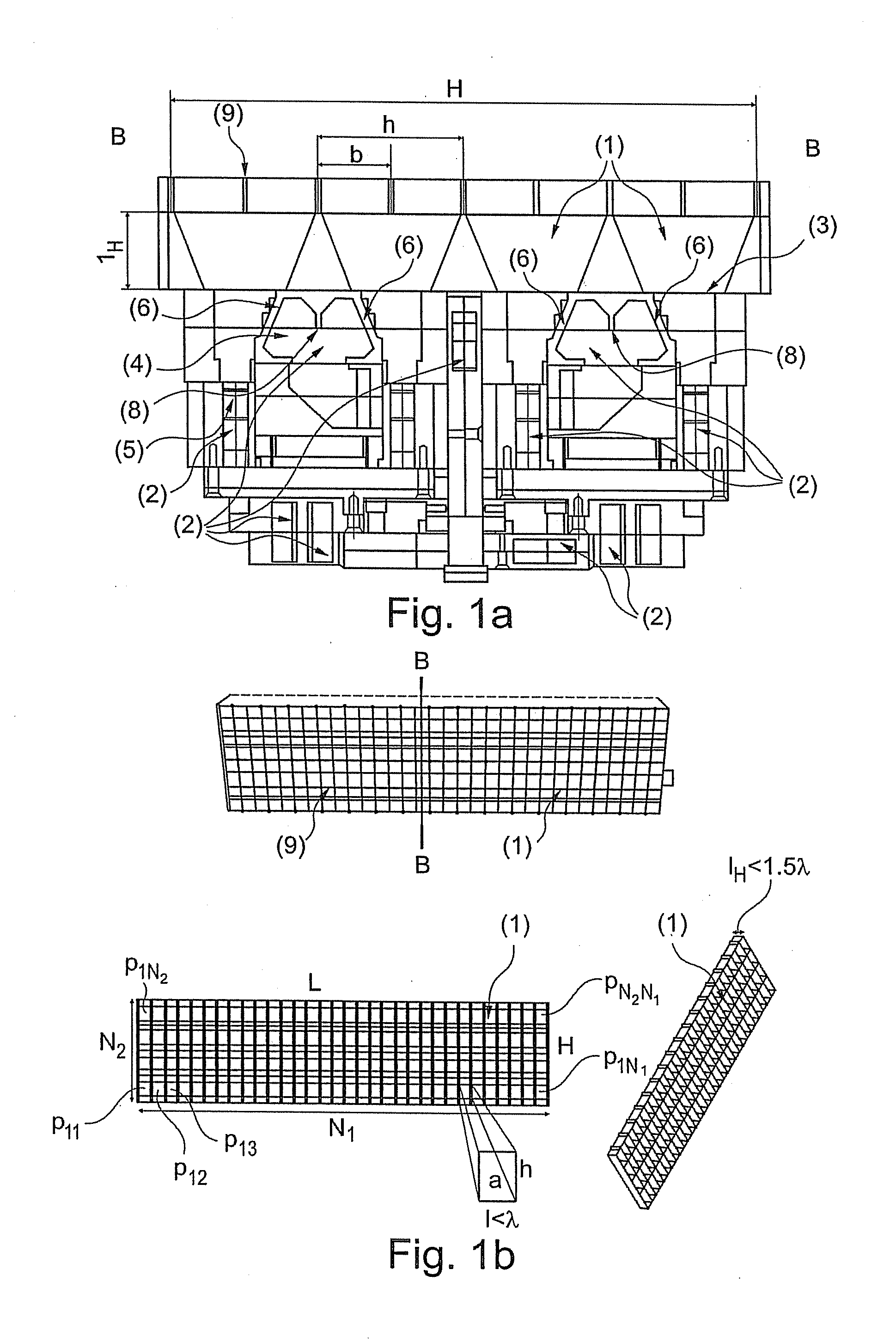
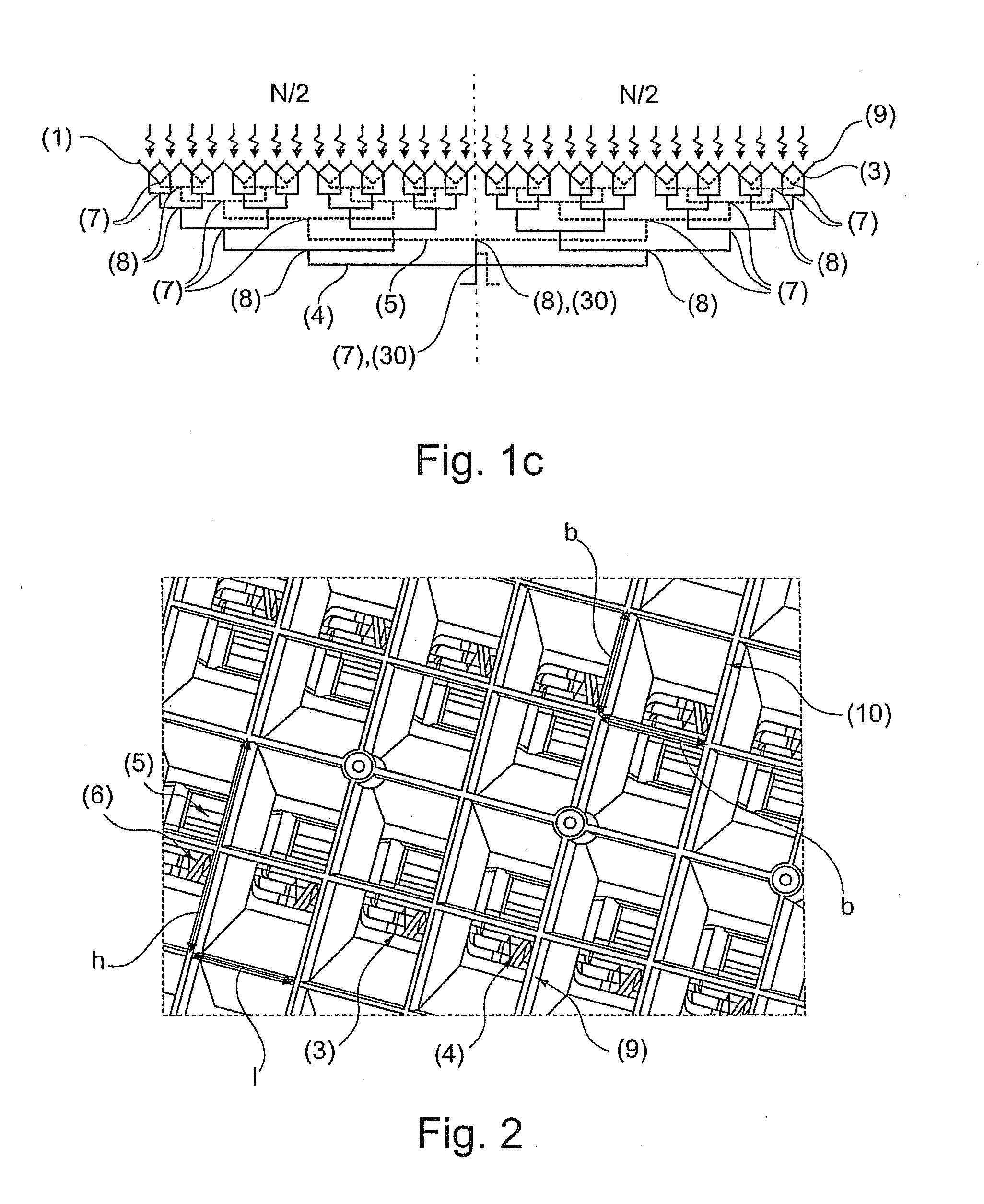
 Login to View More
  Login to View More