
Electrolytically driven drug pump devices
- Summary
- Abstract
- Description
- Claims
- Application Information
AI Technical Summary
Benefits of technology
Problems solved by technology
Method used
Image

Examples
Embodiment Construction
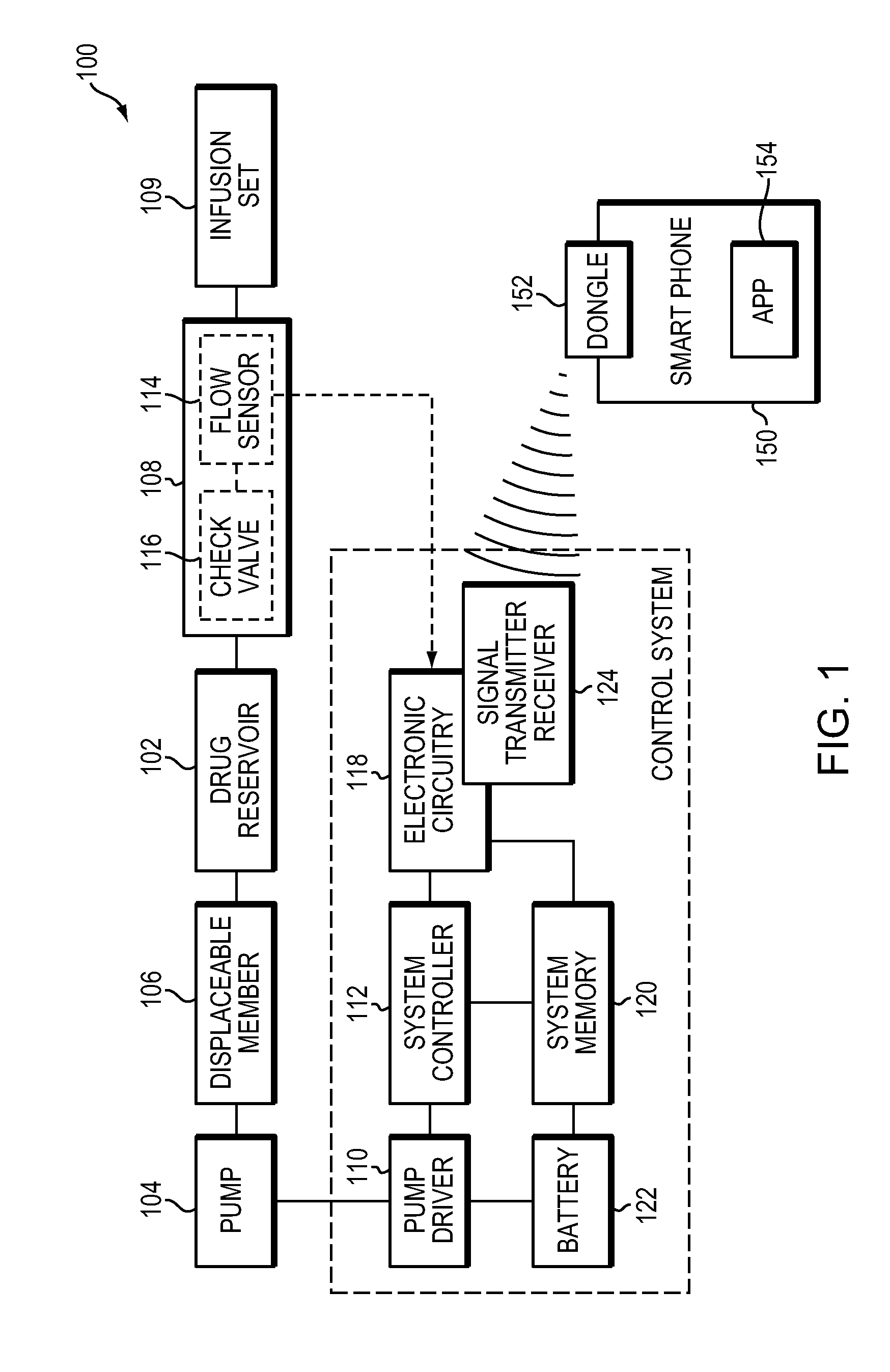
[0031]FIG. 1 illustrates, in block diagram form, the components of a drug pump device 100 in accordance with various embodiments of the present invention. In general, the pump device 100 includes a drug reservoir 102 that interfaces with a pump 104 via a displaceable member 106. The displaceable member 106 may be, for example, a piston, diaphragm, bladder, or plunger. In use, the drug reservoir 102 is filled with medication in liquid form, and pressure generated by the pump 104 moves or expands the displaceable member 106 so as to push the liquid drug out of the reservoir 102. A cannula 108 connected to an outlet of the drug reservoir 102 conducts the liquid to an infusion set 109. The cannula 108 may be made of substantially impermeable tubing, such as medical-grade plastic. The infusion set 109 may include a catheter that is fluidically connected to the cannula 108 and delivers the drug to a subcutaneous tissue region. A lancet and associated insertion mechanism may be used to dri...
PUM
 Login to View More
 Abstract
Description
Claims
Application Information
 Login to View More