
Device for reducing speckle effect in a display system
a display system and speckle technology, applied in the field of speckle devices, can solve the problems of generating granular bright and dark patterns called speckles, giving rise to scattering, and more difficult in miniaturizing systems, and achieve the effect of suppressing speckle noise and simple optical systems
- Summary
- Abstract
- Description
- Claims
- Application Information
AI Technical Summary
Benefits of technology
Problems solved by technology
Method used
Image

Examples
Embodiment Construction
[0048]A MEMS device has at least one movable component. In one embodiment, the movable component is a membrane. The membrane has a certain degree of flexibility allowing the membrane to be deformed and change shapes. The membrane may reflect, refract, polarize or scatter light such as laser beams and may be made of materials such as thin film or conductive film (e.g. ITO).
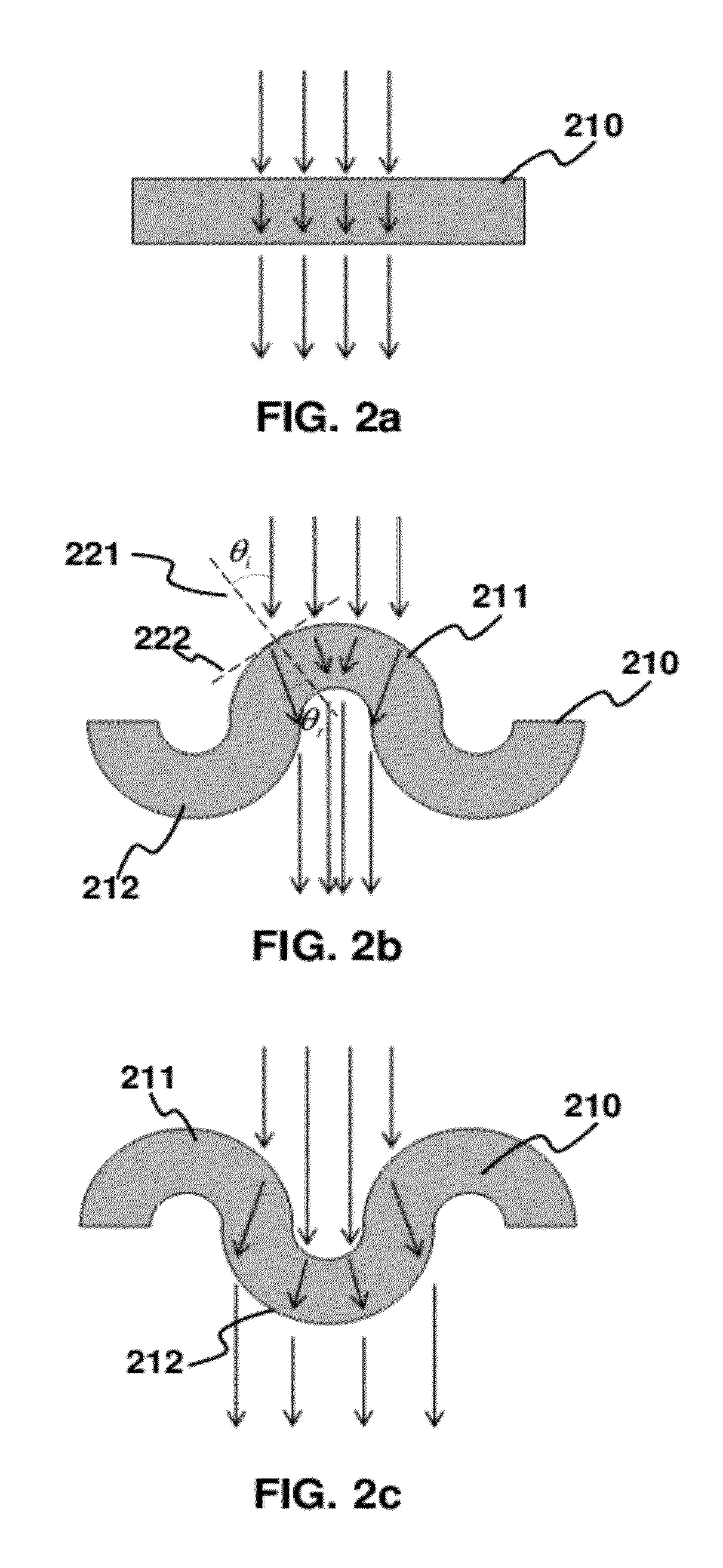
[0049]FIGS. 2a, 2b and 2c depict a transverse wave propagating through a membrane according to one embodiment of the present invention. In this embodiment, light rays such as laser beams travel through the membrane and get refracted.
[0050]According to the Snell's law, the refraction angle θr is given by the following equation (1):
sinθisinθr=ninr(1)
[0051]where θi is the incidence angle, ni is the refractive index of a first medium where an incident ray is travelling before it reaches a second medium with the refractive index nr. The incident ray is refracted by the second medium and travels in the second medium at t...
PUM
| Property | Measurement | Unit |
|---|---|---|
| size | aaaaa | aaaaa |
| refraction angles | aaaaa | aaaaa |
| shape | aaaaa | aaaaa |
Abstract
Description
Claims
Application Information
 Login to View More