
N-channel and p-channel finfet cell architecture
a cell architecture and finfet technology, applied in the field of integrated circuit devices, cell libraries, cell architectures and electronic design automation tools for, can solve the problems of increasing the requirements of compact layout and low power
- Summary
- Abstract
- Description
- Claims
- Application Information
AI Technical Summary
Benefits of technology
Problems solved by technology
Method used
Image

Examples
Embodiment Construction
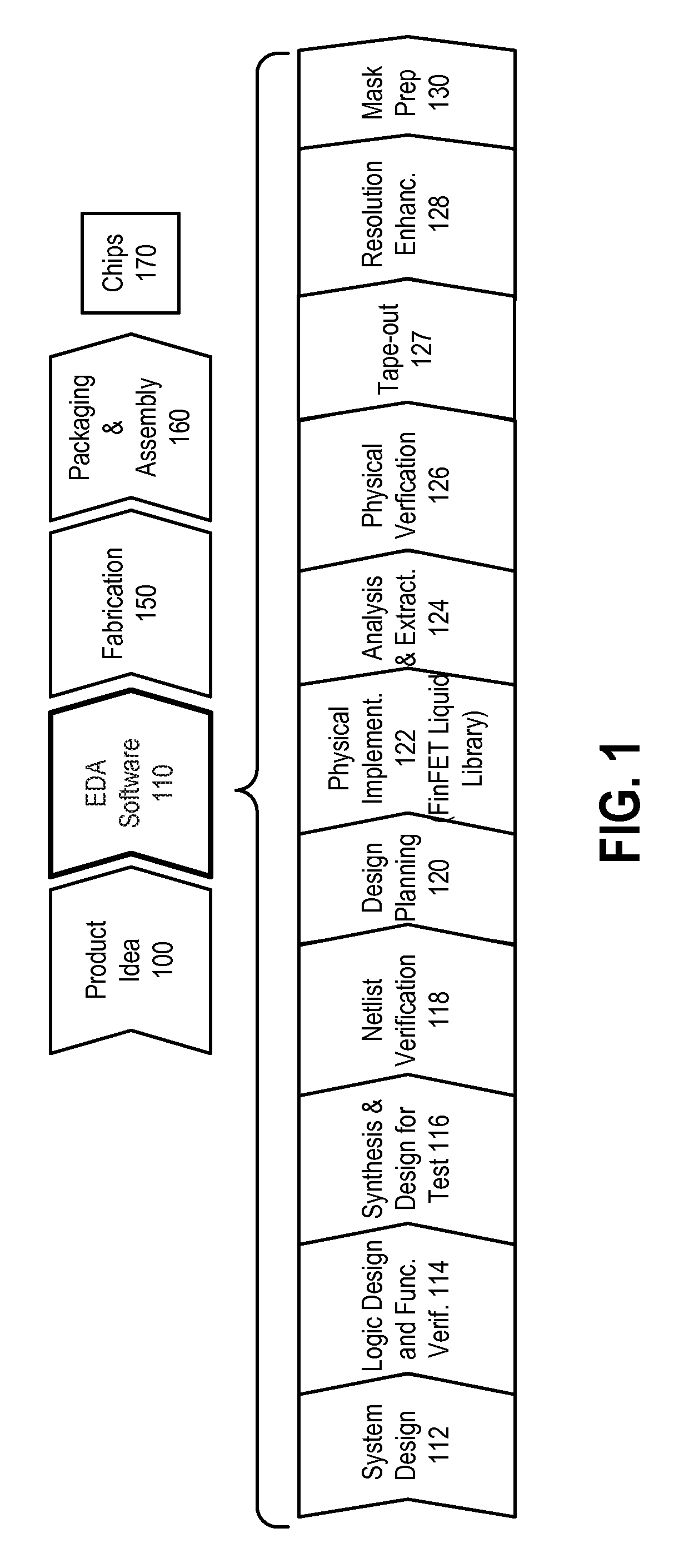
[0019]FIG. 1 is a simplified representation of an integrated circuit design flow. As with all flowcharts herein, it will be appreciated that many of the steps of FIG. 1 can be combined, performed in parallel or performed in a different sequence without affecting the functions achieved. In some cases a rearrangement of steps will achieve the same results only if certain other changes are made as well, and in other cases a rearrangement of steps will achieve the same results only if certain conditions are satisfied. Such rearrangement possibilities will be apparent to the reader.
[0020]At a high level, the process of FIG. 1 starts with the product idea (block 100) and is realized in an EDA (Electronic Design Automation) software design process (block 110). When the design is finalized, the fabrication process (block 150) and packaging and assembly processes (block 160) occur, ultimately resulting in finished integrated circuit chips (result 170).
[0021]The EDA software design process (b...
PUM
 Login to View More
 Abstract
Description
Claims
Application Information
 Login to View More