This helps you quickly interpret patents by identifying the three key elements:
Problems solved by technology
Method used
Benefits of technology
Benefits of technology
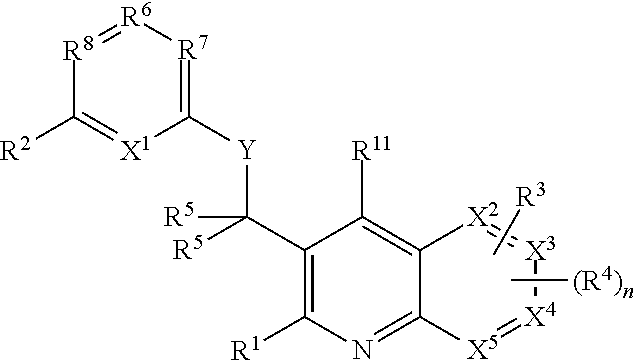
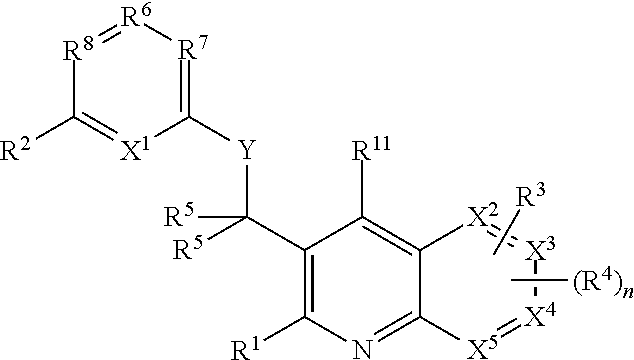
The present patent introduces a new type of chemical compounds that can stop the action of human P13Kδ. These compounds specifically target PI3Kδ without affecting other PI3K proteins in the body. The invention also provides methods for studying and treating diseases caused by dysfunction of P13Kδ. Overall, this patent presents a valuable tool to research and develop new treatments for certain medical conditions.
Problems solved by technology
Though a wealth of information has been accumulated in recent past on the cellular functions of PI 3-kinases in general, the roles played by the individual isoforms are not fully understood.
These compounds, however, are nonspecific PI3K inhibitors, as they do not distinguish among the four members of Class I PI 3-kinases.
Hence, the utility of these compounds in studying the roles of individual Class I PI 3-kinases is limited.
However, inasmuch as these compounds do not distinguish among the various isoforms of PI3K, it remains unclear from these studies which particular PI3K isoform or isoforms are involved in these phenomena and what functions the different Class I PI3K enzymes perform in both normal and diseased tissues in general.
Method used
the structure of the environmentally friendly knitted fabric provided by the present invention; figure 2 Flow chart of the yarn wrapping machine for environmentally friendly knitted fabrics and storage devices; image 3 Is the parameter map of the yarn covering machine
View more
Image
Smart Image Click on the blue labels to locate them in the text.
Viewing Examples
Smart Image
Click on the blue label to locate the original text in one second.
Reading with bidirectional positioning of images and text.
[0110]A reaction flask containing N,N-diisopropylethylamine (101 μL, 581 μmol), 6-chloropurine (66 mg, 426 μmol) and (S)-1-(7-fluoro-2-propylquinolin-3-yl)ethanamine (90 mg, 387 μmol) in n-butanol (3 mL) was heated to 110° C. After the reaction was determined to be complete, the solvent was removed in vacuo. Purification by column chromatography using 0-70% gradient of (90:9:1 DCM:MeOH:NH4OH) in DCM. Further purification was performed by slurrying the crude product in ethyl ether and decanting away from an insoluble contaminant. Concentration afforded (S)-N-(1-(7-fluoro-2-propylquinolin-3-yl)ethyl)-9H-purin-6-amine. LC / MS (M+1)=361.2. 1H-NMR (400 MHz, CDCl3) δ 8.38 (s, 1H), 8.15 (s, 1H), 7.96 (s, 1H), 7.69 (dd, J=9.0, 6.3 Hz, 1H), 7.66 (dd, J=10.6, 2.7 Hz, 1H), 7.23 (td, J=8.6, 2.3 Hz, 1H), 6.43 (td, J=8.6, 2.3 Hz, 1H), 5.95 (br s, 1H), 3.12 (m, 2H), 2.20-1.80 (series of m, 4H), 1.74 (d, J=6.6 Hz, 3H), 1.07 (t, J=...
[0118]To a reaction flask containing DIEA (51.3 μL, 0.293 mmol), 4-amino-6-chloropyrimidine-5-carbonitrile (39.7 mg, 0.257 mmol), and (S)-tert-butyl 4-((3-(1-aminoethyl)-7-fluoroquinolin-2-yl)methyl)piperazine-1-carboxylate (95 mg, 0.245 mmol) (made from (S)-3-(1-(1,3-dioxoisoindolin-2-yl)ethyl)-7-fluoroquinoline-2-carbaldehyde and tert-butyl piperazine-1-carboxylate according to General Methods G and C) was added n-butanol (2.5 mL). The reaction was heated to 80° C. for 3.5 h, cooled to 0° C., and filtered. The precipitate was washed with cold 2:1 ethanol:ether and the solid was recrystallized from ethanol to afford (S)-tert-butyl 4-((3-(1-(6-amino-5-cyanopyrimidin-4-ylamino)ethyl)-7-fluoroquinolin-2-yl)methyl)piperazine-1-carboxylate. LC / MS (M+1)=507.2 1H-NMR (500 MHz, DMSO-d6) δ 8.54 (s, 1H), 7.98 (dd, J=9.0, 6.4 Hz, 1H), 7.98 (s, 1H), 7.76 (d, J=7.6 Hz, 1...
[0130](S)-N-(1-(2-Butyl-8-fluoroquinolin-3-yl)ethyl)-9H-purin-6-amine was synthesized from (S)-2-(1-(2-butyl-8-fluoroquinolin-3-yl)ethyl)isoindoline-1,3-dione according to General Methods C and D. LC / MS (M+H)=365.2. 1H-NMR (400 MHz, CDCl3) δ 13.5 (br s, 1H), 8.38 (s, 1H), 8.13 (s, 1H), 7.97 (s, 1H), 7.47 (m, 1H), 7.32 (m, 2H), 6.41 (br d, J=6.9 Hz, 1H), 5.97 (br s, 1H), 3.20 (m, 2H), 2.05-1.80 (series of m, 4H), 1.75 (d, J=6.9 Hz, 3H), 1.50 (m, 2H), 0.96 (t, J=7.4 Hz, 3H) ppm.
the structure of the environmentally friendly knitted fabric provided by the present invention; figure 2 Flow chart of the yarn wrapping machine for environmentally friendly knitted fabrics and storage devices; image 3 Is the parameter map of the yarn covering machine
Login to View More
PUM
Property
Measurement
Unit
Molar density
aaaaa
aaaaa
Molar density
aaaaa
aaaaa
Molar density
aaaaa
aaaaa
Login to View More
Abstract
Substituted bicyclic heteroaryls and compositions containing them, for the treatment of general inflammation, arthritis, rheumatic diseases, osteoarthritis, inflammatory bowel disorders, inflammatory eye disorders, inflammatory or unstable bladder disorders, psoriasis, skin complaints with inflammatory components, chronic inflammatory conditions, including but not restricted to autoimmune diseases such as systemic lupus erythematosis (SLE), myestenia gravis, rheumatoid arthritis, acute disseminated encephalomyelitis, idiopathic thrombocytopenic purpura, multiples sclerosis, Sjoegren's syndrome and autoimmune hemolytic anemia, allergic conditions including all forms of hypersensitivity, The present invention also enables methods for treating cancers that are mediated, dependent on or associated with pi 105 activity, including but not restricted to leukemias, such as Acute Myeloid leukaemia (AML) Myelodysplastic syndrome (MDS) myelo-proliferative diseases (MPD) Chronic Myeloid Leukemia (CML) T-cell Acute Lymphoblastic leukaemia (T-ALL) B-cell Acute Lymphoblastic leukaemia (B-ALL) Non Hodgkins Lymphoma (NHL) B-celllymphoma and solid tumors, such as breast cancer.
Description
[0001]This application claims the benefit of U.S. Provisional Application No. 61 / 361,014, filed Jul. 2, 2010, which is hereby incorporated by reference.[0002]The present invention relates generally to phosphatidylinositol 3-kinase (PI3K) enzymes, and more particularly to selective inhibitors of PI3K activity and to methods of using such materials.BACKGROUND OF THE INVENTION[0003]Cell signaling via 3′-phosphorylated phosphoinositides has been implicated in a variety of cellular processes, e.g., malignant transformation, growth factor signaling, inflammation, and immunity (see Rameh et al., J. Biol Chem, 274:8347-8350 (1999) for a review). The enzyme responsible for generating these phosphorylated signaling products, phosphatidylinositol 3-kinase (PI 3-kinase; PI3K), was originally identified as an activity associated with viral oncoproteins and growth factorreceptortyrosine kinases that phosphorylates phosphatidylinositol (PI) and its phosphorylated derivatives at the 3′-hydroxyl o...
Claims
the structure of the environmentally friendly knitted fabric provided by the present invention; figure 2 Flow chart of the yarn wrapping machine for environmentally friendly knitted fabrics and storage devices; image 3 Is the parameter map of the yarn covering machine
Login to View More
Application Information
Patent Timeline
Application Date:The date an application was filed.
Publication Date:The date a patent or application was officially published.
First Publication Date:The earliest publication date of a patent with the same application number.
Issue Date:Publication date of the patent grant document.
PCT Entry Date:The Entry date of PCT National Phase.
Estimated Expiry Date:The statutory expiry date of a patent right according to the Patent Law, and it is the longest term of protection that the patent right can achieve without the termination of the patent right due to other reasons(Term extension factor has been taken into account ).
Invalid Date:Actual expiry date is based on effective date or publication date of legal transaction data of invalid patent.


 Login to View More