Arranging interaction and back pressure chambers for microfluidization

a back pressure chamber and microfluidization technology, which is applied in the direction of antibody medical ingredients, drug compositions, immunological disorders, etc., can solve the problems of emulsion degradation during storag

a back pressure chamber and microfluidization technology, which is applied in the direction of antibody medical ingredients, drug compositions, immunological disorders, etc., can solve the problems of emulsion degradation during storag

US20130189311A1Inactive Publication Date: 2013-07-25NOVARTIS AG

Image

Smart Image Click on the blue labels to locate them in the text.
Viewing Examples
Smart Image
  • Arranging interaction and back pressure chambers for microfluidization
  • Arranging interaction and back pressure chambers for microfluidization
  • Arranging interaction and back pressure chambers for microfluidization

Examples

Experimental program
Comparison scheme
Effect test

Embodiment Construction

[0198]A first emulsion comprising squalene, polysorbate 80, sorbitan trioleate and sodium citrate buffer was prepared by homogenization. The first emulsion was homogenized until it had an average oil droplet size of 1200 nm or less and a number of oil droplets having a size >1.2 μm of 5×10⁹ / ml or less.

[0199]The first emulsion was then subject to microfluidization to form a second emulsion. The microfluidization device comprised two synchronous intensifier pumps providing a substantially constant pressure of approximately 700 bar (i.e. approximately 10000 psi). The emulsion was passed through the microfluidization device five times. The emulsion was maintained at a temperature of 40±5° C. during microfluidization through the use of a cooling mechanism.

[0200]Four test runs were carried out. In the first pair of test runs a single channel auxiliary processing module (APM) was positioned upstream of an 8 channel, Z-type interaction chamber (IXC), as recommended by the manufacturer, and ...

the structure of the environmentally friendly knitted fabric provided by the present invention; figure 2 Flow chart of the yarn wrapping machine for environmentally friendly knitted fabrics and storage devices; image 3 Is the parameter map of the yarn covering machine
Login to View More

PUM

PropertyMeasurementUnit
Frequencyaaaaaaaaaa
Angleaaaaaaaaaa
Angleaaaaaaaaaa
Login to View More

Abstract

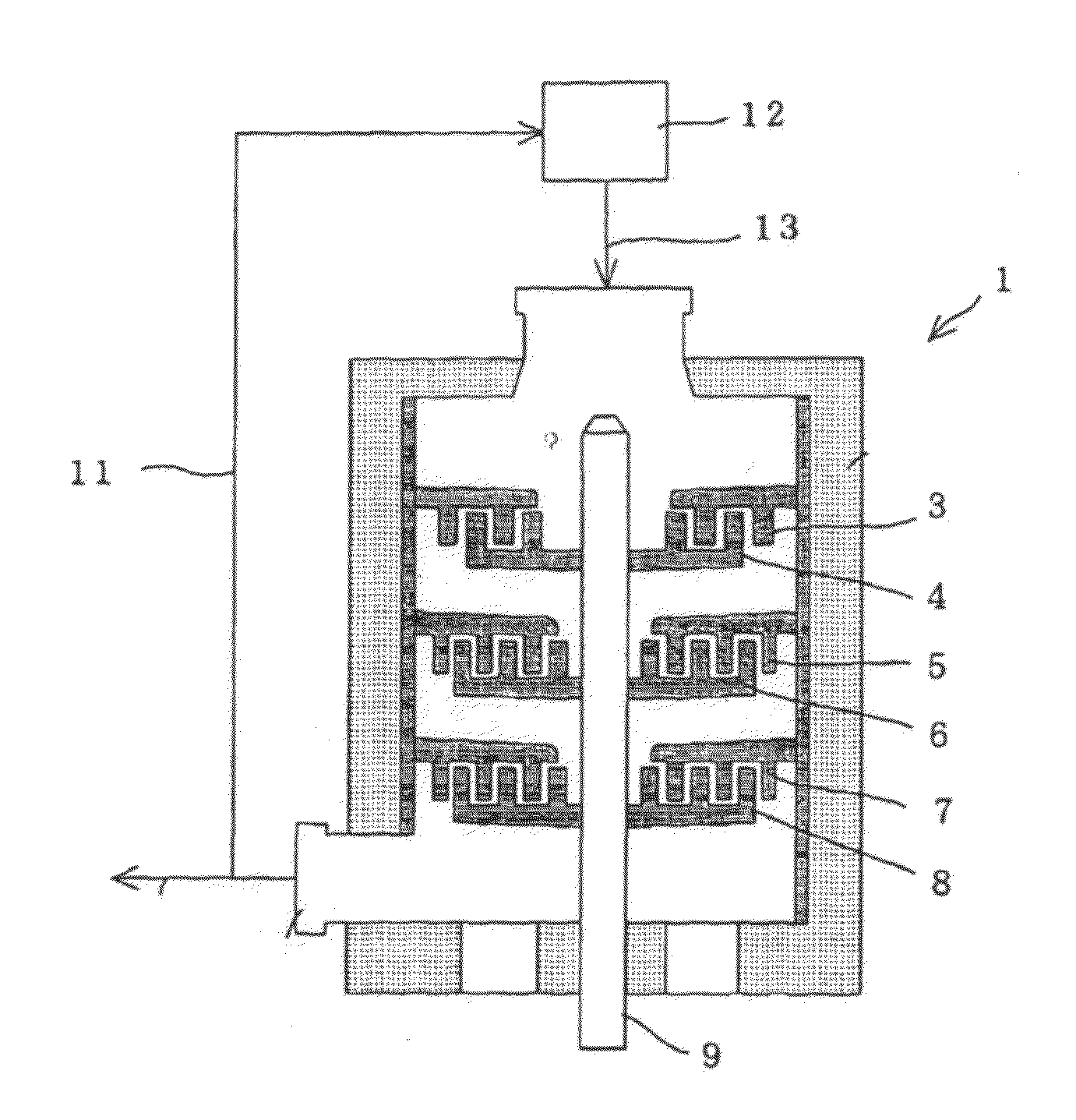
An improved method for the manufacture of an oil-in-water emulsion comprises using a microfluidisation device whose interaction chamber comprises a plurality of Z-type channels upstream of a back pressure chamber.

Description

[0001]This application claims the benefit of U.S. provisional patent application 61 / 283,548 filed Dec. 3, 2009, the complete contents of which are incorporated herein by reference for all purposes.TECHNICAL FIELD[0002]This invention is in the field of manufacturing oil-in-water emulsion adjuvants for vaccines by microfluidization.BACKGROUND ART[0003]The vaccine adjuvant known as ‘MF59’ [1-3] is a submicron oil-in-water emulsion of squalene, polysorbate 80 (also known as Tween 80), and sorbitan trioleate (also known as Span 85). It may also include citrate ions e.g. 10 mM sodium citrate buffer. The composition of the emulsion by volume can be about 5% squalene, about 0.5% Tween 80 and about 0.5% Span 85. The adjuvant and its production are described in more detail in Chapter 10 of reference 4, chapter 12 of reference 5 and chapter 19 of reference 6.[0004]As described in reference 7, MF59 is manufactured on a commercial scale by dispersing Span 85 in the squalene phase and Tween 80 in...

Claims

the structure of the environmentally friendly knitted fabric provided by the present invention; figure 2 Flow chart of the yarn wrapping machine for environmentally friendly knitted fabrics and storage devices; image 3 Is the parameter map of the yarn covering machine
Login to View More

Application Information

Patent Timeline
25 Jul 2013
Publication
US20130189311A1
IPC
B01F13/00; B01F23/00
CPC
A61K9/0019; A61K39/39; A61K2039/55566; B01F3/0807; B01F5/0644; B01F5/104; B01F7/00766; B01F13/0059
Inventors
RUECKL, HARALD; SCHEFFCZIK, HANNO