
Method and apparatus providing wave division multiplexing optical communication system with active carrier hopping
- Summary
- Abstract
- Description
- Claims
- Application Information
AI Technical Summary
Benefits of technology
Problems solved by technology
Method used
Image

Examples
Embodiment Construction
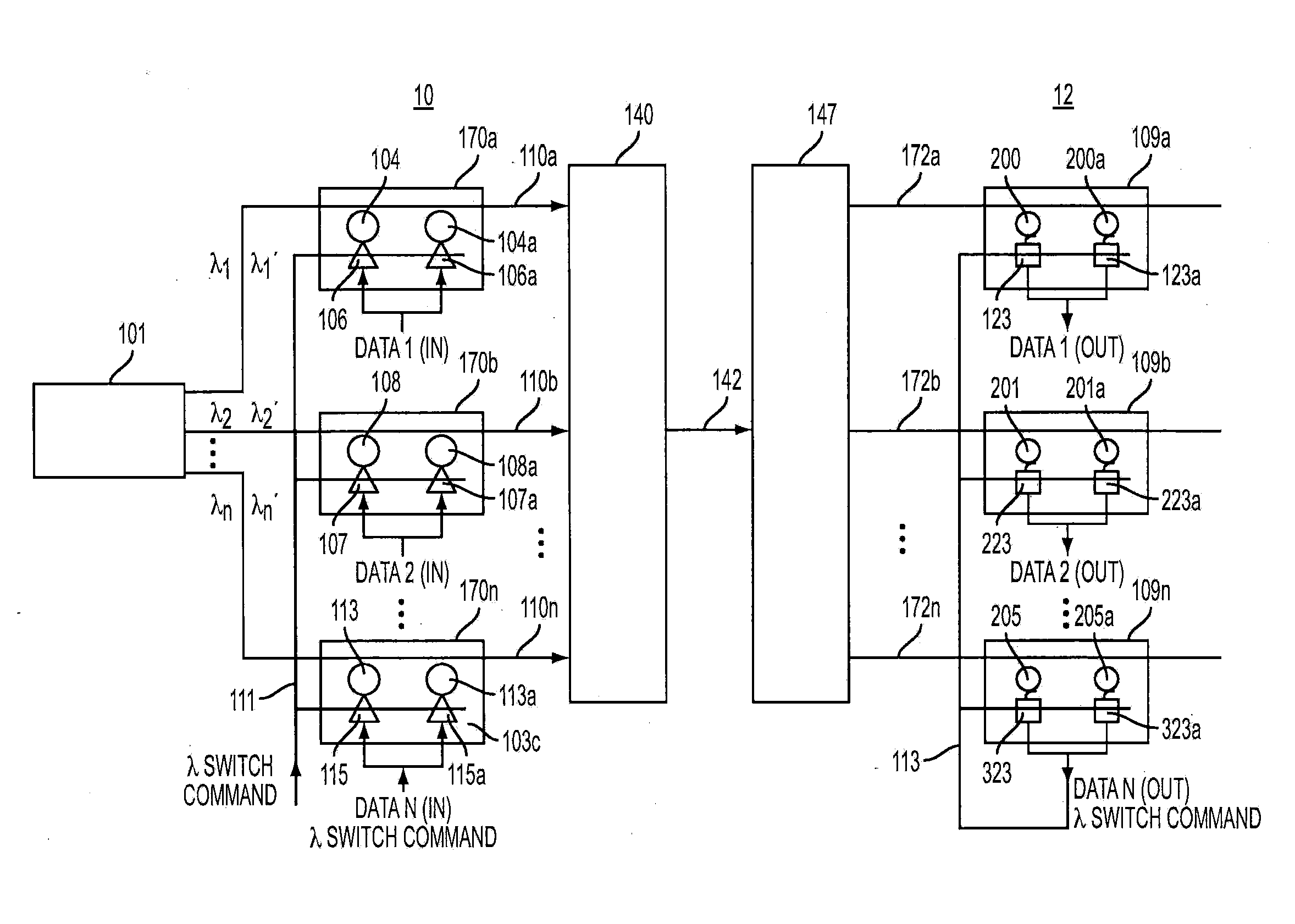
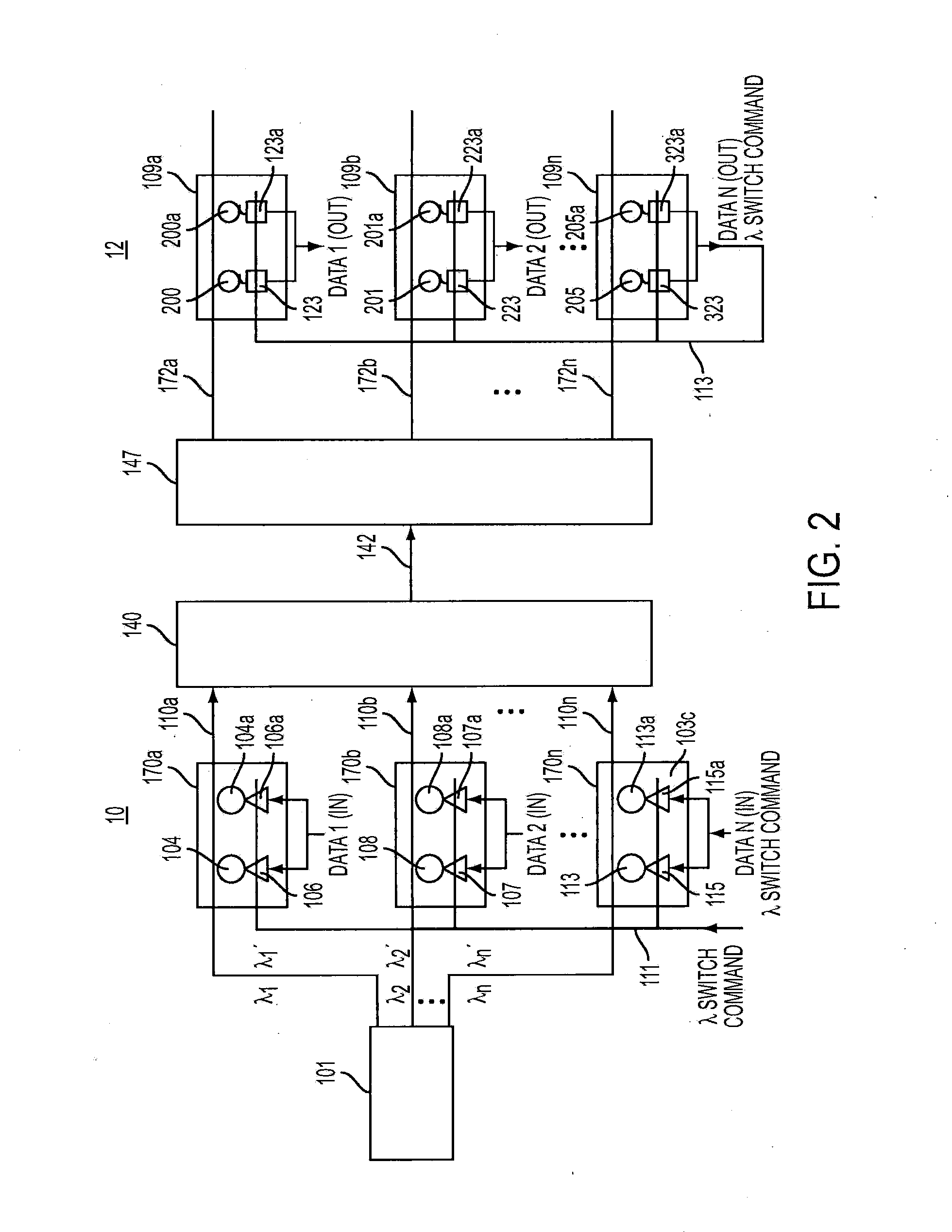
[0016]Example embodiments described herein provide a wave division multiplex (WDM) optical communication system having a plurality of optical communications channels which can be multiplexed and demultiplexed. The WDM optical communications system can be partially or entirely integrated onto a die. Each optical communication channel has at least two spaced carriers and a data modulator having at least a first and a second resonant optical modulator circuit, each associated with a respective carrier. The first resonant optical modulator circuit has a resonant frequency at its respective carrier wavelength and the second resonant modulator circuit has a resonant frequency which is offset from its respective carrier wavelength. When temperature or other changes cause the resonance of the first resonant modulator circuit to move in a direction out of resonance with its associated carrier wavelength the same temperature or other change will also cause the resonant frequency of the second...
PUM
 Login to View More
 Abstract
Description
Claims
Application Information
 Login to View More