Method for dynamically transforming the bytecode of JAVA virtual machine bootstrap classes

a technology bytecode, applied in the field of dynamically transforming the bytecode of java virtual machine bootstrap classes, can solve the problems of many available techniques for bytecode transformation, lack of bytecode enhancement for parts of the program, and limitations that are far too restrictive for many instrumentation-processes

US20140075422A1Active Publication Date: 2014-03-13ZEROTURNAROUND
25 Cites 14 Cited by

Patent Information

Authority / Receiving Office
US · United States
Patent Type
Applications(United States)
Current Assignee / Owner
Publication Date
2014-03-13

Smart Images

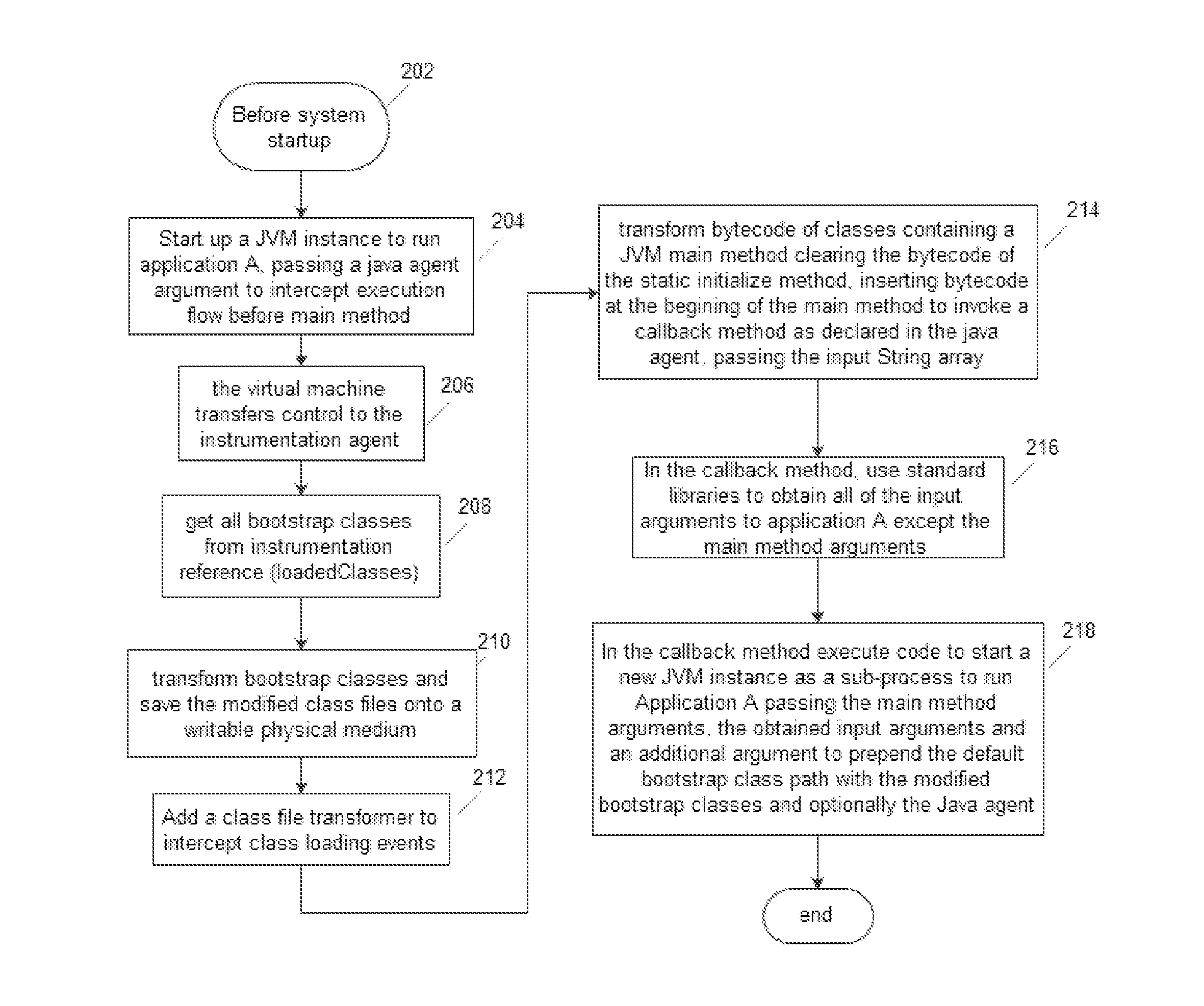
  • Figure 1
    Figure 1
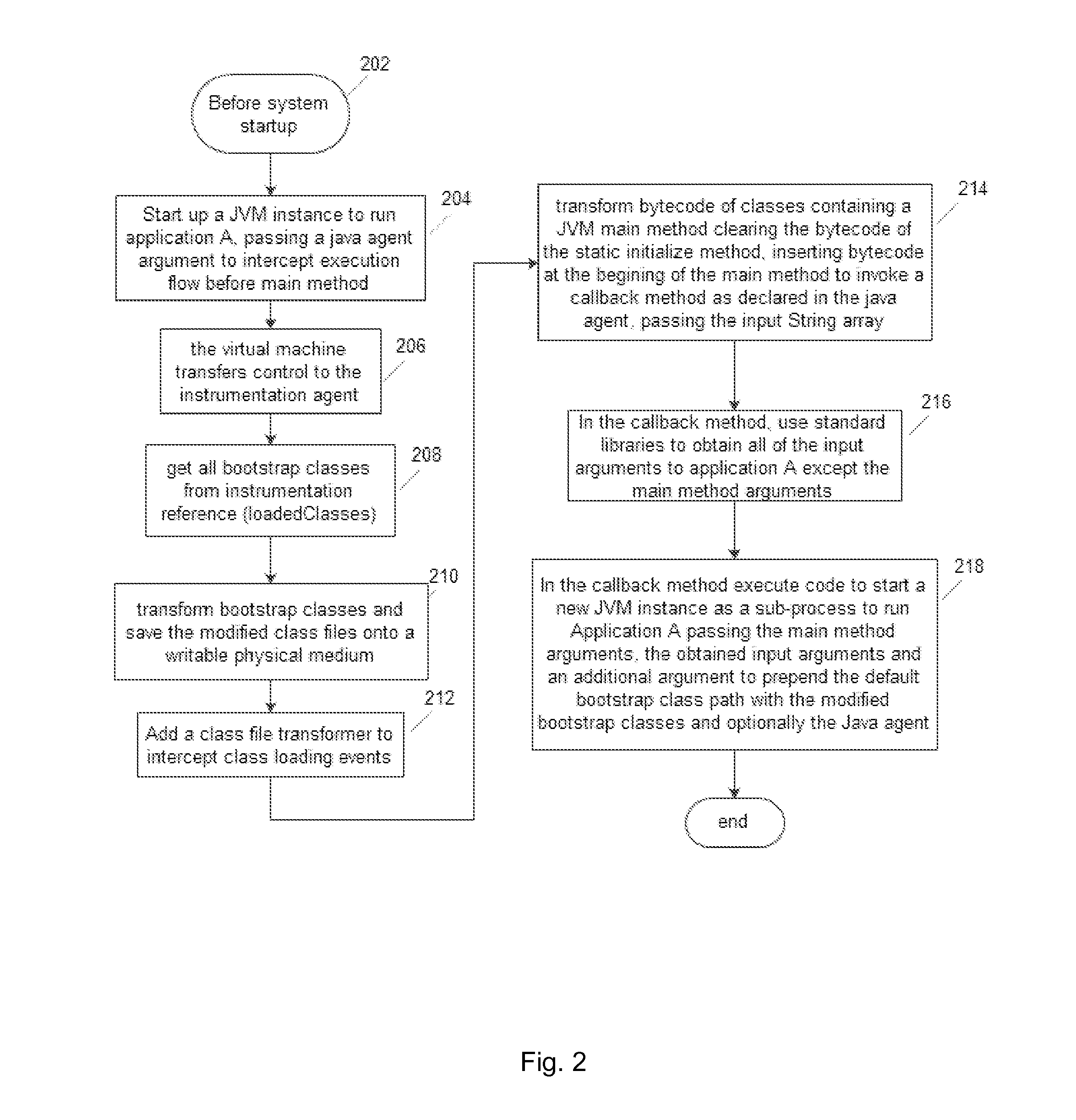
  • Figure 2
    Figure 2
  • Figure 3
    Figure 3
Patent Text Reader

Abstract

Under the present invention, a method for dynamically transforming the bytecode of Java Virtual Machine (JVM) bootstrap classes during program startup is provided. A JVM agent is used to intercept the execution flow before the execution of the special program startup-method of a JVM compliant computer program. The said JVM Agent executes code to transform the bytecode of the already loaded JVM bootstrap classes, storing the new set of modified bootstrap classes onto data storage. Subsequently, the JVM Agent intercepts all class loading events transforming the bytecode of classes declaring a special program statrup-method. In those classes the bytecode within the method body of the special class-initialize method, as defined in the present JVM class file format as “<clinit>”, is removed to avoid any side-effects in the program. The special program startup-method in the said classes is transformed to insert bytecode at the beginning of the method to invoke a special callback method, as declared within the said JVM Agent, passing as parameters to the callback method the main arguments as passed to the JVM upon program startup. Subsequently, when the said callback method intercepts the execution flow it starts a second JVM instance passing to it the obtained input parameters, the main method arguments as well as a JVM input argument to use the stored set of modified bootstrap classes.
Need to check novelty before this filing date? Find Prior Art

Description

FIELD OF THE INVENTION

[0001] The present invention relates to the ability to perform bytecode transformations to enable user-defined customizations of the behavior of computer programs running on top of an unmodified JVM. More particularly, the present invention enables transparent bytecode transformations of the special JVM bootstrap classes in order to obtain full bytecode coverage of user-defined customizations for existing classes. With the present invention, computer programs requiring bytecode transformations of the foresaid bootstrap classes, beyond the capabilities of the current Java HotSwap mechanism, no longer have to use an off-line transformation tool that performs the required bytecode transformations statically to the bootstrap classes before the computer program can be started on the JVM with the modified bootstrap classes. Rather, the present invention enables transparent on-line bytecode transformations and automatic program execution with the set of hereby dynamica...

Examples

Embodiment Construction

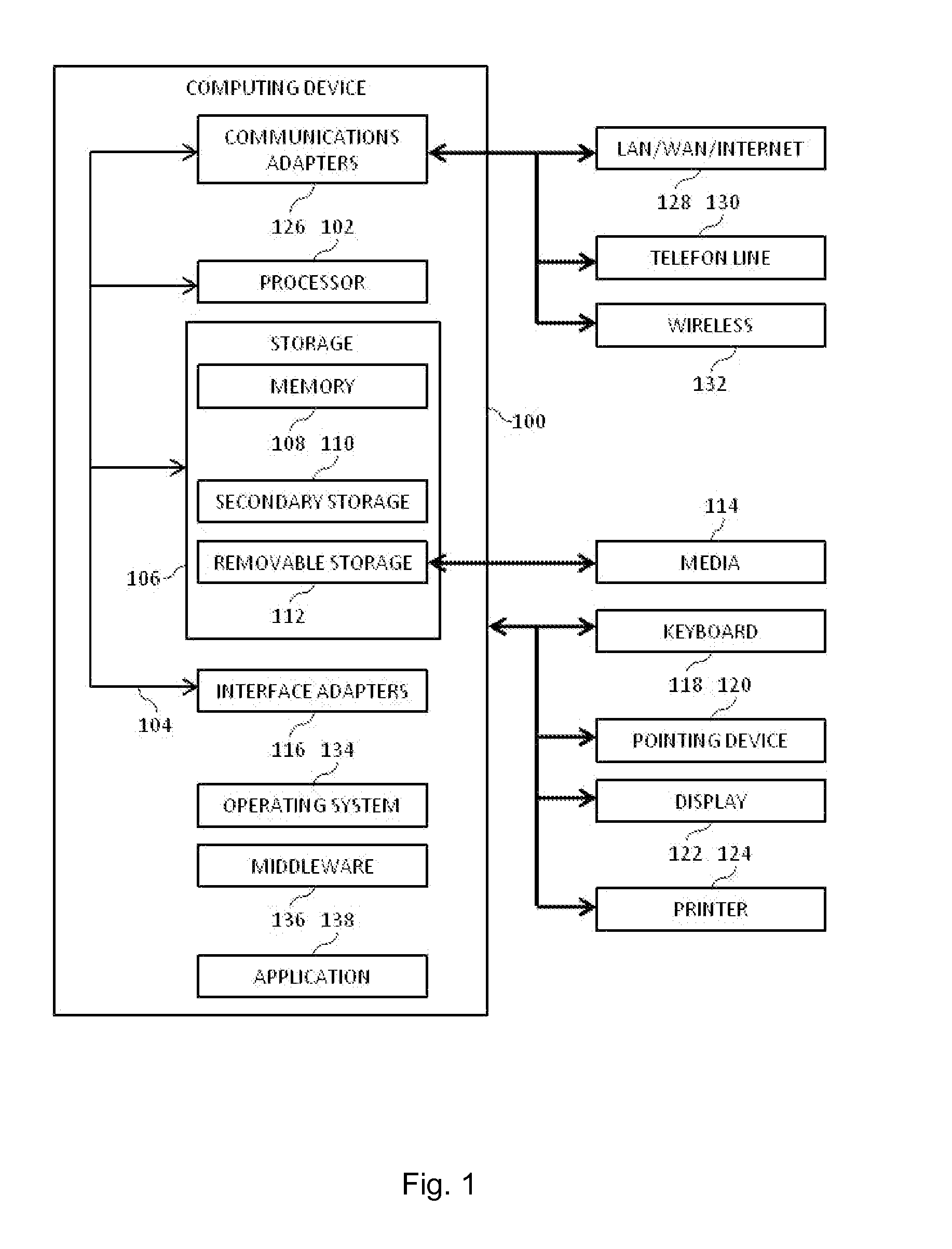
[0014]FIG. 1 is a block diagram of a computing device, such as a workstation, wherein the present invention may be practiced. The environment of FIG. 1 comprises a single representative computing device 100, such as a personal computer, workstation, enterprise mainframe computer, server, laptop, hand-held computer, information appliance, etc., including related peripheral devices. The computing device 110 includes a microprocessor 102 or equivalent processing capability and a bus 104 to connect and enable communication between the microprocessor 102 and the components of the computing device 100 in accordance with known techniques. Note that in some computing devices there may be multiple processors incorporated therein.

[0015]The microprocessor 102 communicates with storage 106 via the bus 104. Memory 108, such as Random Access Memory (RAM), Read Only Memory (ROM), flash memory, etc. is directly accessible while secondary storage device 110, such as a hard disk, and removable storag...