
Recursive Least Squares Adaptive Acoustic Signal Filtering for Physiological Monitoring System
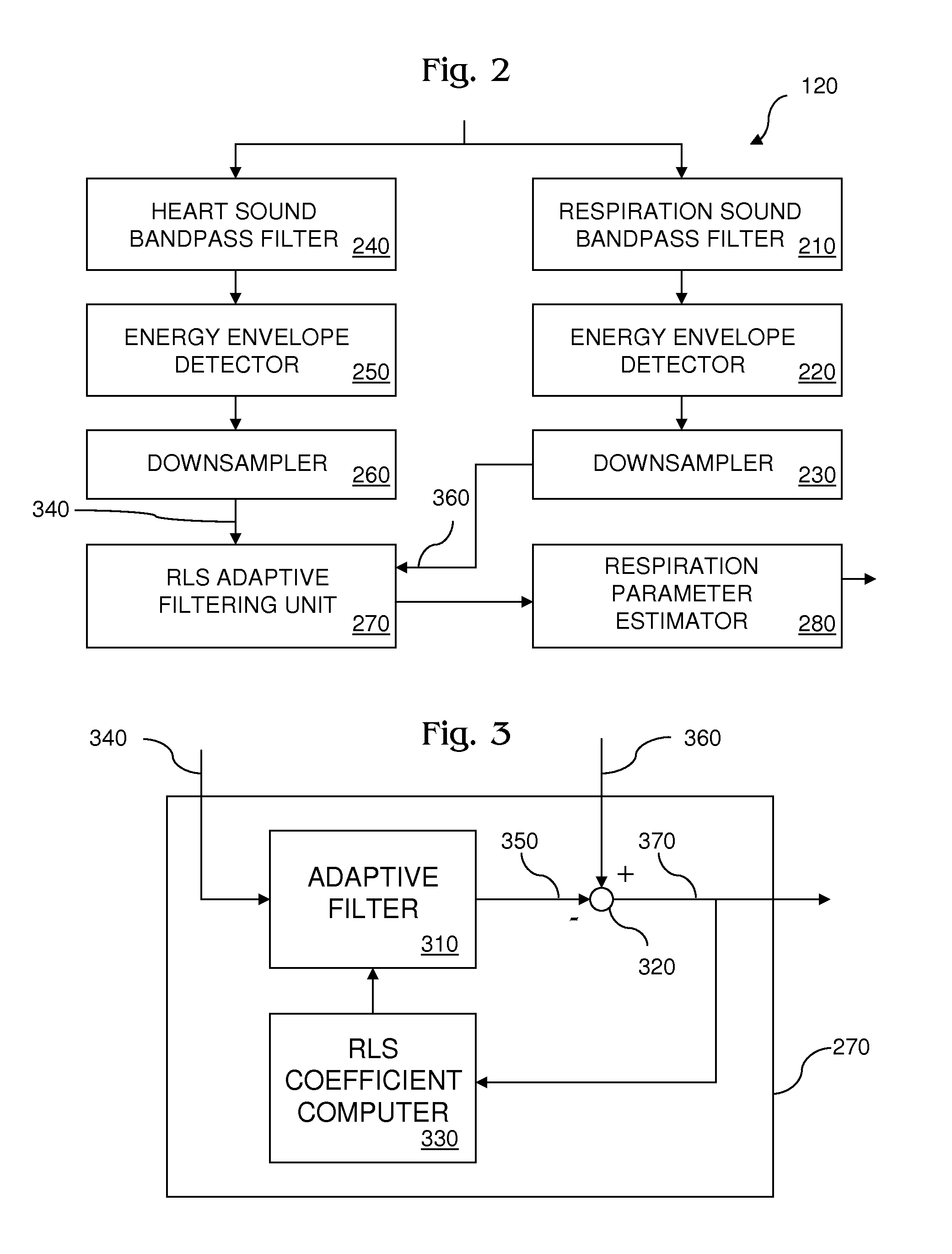
a physiological monitoring and adaptive acoustic signal technology, applied in the field of physiological monitoring, can solve the problems of preventing the whole recovery of respiration sound, erroneous respiration parameter estimation, and size, weight and complexity, and achieve the effect of minimizing the least square error of the residual signal, and reducing the residual heart sound in the primary signal
- Summary
- Abstract
- Description
- Claims
- Application Information
AI Technical Summary
Benefits of technology
Problems solved by technology
Method used
Image

Examples
Embodiment Construction
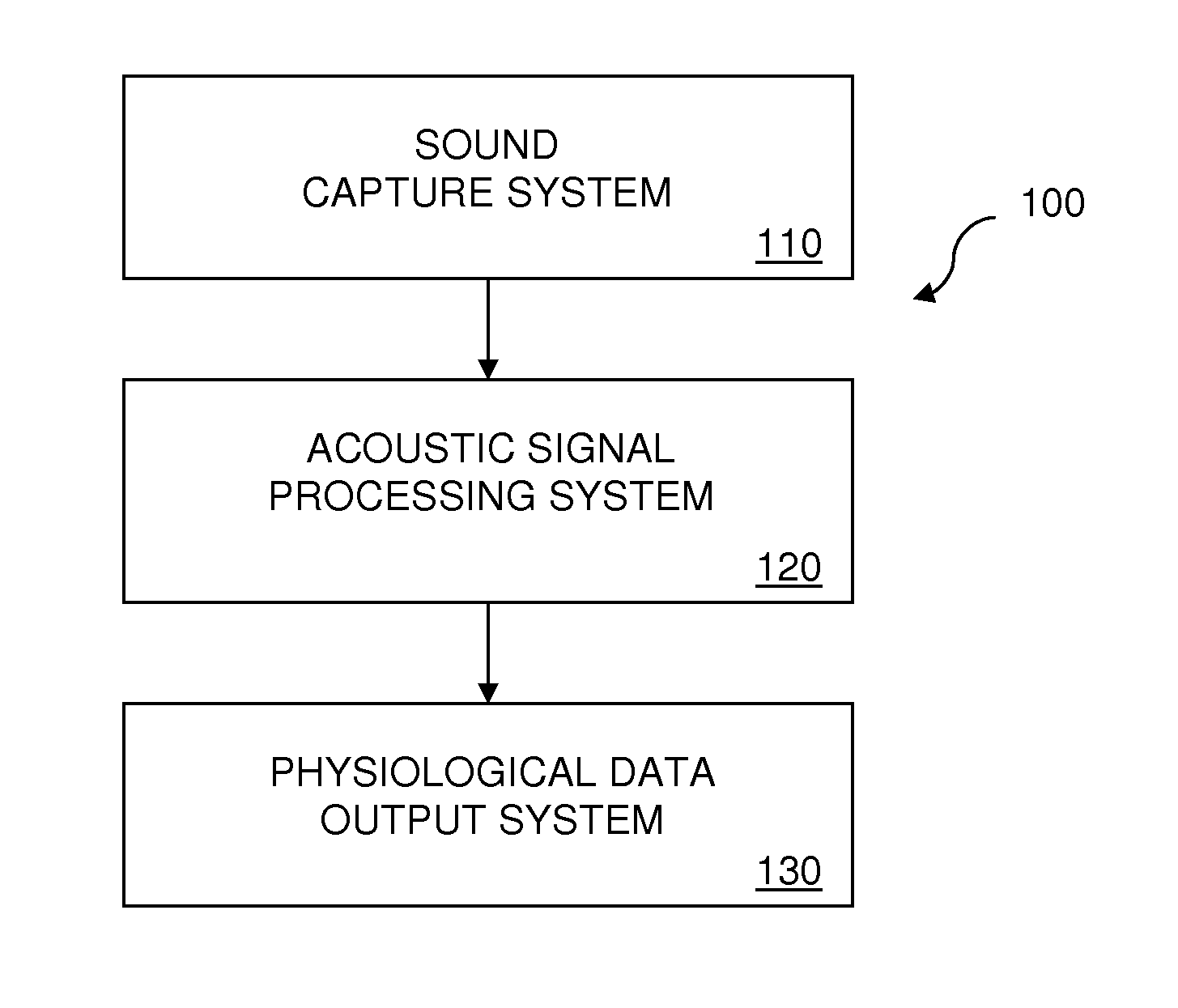
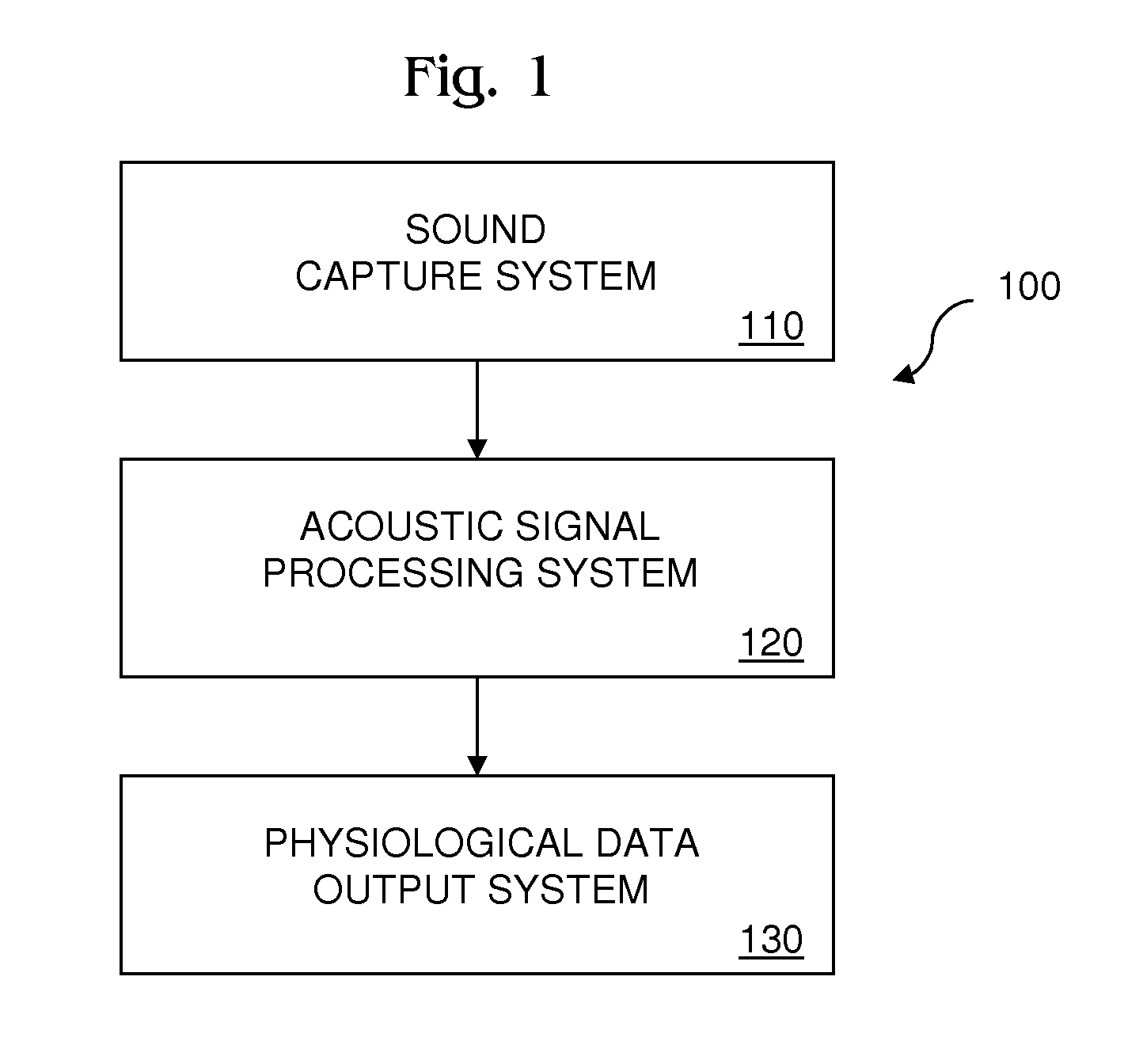
[0028]FIG. 1 shows a physiological monitoring system 100 in some embodiments of the invention. Monitoring system 100 includes a sound capture system 110, an acoustic signal processing system 120 and a physiological data output system 130, which are communicatively coupled in series.
[0029]Capture system 110 includes a sound transducer that detects body sound, including respiration sound and heart sound, at a detection point, such as the trachea, chest or back of a person being monitored, and continually transmits a mixed acoustic signal containing the detected body sound to processing system 120. Capture system 110 may include, for example, a microphone positioned on the body of a human subject that detects the body sound. Capture system 110 also includes an amplifier, a lowpass filter and an analog / digital (A / D) converter that transform the detected body sound into the mixed signal. Detected body sounds are represented in the mixed signal as a time sequence of digital samples of var...
PUM
 Login to View More
 Abstract
Description
Claims
Application Information
 Login to View More