
Downlink Data Collision Avoidance Method, Access Point and Station
a data collision and access point technology, applied in the field of wireless communication, can solve the problems of difficult detection of collisions, and increasing the number of stas which cannot be listened for each other, so as to save the link overhead and avoid collisions.
- Summary
- Abstract
- Description
- Claims
- Application Information
AI Technical Summary
Benefits of technology
Problems solved by technology
Method used
Image

Examples
embodiment one
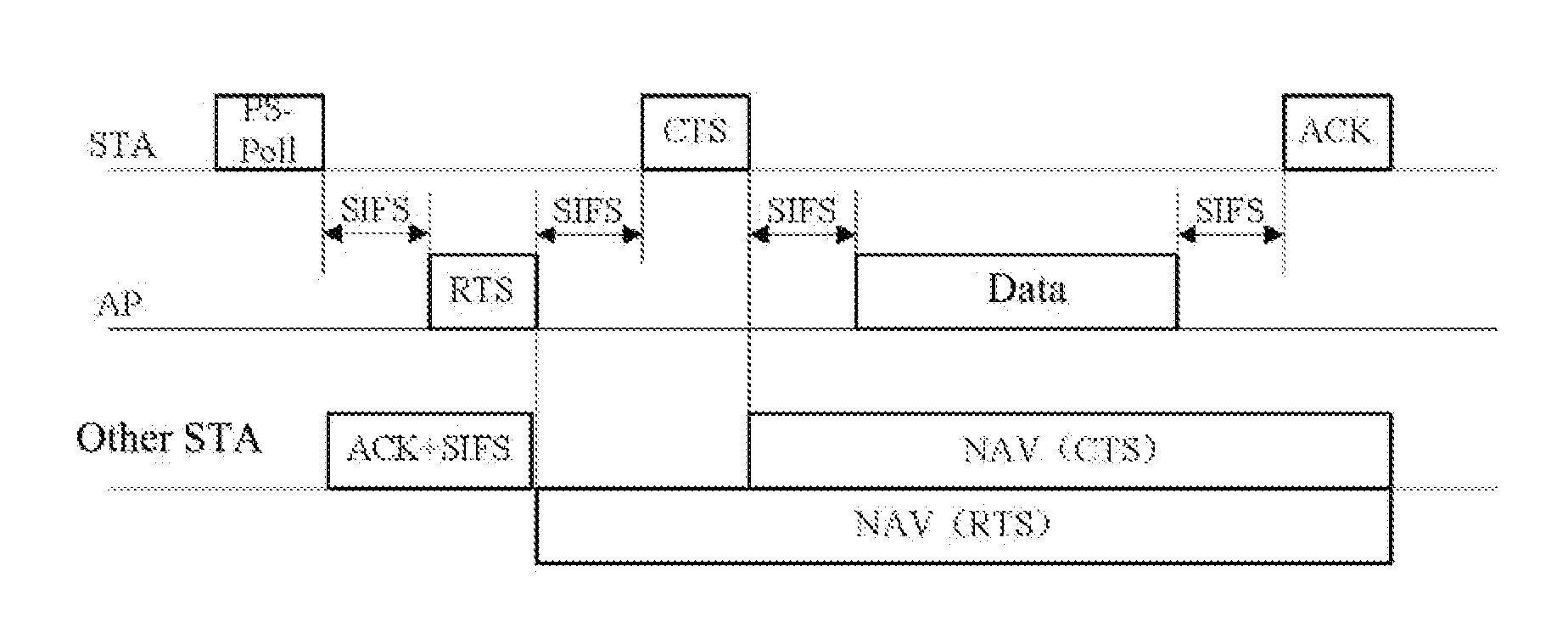
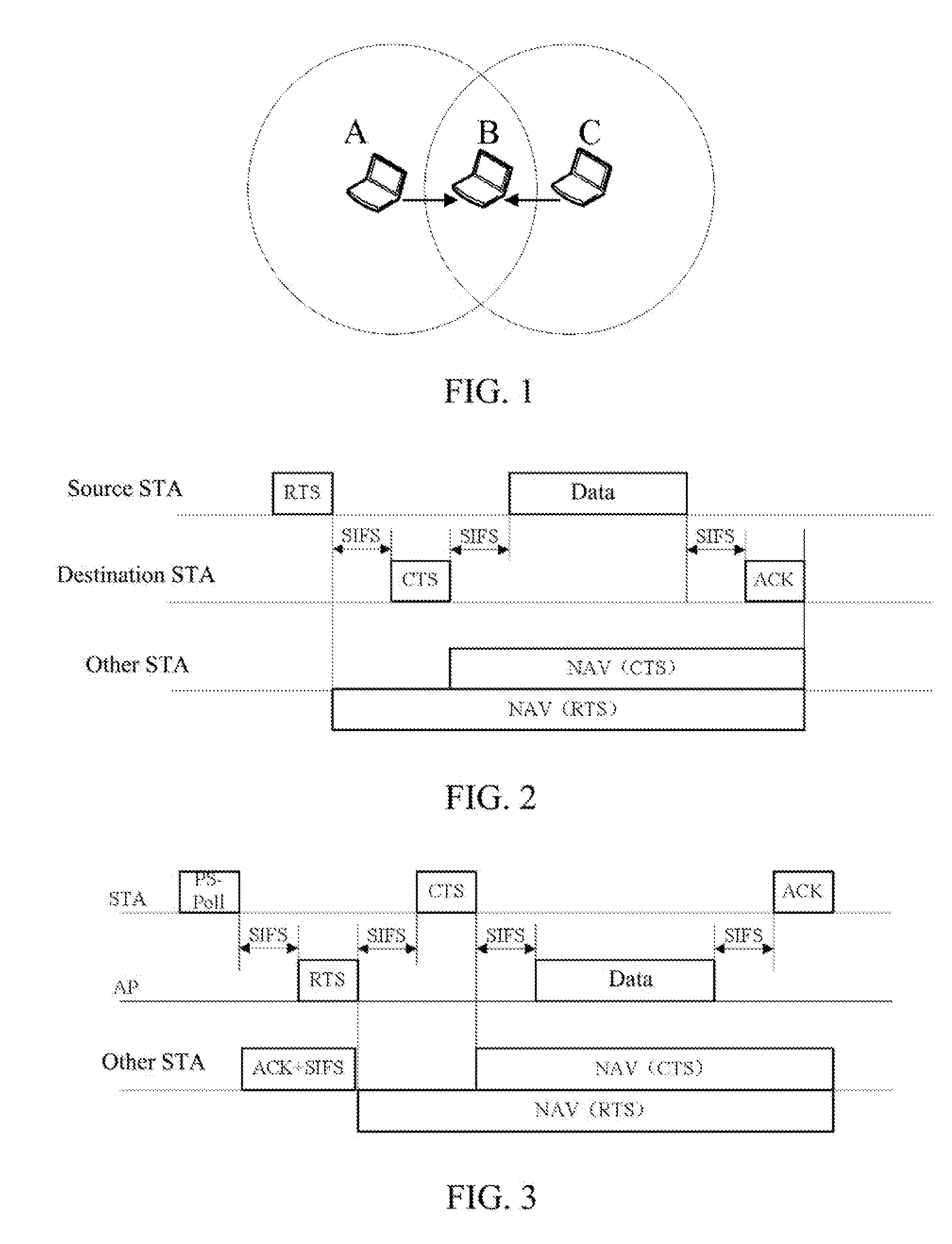
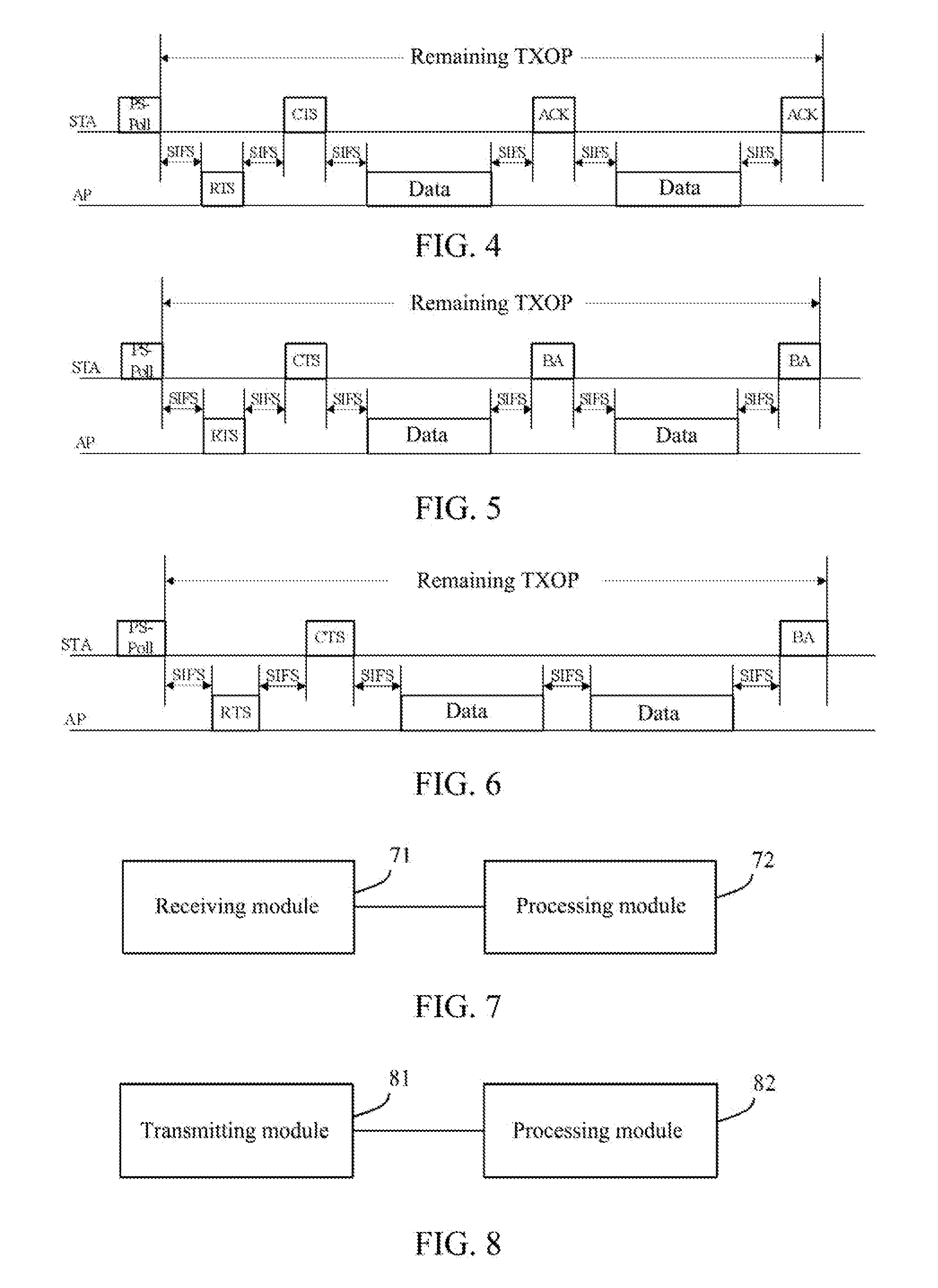
[0061]The present embodiment is an embodiment using a transmission method for avoiding downlink data collision according to the present document. In the present embodiment, the implementation of downlink data transmission primarily includes the following steps.
[0062]An STA notifies the above predetermined threshold or negotiates the above predetermined threshold with an AP in an association process.
[0063]The STA in a power saving mode actively awakes, transmits a PS-Poll frame, and inquires whether the AP has a BU of the STA; and after receiving the PS-Poll transmitted by the STA in the PS mode, the AP makes a response according to a condition of the BU of the STA:
[0064]When the AP does not have the BU of the STA, the AP transmits an ACK indicating that there is no BU. When the AP has the BU of the STA, the AP responds with an ACK indicating that there is a BU, or when the BU is less than the threshold value negotiated above, the AP can directly respond with the BU, or when the BU i...
embodiment two
[0069]In the present embodiment, the above predetermined threshold is configured using a system default parameter.
[0070]The STA in a power saving mode actively awakes, transmits a PS-Poll frame, and inquires whether the AP has a BU of the STA. After receiving the PS-Poll transmitted by the STA in the PS mode, the AP makes a response according to a condition of the BU of the STA:
[0071]When the AP does not have the BU of the STA, the AP transmits an ACK indicating that there is no BU. When the AP has the BU of the STA, the AP responds with an ACK indicating that there is a BU, or when the BU is less than the threshold value negotiated above, the AP can directly respond with the BU, or when the BU is larger than the threshold value negotiated above, the AP firstly transmits a RTS to reserve a channel, wherein, the channel reservation time of the RTS is set to a time required for transmitting data.
[0072]When the STA which transmits the PS-Poll receives the RTS frame, the STA will respon...
embodiment three
[0076]The present embodiment is an embodiment using a transmission method for avoiding downlink data collision according to the present document. In the present embodiment, the implementation of downlink data transmission primarily includes the following steps.
[0077]In the present embodiment, an STA notifies the above predetermined threshold or negotiates the above predetermined threshold with an AP in an association process.
[0078]The STA in a power saving mode periodically awakes, listens for a traffic indication in the Beacon, and if it finds that the AP has a BU of its own, it will transmits a PS-Poll frame through competition; and after receiving the PS-Poll transmitted by the STA in the PS mode, the AP makes a response according to a condition of the BU of the STA:
[0079]When the AP does not have the BU of the STA, the AP transmits an ACK indicating that there is no BU. When the AP has the BU of the STA, the AP responds with an ACK indicating that there is a BU, or when the BU i...
PUM
 Login to View More
 Abstract
Description
Claims
Application Information
 Login to View More