
Mobile instrument assembly for use as part of a medical/surgical waste collection system, the assembly including a vacuum source to which a mobile waste collection cart can be releasably attached
a technology for medical/surgical waste collection and mobile instruments, applied in the field of waste collection systems, can solve the problems of reducing the extent to which the suction tubing is used, clutter, and the surgical personnel are present around, and reducing their utility
- Summary
- Abstract
- Description
- Claims
- Application Information
AI Technical Summary
Benefits of technology
Problems solved by technology
Method used
Image

Examples
first embodiment
II. First Embodiment
A. Mobile Chassis
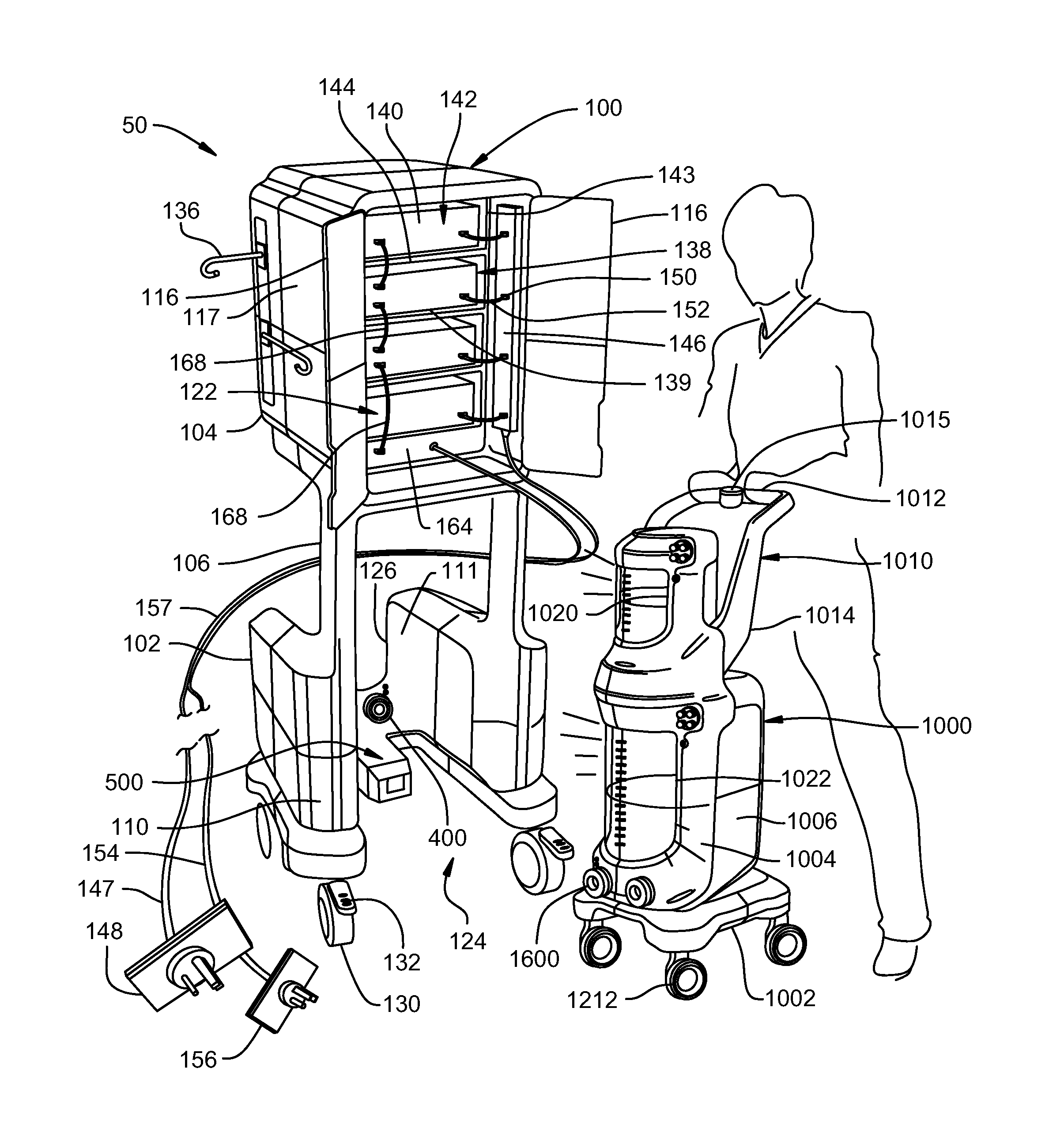
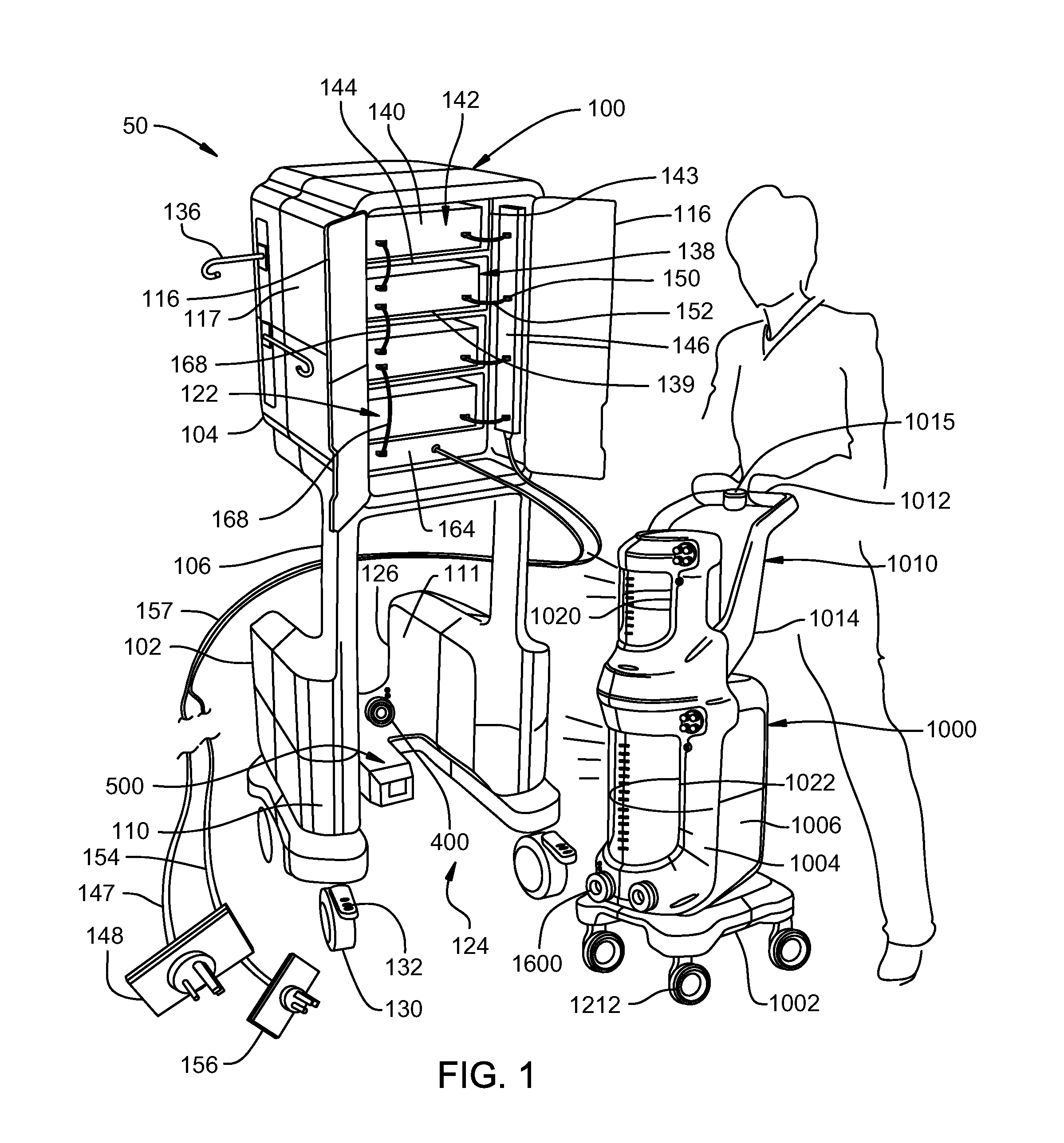
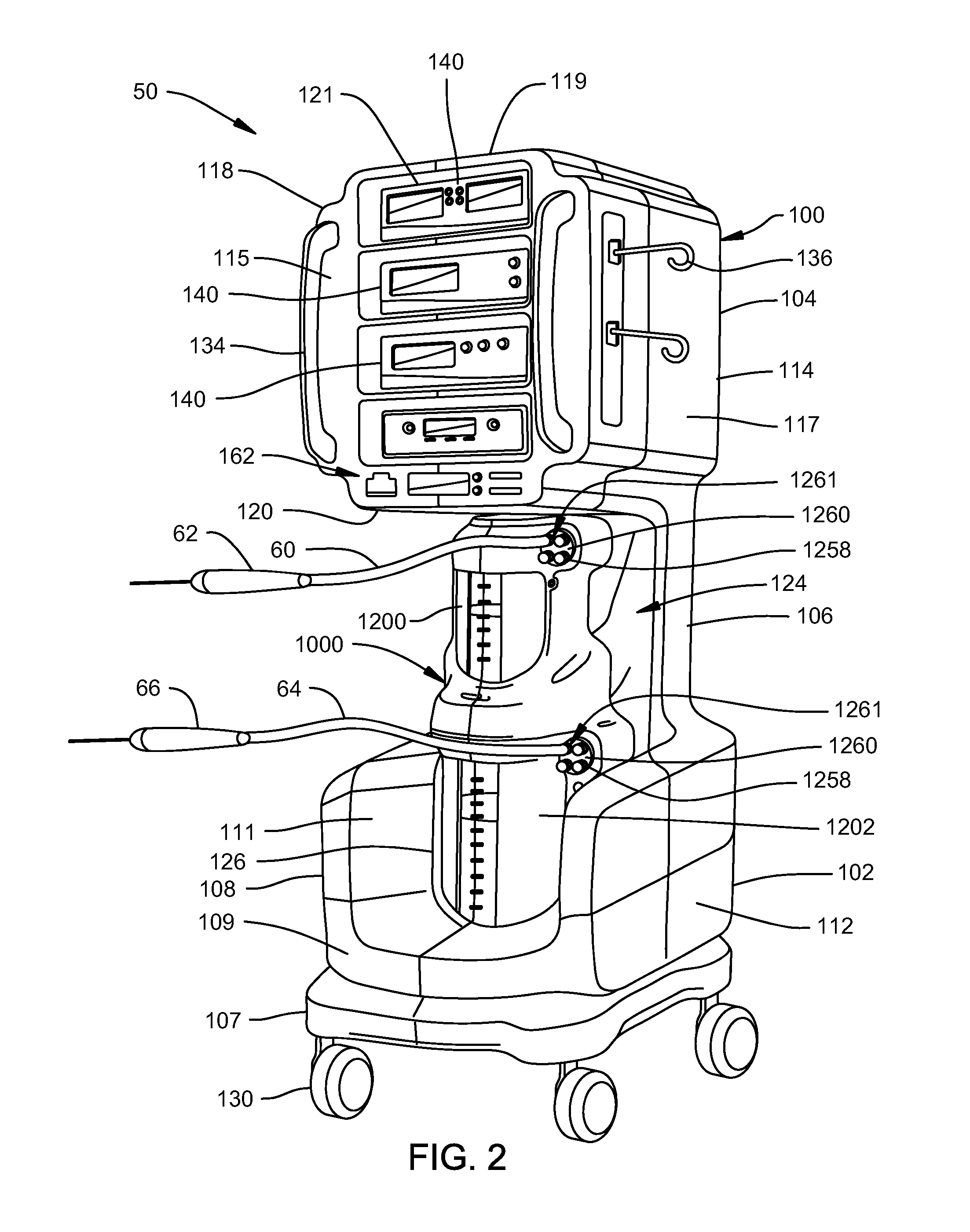
[0074]Turning to FIGS. 1 and 2, mobile chassis 100 of the first embodiment of this invention is illustrated. Mobile chassis 100 comprises a generally rectangular lower chassis 102 and a generally rectangular upper chassis 104. Upper chassis 104 is supported above lower chassis 102 by a pair of spaced apart supports 106. Lower chassis 102 has outer covers 107 and 108. Outer cover 108 includes a U-shaped front panel 109, rear panels 110, inner panels 111 and outer panels 112. Upper chassis 104 has an outer cover 114 that includes a front panel 115, a pair of rear doors 116, side panels 117, 118, top panel 119 and bottom panel 120. Front panel 115 has several rectangular shaped openings 121. An interior cavity 122 is defined within upper chassis 104.
[0075]Covers 107, 108, 114 and doors 116 can be formed from injection molded plastic or other suitable materials and are attached to lower chassis 102 and upper chassis 104 by suitable methods such as th...
second embodiment
III. Second Embodiment
[0188]FIG. 25 illustrates an alternative embodiment of a medical / surgical waste collection system 2000 constructed in accordance with the present invention. Waste collection system 2000 comprises a mobile chassis 2100 and a mobile rover 2500. Mobile rover 2500 is the same as described in the first embodiment except that the shapes and sizes of some of the exterior components have been changed. The internal components and operation of mobile rover 2500 are the same as for mobile rover 1000. Mobile chassis 2100 is sometimes called a suction cart 2100. Mobile rover 2500 is sometimes called a container cart 2500.
[0189]Mobile chassis 2100 is similar to mobile chassis 100 of the first embodiment except that the upper chassis 104 (FIG. 1) has been omitted. Mobile chassis 2100 is generally rectangular in shape and includes a generally planar top cover 2104 that extends over four outer side walls 2106 of mobile chassis 2100. Handles 2108 are attached to one or more wall...
third embodiment
IV. Third Embodiment
A. Mobile Chassis
[0190]Turning to FIGS. 26 and 28, waste collection system 3000 includes a chassis 3100 and a mobile rover 4000. Rover 4000 can be mated with the chassis 3100. Chassis 3100 is sometimes called a suction cart 3100. Mobile rover 4000 is sometimes called a container cart 4000. With specific reference to FIG. 26, chassis 3100 is generally rectangular in shape and has a lower chassis 3102 and an upper chassis 3104. Chassis 3100 has an inner frame that supports several outer molded covers 3108. Covers 3108 include front panel 3109, rear panel 3110, side panels 3111 and top panel 3112.
[0191]Covers 3108 can be formed from molded plastic and attached to lower chassis 3102 and upper chassis 3104 by suitable methods such as through the use of fasteners. Covers 3108 are used to protect the internal components of chassis 3100 and to provide improved visual aesthetics. A receptacle or void space 3124 is defined in front panel 3109. Void space 3124 receives mobi...
PUM
 Login to View More
 Abstract
Description
Claims
Application Information
 Login to View More