
Memory controller
a memory controller and controller technology, applied in the field of memory controllers, can solve the problems of nullifying stealing the cryptographic key by a malicious third party, and unable to ensure the security so as to facilitate the duplication of the data stored in the semiconductor memory
- Summary
- Abstract
- Description
- Claims
- Application Information
AI Technical Summary
Benefits of technology
Problems solved by technology
Method used
Image

Examples
first embodiment
1. Configuration of Memory System
[0040]{1.1 Overall Configuration}
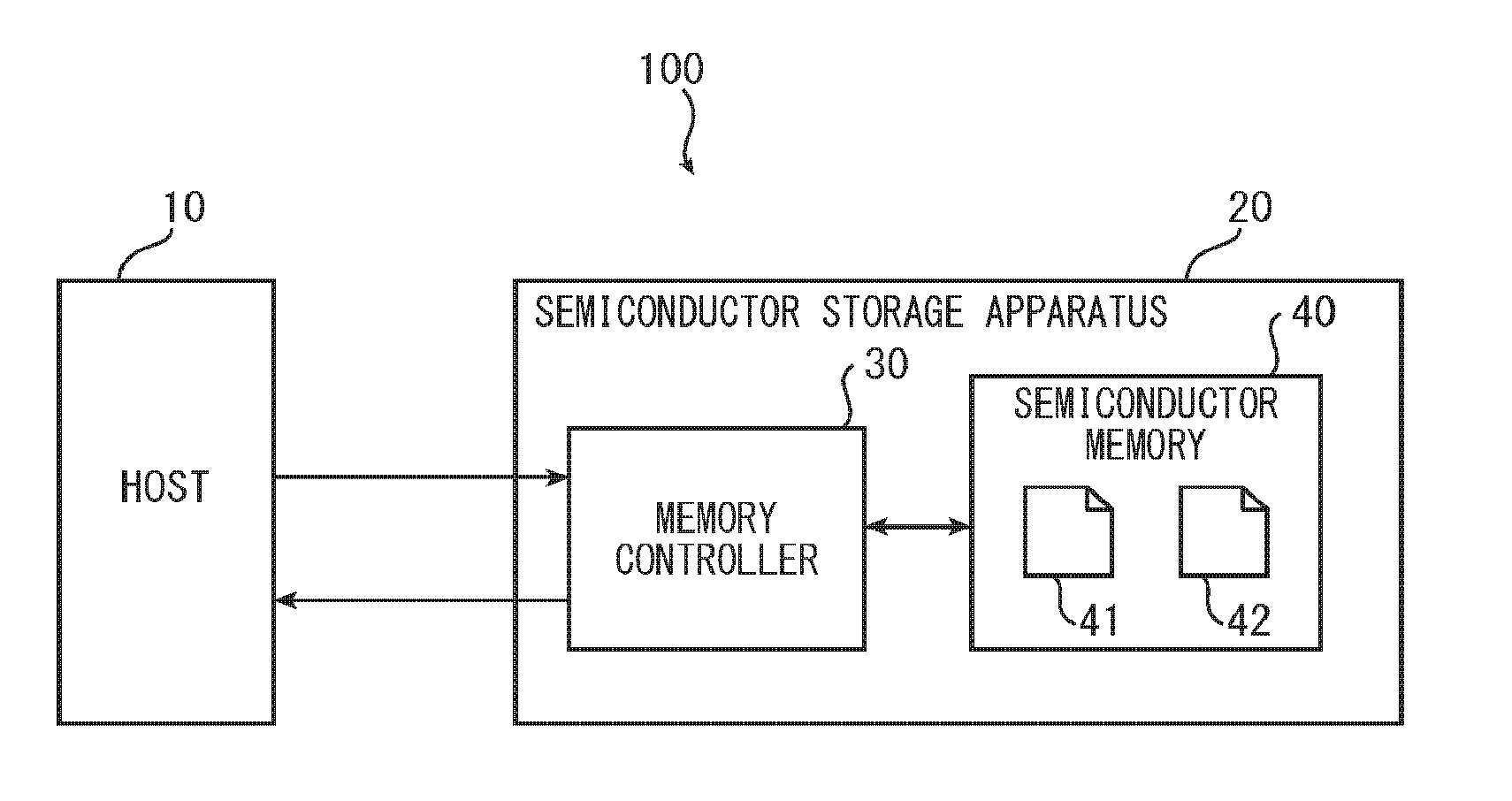
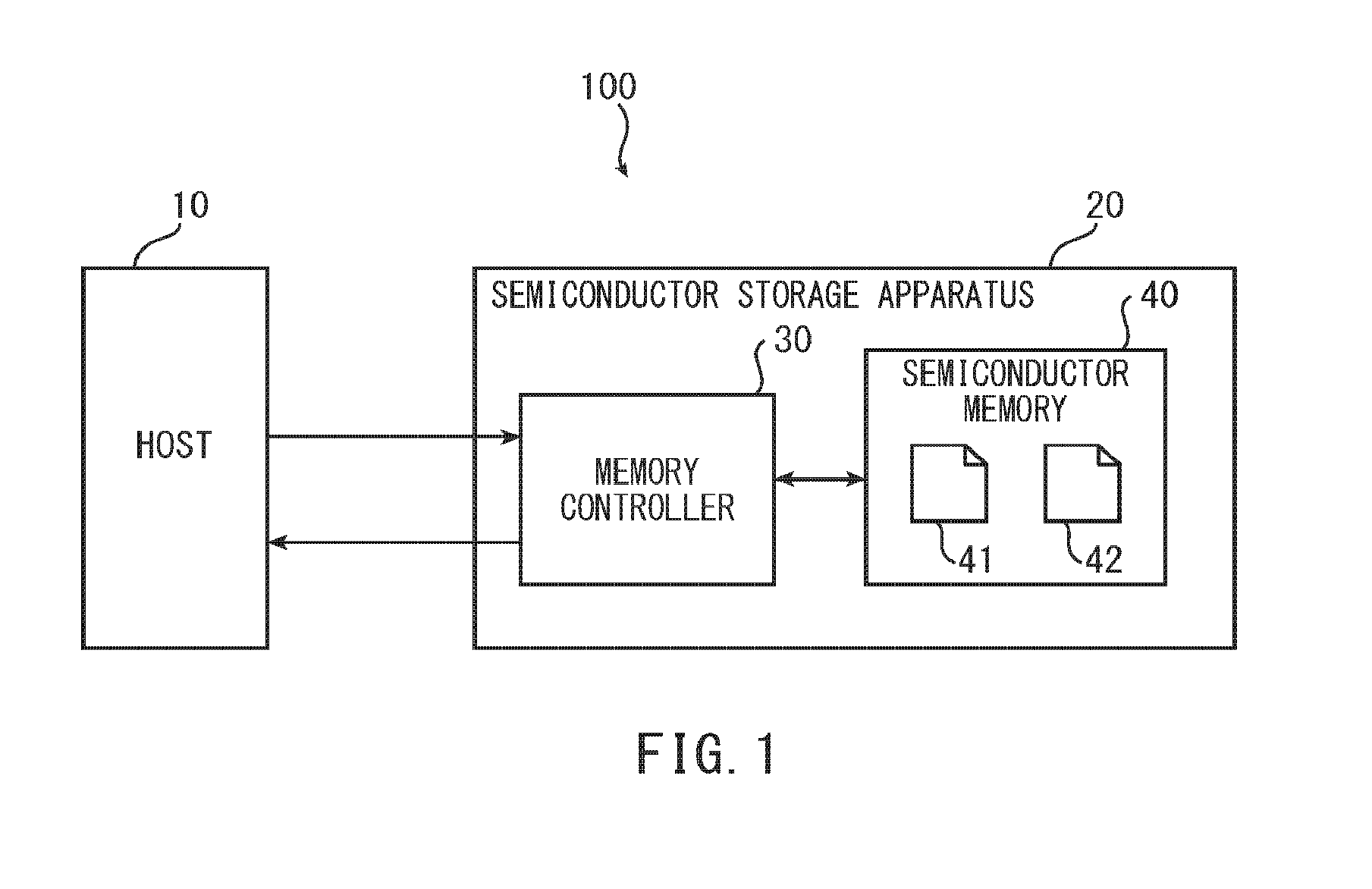
[0041]FIG. 1 is a functional block diagram of a memory system 100 according to a first embodiment of the present invention. As shown in FIG. 1, the memory system 100 includes a host 10 and a semiconductor storage apparatus 20. The semiconductor storage apparatus 20 includes a memory controller 30 and a semiconductor memory 40.
[0042]In response to a request from the host 10, the memory controller 30 accesses the semiconductor memory 40.
[0043]The semiconductor memory 40 is non-volatile, and may be a NAND flash memory, for example. The semiconductor memory 40 stores a program 41 and content data 42 that can be used by the host 10. The program 41 is a program for using the content data 42.
[0044]{1.2 Configuration of Host 10}
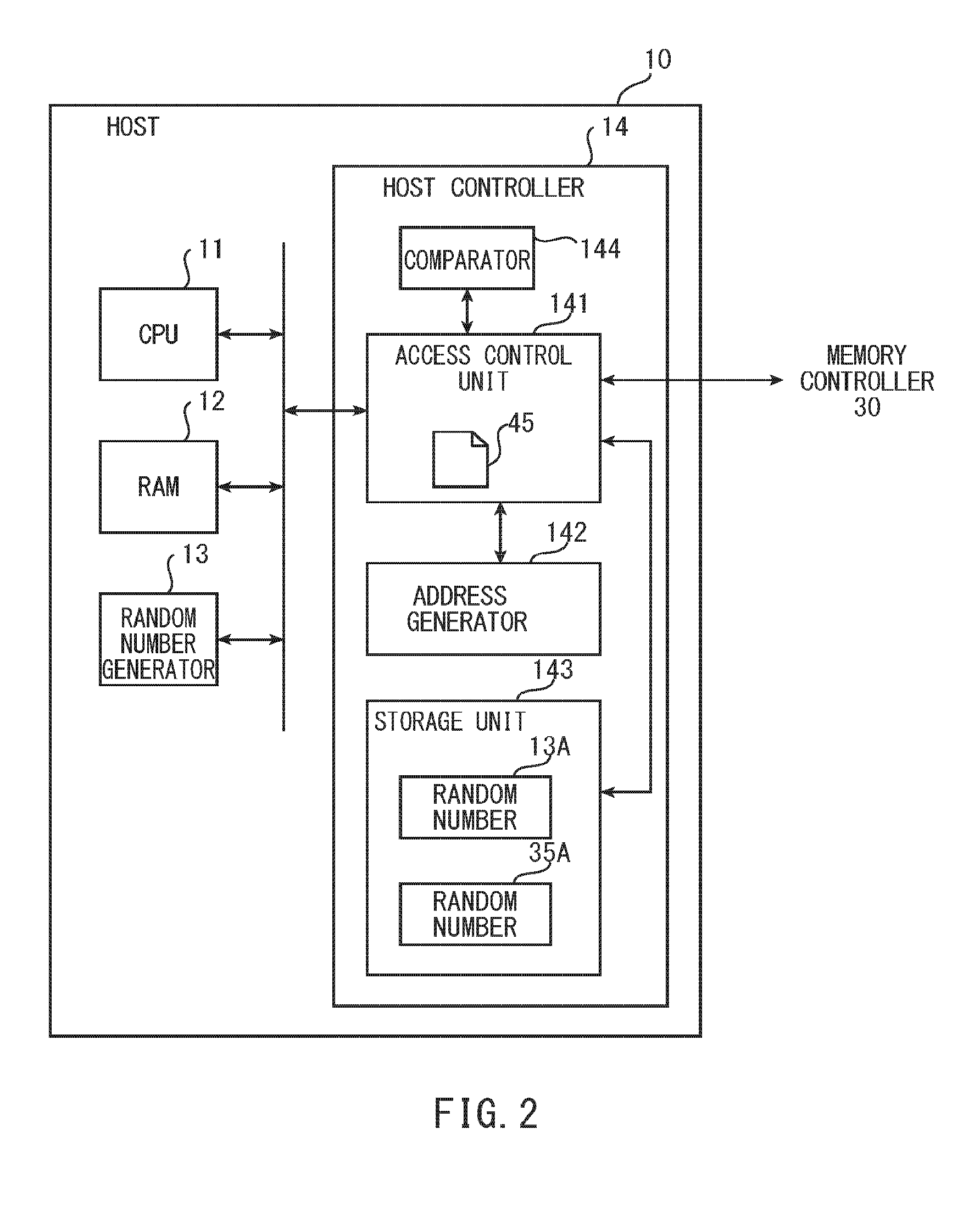
[0045]FIG. 2 is a functional block diagram of the host 10 shown in FIG. 1. As shown in FIG. 2, the host 10 includes a central processing unit (CPU) 11, a random access memory (RAM) 12, a random number ...
second embodiment
1. Configuration of Memory System
[0139]{1.1 Overall Configuration}
[0140]FIG. 12 is a functional block diagram of a memory system 500 according to a second embodiment of the present invention. As shown in FIG. 12, the memory system 500 includes a host 50 and a semiconductor storage apparatus 60. The semiconductor storage apparatus 60 includes a memory controller 70 and a semiconductor memory 80.
[0141]In response to a request from the host 50, the memory controller 70 accesses the semiconductor memory 80.
[0142]The semiconductor memory 80 is non-volatile, and may be a NAND flash memory, for example. The semiconductor memory 80 stores a program 81, content data 82 and specified address data 83. The program 81 is a program for using the content data 82. The specified address data 83 is used to decide whether the memory controller 70 should perform the fixed latency process or variable latency process. The fixed latency process and variable latency process will be described in detail furt...
PUM
 Login to View More
 Abstract
Description
Claims
Application Information
 Login to View More