Transient electronic device
a technology of electronic devices and transients, applied in the direction of reclaiming serviceable parts, cell components, secondary cell servicing/maintenance, etc., can solve the problems of metallic thin-film transiency, even for very small thickness, and slow deposited bulk, so as to reduce the break point viscosity and reduce the viscosity
- Summary
- Abstract
- Description
- Claims
- Application Information
AI Technical Summary
Benefits of technology
Problems solved by technology
Method used
Image

Examples
example 1
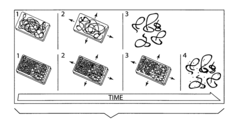
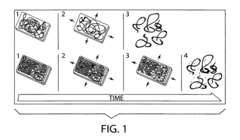
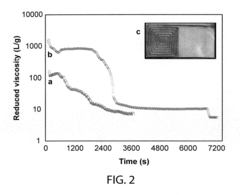
[0027]This Example demonstrates fabrication of conductive electronic components of a transient electronic device utilizing deposited and re-dispersible colloidal metal particles to achieve fast and coordinated deconstruction and transiency of polymeric substrate and electronic components in transient electronic devices. This Example demonstrates realization of controlled transiency by eliminating limiting factors posed by slow dissolution rate of metals and demonstrates that, if colloidal metal particles are used for conductive paths, the transiency of polymer-based substrates, which is easier to control, can be used to program transiency of the whole system, unlike conventional transient electronics.
[0028]Experimental
[0029]Preparation of Substrates:
[0030]Poly(vinyl alcohol) (PVA) (Mowiol 10-98, MW: 61,000 g mol′, 98.0-98.8 mol% hydrolysis) and sucrose were purchased from the Sigma Aldrich and used as received. To prepare polymer membranes with different PVA:sucrose ratio, desired a...
example 2
[0064]As mentioned above, in the very recent years, researchers have developed a wide range of transient electronic devices capable of performing a variety of functions and responsive to a variety of triggering mechanisms including exposure to light, heat or solvent (often aqueous). What is common among all these reported transient devices is the need for an external power source. The power is either supplied by inducting coils from a very close distance, or from external power supplies. To realize autonomous transient electronic devices, similar to conventional ones, a transient battery is essential. Thus far, there has been limited efforts in design and construction of transient batteries, mainly due to the lack of soluble proper materials. Jimbo et al. in Sensors and Actuators B; Chemical 2008, 134, 219-224, reported swallowable batteries based on Zn and Pt electrodes and ceramic porous separator; maximum potential of 0.42 V and current of 2.41 mA were achieved. More recently Kim...
PUM
| Property | Measurement | Unit |
|---|---|---|
| temperature | aaaaa | aaaaa |
| thickness | aaaaa | aaaaa |
| diameter | aaaaa | aaaaa |
Abstract
Description
Claims
Application Information
 Login to View More