p63 INACTIVATION FOR THE TREATMENT OF HEART FAILURE
Active Publication Date: 2018-03-08
BAYLOR COLLEGE OF MEDICINE
View PDF0 Cites 3 Cited by
Summary
Abstract
Description
Claims
Application Information
AI Technical Summary
This helps you quickly interpret patents by identifying the three key elements:
Problems solved by technology
Method used
Benefits of technology
Benefits of technology
The patent text describes the discovery that inactivation of certain genes (p63, p53, and p21) can increase the efficiency of converting cardiac fibroblasts into cardiomyocytes (the cells that make up the heart's walls). This is accomplished through a process called transdifferentiation, which offers a novel therapeutic approach for treating cardiac medical conditions like heart failure. The invention is useful because it allows for the conversion of fibroblasts to cardiomyocytes with greater efficiency, potentially improving the effectiveness of cell-based therapies for cardiac conditions.
Problems solved by technology
Nevertheless, the major obstacle in the implementation of this therapy is the low efficiency of reprogramming.
Method used
the structure of the environmentally friendly knitted fabric provided by the present invention; figure 2 Flow chart of the yarn wrapping machine for environmentally friendly knitted fabrics and storage devices; image 3 Is the parameter map of the yarn covering machine
View more
Image
Smart Image Click on the blue labels to locate them in the text.
Viewing Examples
Smart Image
Click on the blue label to locate the original text in one second.
Reading with bidirectional positioning of images and text.
Smart Image
Examples
Experimental program
Comparison scheme
Effect test
example 1
P63 Inactivation Increases the Transdifferentiation Efficiency of Fibroblasts into Cardiomyocytes
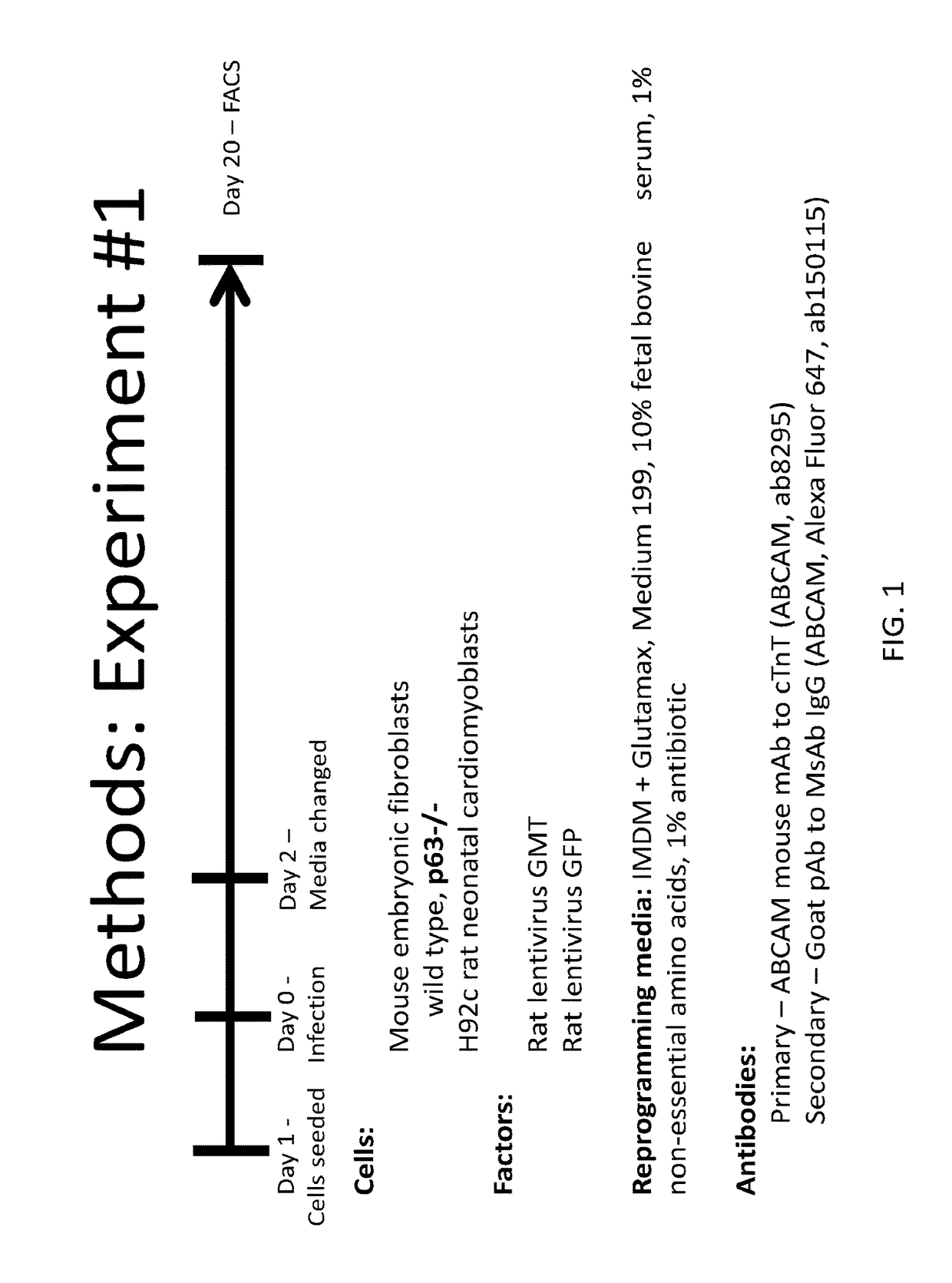
[0286]Cellular regenerative therapy has emerged as a treatment for a number of degenerative diseases, most notably ischemic heartdisease, which is the number one cause of death in the world. Several strategies have been proposed, including transdifferentiation and the formation of induced pluripotent stem cells. Transdifferentiation has been attempted with transcription factors such as Gata4, Mef2c and Tbx5 (GMT), while iPS cells may be formed using the Yamanaka factors (Oct4, Sox2, Klf4, c-myc) or knocking down genes involved in regulating the cell cycle, such as p53.
[0287]While it has been reported that murine cells that are p63 deficient display a high degree of plasticity, no distinct strategy has been developed for their application in ischemic heartdisease. Specifically, it has not been described how the p63 deficient cells may be “driven” down the cardiomyocyte lineage. The atta...
example 2
P63 Inactivation and Addition of Hand2, Myocardin Increases Formation of Ctnt+ Cells from Murine Embryonic Fibroblasts
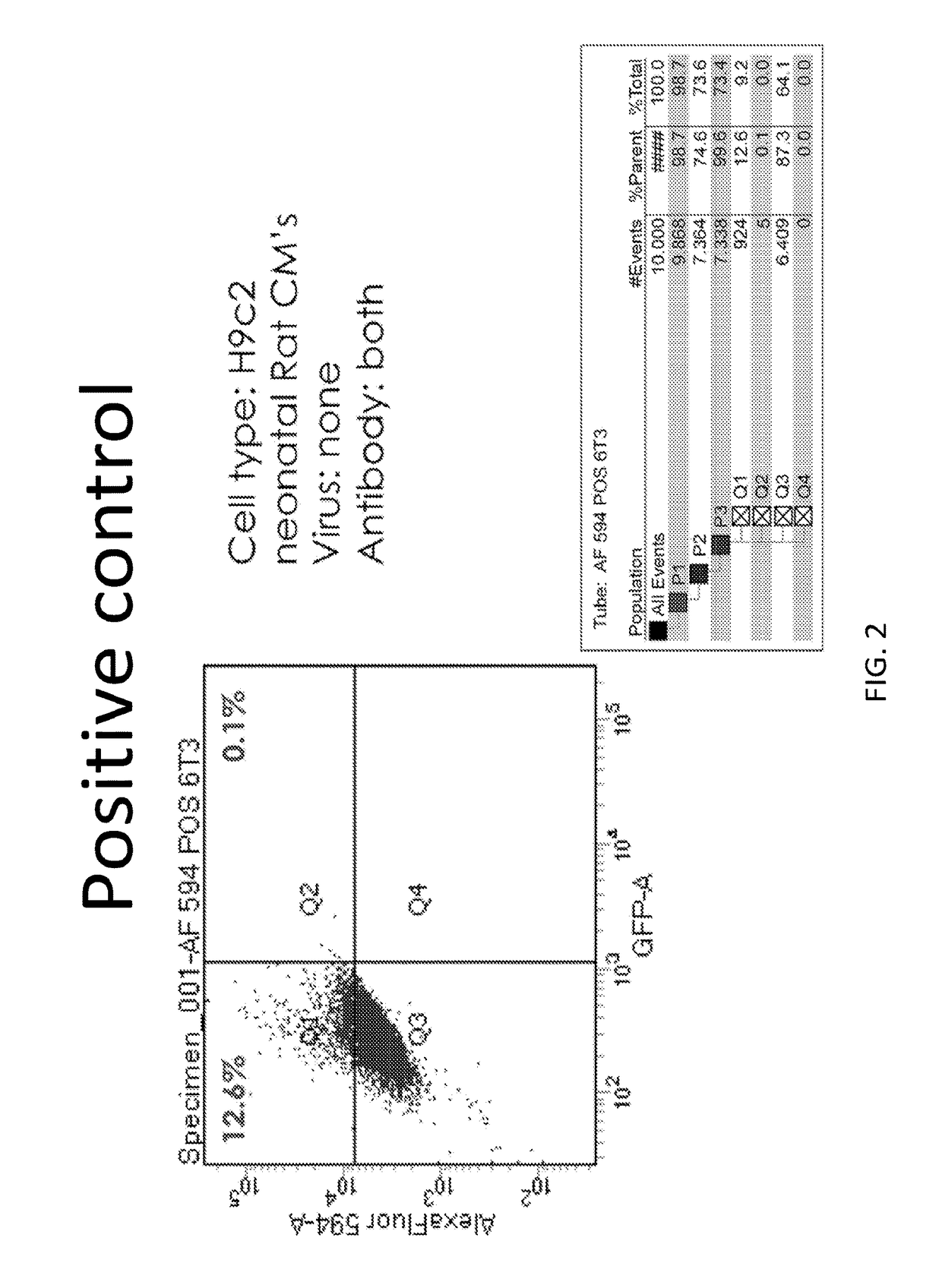
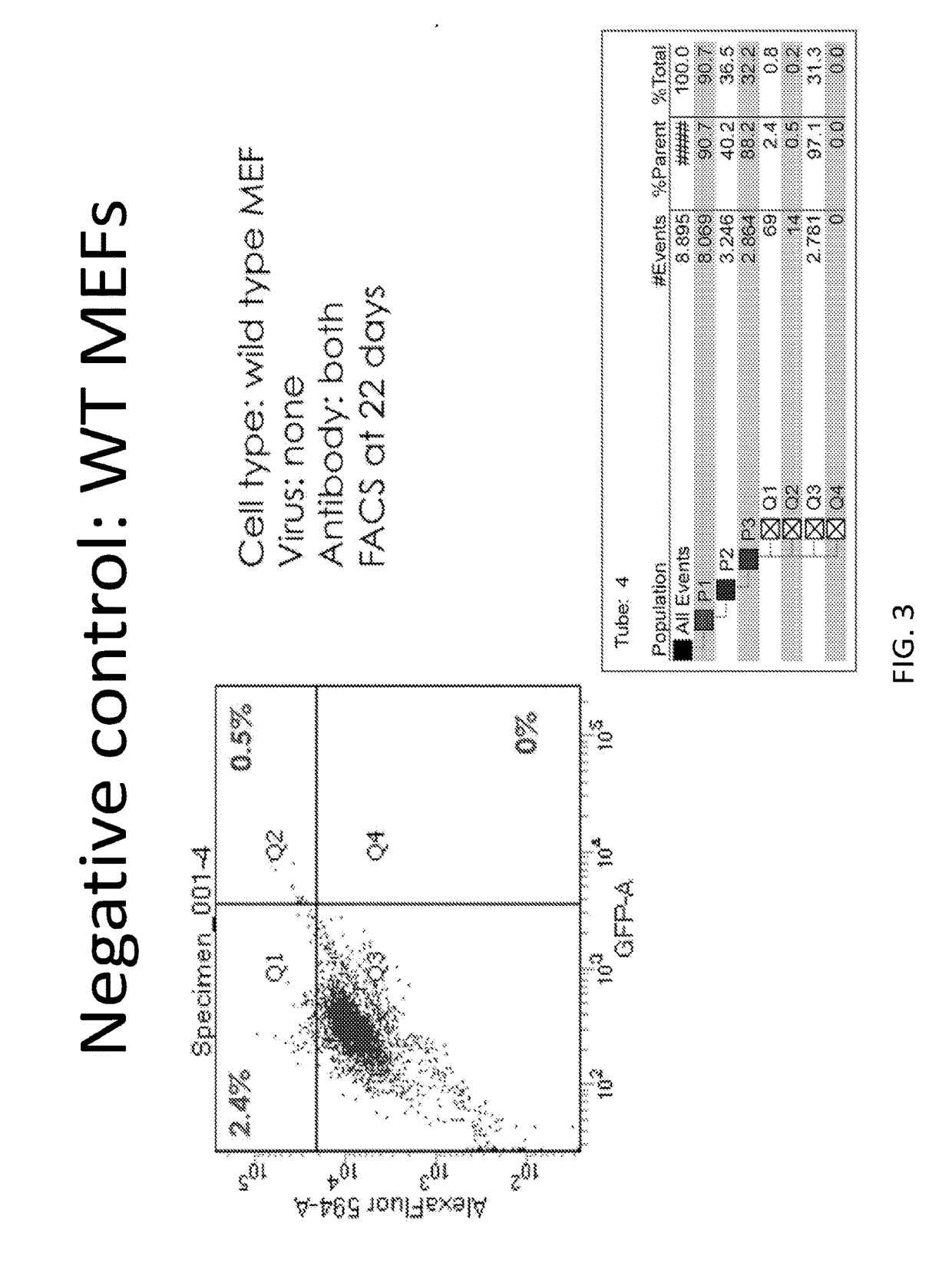
[0291]FIG. 12 illustrates an experimental design for analyzing transdifferentiation of fibroblasts into cardiomyocytes in vitro. FIG. 13 shows FACS data for unstained and stained wild-type MEFs (negative controls). FIG. 14 shows wild type MEFs treated with lentiviral GFP and lentiviral GMT. In FIG. 15, wild-type MEFs were given the noted factors (lentiviral Hand2 & Myocardin) and exposed to both antibodies. In FIG. 16, shows a positive control, h9c2 neonatal rat cardiomyoblasts. FIG. 17 shows the p63 − / − (which concerns the inactivation of both the TA and Delta isoforms of the p63 gene) MEFs where no factors were provided. The left side shows the control stained with only the secondary antibody while the right shows cells stained with both antibodies. FIG. 18 demonstrates the double KO p63− / − MEFs where GFP (left side shows staining only with secondary as a control w...
example 3
P63 Inactivation and the Addition of Several Other Factors May Further Enhance the Transdifferentiation of Fibroblasts into Cardiomyocytes
[0294]Examples 1 and 2 illustrated two embodiments of applications of this disclosure. However, there are several other transcription factors that may be used to further enhance the efficiency: Gata4, Mef2c, Tbx5, miR-133, miR-1, Oct4, Klf4, c-myc, Sox2, Mesp1, Brachyury, Nkx2.5, ETS2, ESRRG, Mrtf-A, MyoD, ZFPM2 (in nucleic acid or polypeptide or peptide form, in specific embodiments). Adjunctive therapy could comprise ITD-1 (TGF beta inhibitor), VEGF, surgery (coronary artery bypass), PCI, or medial therapy, for example.
the structure of the environmentally friendly knitted fabric provided by the present invention; figure 2 Flow chart of the yarn wrapping machine for environmentally friendly knitted fabrics and storage devices; image 3 Is the parameter map of the yarn covering machine
Login to View More
PUM
Login to View More
Abstract
Embodiments of the disclosure include methods and compositions for in situ cardiac cell regeneration, including transdifferentiation of cardiac cells to cardiomyocytes. In particular embodiments, in situ cardiac cell regeneration encompasses delivery of p63 shRNA and one or both of Hand2 and myocardin, and in specific embodiments further includes one or more of Gata4, Mef2c, and Tbx5. In specific aspects of the disclosure, adult cardiac fibroblasts are reprogrammed into cardiomyocytes using viral vectors that harbor p63 shRNA and one or both of the transcription factors Hand2 and myocardin.
Description
[0001]This application claims priority to U.S. Provisional Patent Application Ser. No. 62 / 118,573, filed Feb. 20, 2015, which is incorporated by reference herein in its entirety.TECHNICAL FIELD[0002]Embodiments of the disclosure include at least the fields of molecular biology, cellbiology, cell therapy, and medicine, including cardiac medicine.BACKGROUND OF THE INVENTION[0003]Despite medical and surgical innovations, heart disease remains the number one cause of death in the world. Given the poor regenerative capacity of the heart following myocardial infarction and the irreversible loss of cardiomyocytes, the replacement of cardiomyocytes by forming induced pluripotent stem cells or stimulating direct cellular reprogramming are potential therapeutic strategies that hold great promise. Both technologies are rooted in the idea that endogenous fibroblasts within the infracted myocardium can be reprogrammed into functional cardiomyocytes. Several institutions have reported that a coc...
Claims
the structure of the environmentally friendly knitted fabric provided by the present invention; figure 2 Flow chart of the yarn wrapping machine for environmentally friendly knitted fabrics and storage devices; image 3 Is the parameter map of the yarn covering machine
Login to View More
Application Information
Patent Timeline
Application Date:The date an application was filed.
Publication Date:The date a patent or application was officially published.
First Publication Date:The earliest publication date of a patent with the same application number.
Issue Date:Publication date of the patent grant document.
PCT Entry Date:The Entry date of PCT National Phase.
Estimated Expiry Date:The statutory expiry date of a patent right according to the Patent Law, and it is the longest term of protection that the patent right can achieve without the termination of the patent right due to other reasons(Term extension factor has been taken into account ).
Invalid Date:Actual expiry date is based on effective date or publication date of legal transaction data of invalid patent.



 Login to View More
  Login to View More