

Treatment of age-related macular degeneration and other eye diseases with one or more therapeutic agents
a technology of age-related macular degeneration and other eye diseases, applied in the direction of antibody medical ingredients, peptide/protein ingredients, drug compositions, etc., can solve the problems of patients' likely to lose the central vision of the affected eye, vision loss, and vision impairment in the center of the visual field, so as to prevent or delay the onset of amd, prevent or slow the progression
- Summary
- Abstract
- Description
- Claims
- Application Information
AI Technical Summary
Benefits of technology
Problems solved by technology
Method used
Image

Examples
example 1
Reduction of Lipid Deposits from Bruch's Membrane in Geriatric Monkeys by L-4F
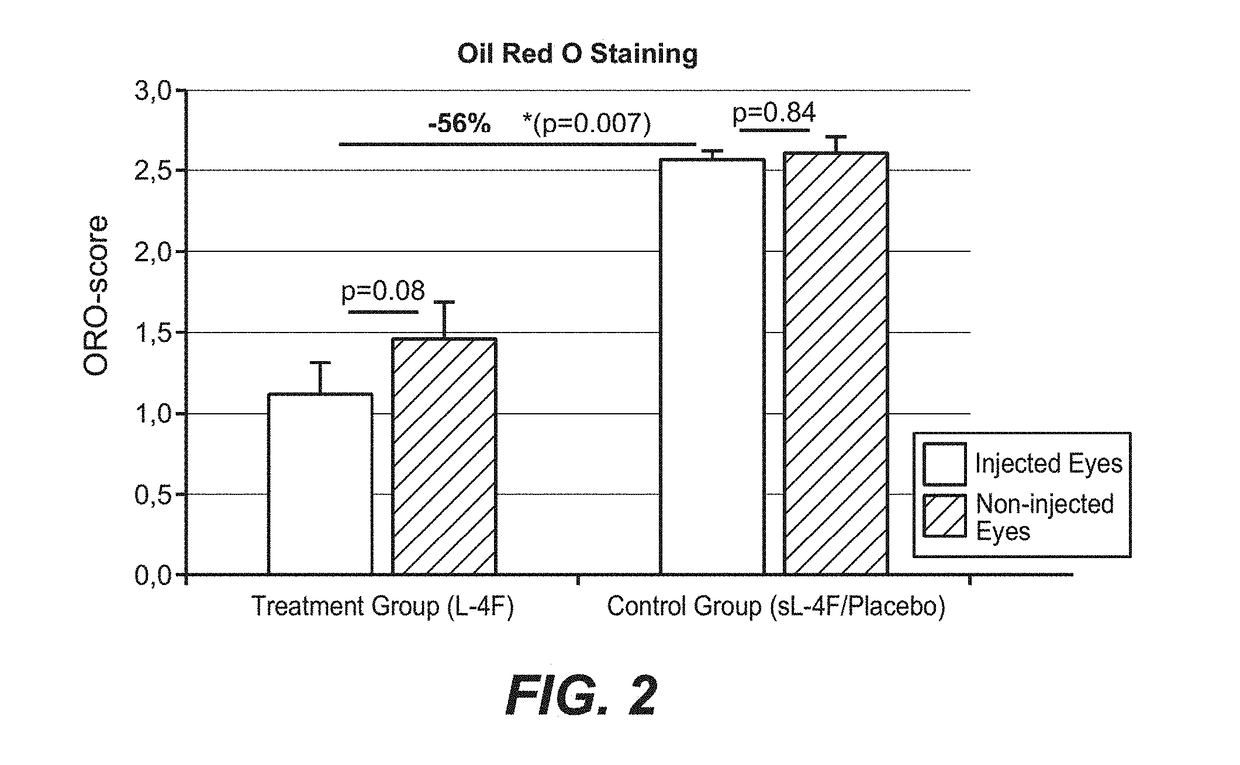
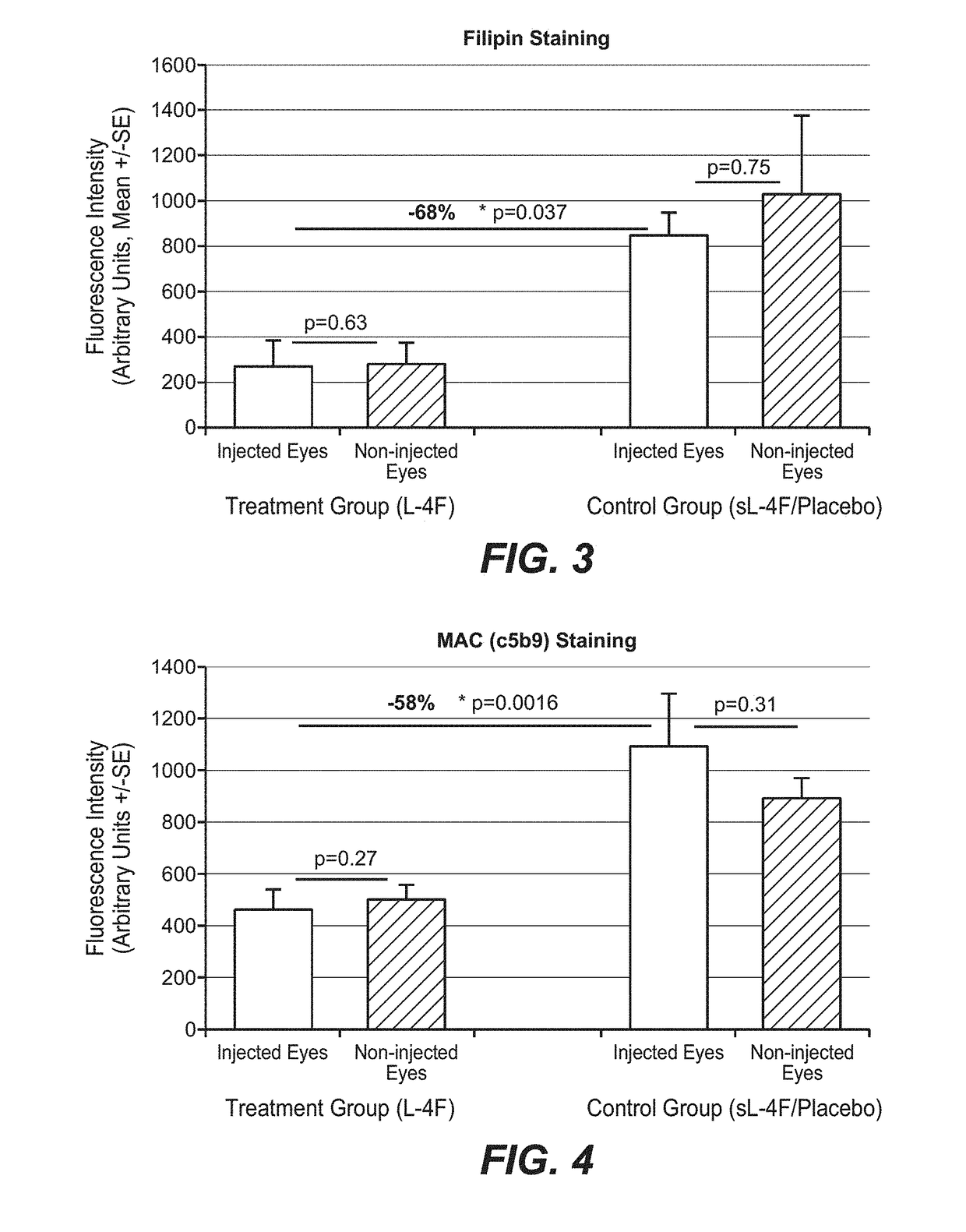
[0907]The macaque study was conducted according to accepted guidelines. Nine female geriatric macaques (Macaca fascicularis, all more than 20 years of age) with naturally occuring age-related maculopathy (exhibiting age-related drusenoid macular changes / maculopathy resembling early AMD in humans) were intravitreally injected with a sterile balanced salt solution (BSS) of the apoA-I mimetic L-4F, Ac-DWFKAFYDKVAEKFKEAF-NH2 acetate salt (SEQ. ID. NO. 13) (n=7), or a placebo (a sterile BSS of scrambled L-4F [sL-4F] having the same amino acids but in a non-functional order) (n=2). One eye per animal received 6 monthly injections of the same escalating dosages of L-4F or scrambled L-4F (total of 625 μg) in a 50 μL volume. The second eye per animal was not injected and was just observed. The injected eye exhibited worse drusenoid changes than the uninjected eye per animal at baseline. Table 1 shows the dosing reg...
example 2
Phase I / II Safety / Efficacy Studies of L-4F Alone
[0918]Randomized, open-label, dose-escalation Phase I / II studies are conducted to evaluate the safety, tolerability, pharmacokinetics and effective dose of L-4F or a variant (e.g., D-4F) or a salt (e.g., acetate salt) thereof administered (e.g., by intravitreal injection) to patients with AMD (e.g., intermediate-stage AMD). Soft drusen are a high-risk factor for progression of AMD and are clinically well-recognized lipid-rich sub-RPE-BL deposits that are hallmarks for AMD. The cumulative dose of L-4F until drusen reduction as well the maximum tolerated dose provide important information about the optimum L-4F dose(s) in other studies, including those where L-4F (or a variant or salt thereof) is administered in combination with one or more other therapeutic agents (e.g., an anti-angiogenic agent or a complement inhibitor) for the treatment of neovascular (wet) AMD or atrophic (dry) AMD.
[0919]In Phase I / II studies, L-4F or a variant (e.g...
example 3
Phase I / II Safety / Efficacy Studies of a Statin Alone
[0920]Randomized, open-label, dose-escalation Phase I / II studies are conducted to evaluate the safety, tolerability, pharmacokinetics and effective dose of a statin (e.g., atorvastatin [LIPITOR®] or a salt [e.g., calcium salt] thereof, or simvastatin [ZOCOR®]) administered (e.g., by intravitreal injection or eye drop) to patients with AMD (e.g., intermediate-stage AMD). Soft drusen are a high-risk factor for progression of AMD and are clinically well-recognized lipid-rich sub-RPE-BL deposits that are hallmarks for AMD. The cumulative dose of the statin until drusen reduction as well the maximum tolerated dose provide important information about the optimum statin dose(s) in other studies, including those where the statin or a salt thereof is administered in combination with one or more other therapeutic agents (e.g., an anti-angiogenic agent or a complement inhibitor) for the treatment of neovascular AMD or atrophic AMD.
[0921]In Ph...
PUM
| Property | Measurement | Unit |
|---|---|---|
| Time | aaaaa | aaaaa |
| Time | aaaaa | aaaaa |
| Time | aaaaa | aaaaa |
Abstract
Description
Claims
Application Information
 Login to View More