Incised prepreg, cross-ply laminate, and production method for incised prepreg (as amended)
a production method and prepreg technology, applied in the direction of layered products, synthetic resin layered products, chemistry apparatus and processes, etc., can solve the problems of unidirectional prepreg, high stiffness, and inability to easily stretch in the direction, etc., to achieve excellent mechanical properties, good surface quality, and excellent three-dimensional shape conformity
- Summary
- Abstract
- Description
- Claims
- Application Information
AI Technical Summary
Benefits of technology
Problems solved by technology
Method used
Image

Examples
example 1
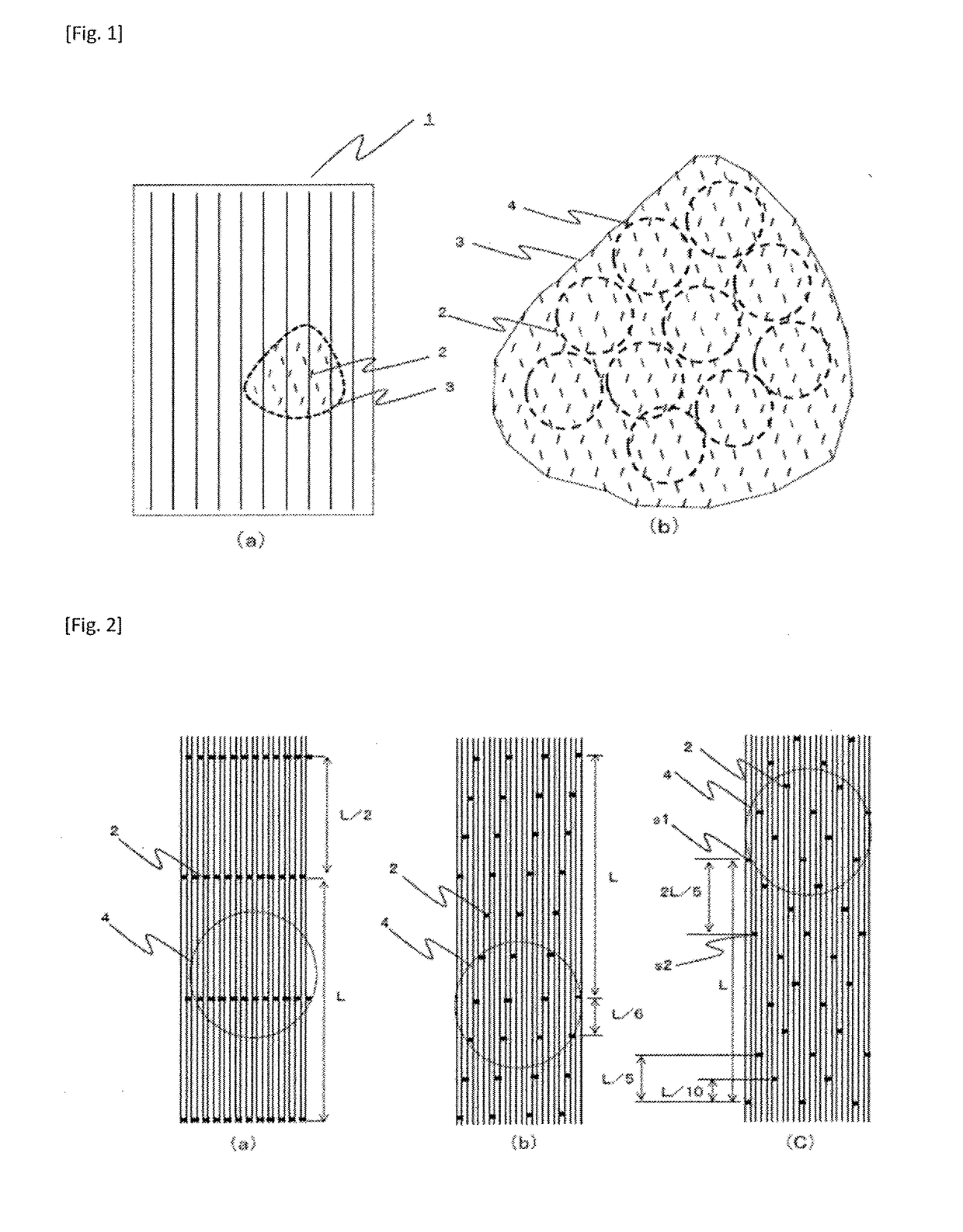
[0147]The incision pattern of incised prepregs was an incision pattern as in FIG. 15(a). The length of divided reinforcing fibers was 8 mm, the projected length Ws of the incisions projected to a plane perpendicular to the orientation direction of reinforcing fibers was 1 mm, and the angle formed between the incisions and the orientation direction of reinforcing fibers was 90°. Reinforcing fiber bundles divided by incisions were shifted by ⅓ of the reinforcing fiber length L from the adjacent reinforcing fiber bundles.
[0148]As for press molded articles, openings of incisions were seen on the surfaces. The length of reinforcing fibers thereof was short but the tensile elastic modulus thereof was high in value.
example 2
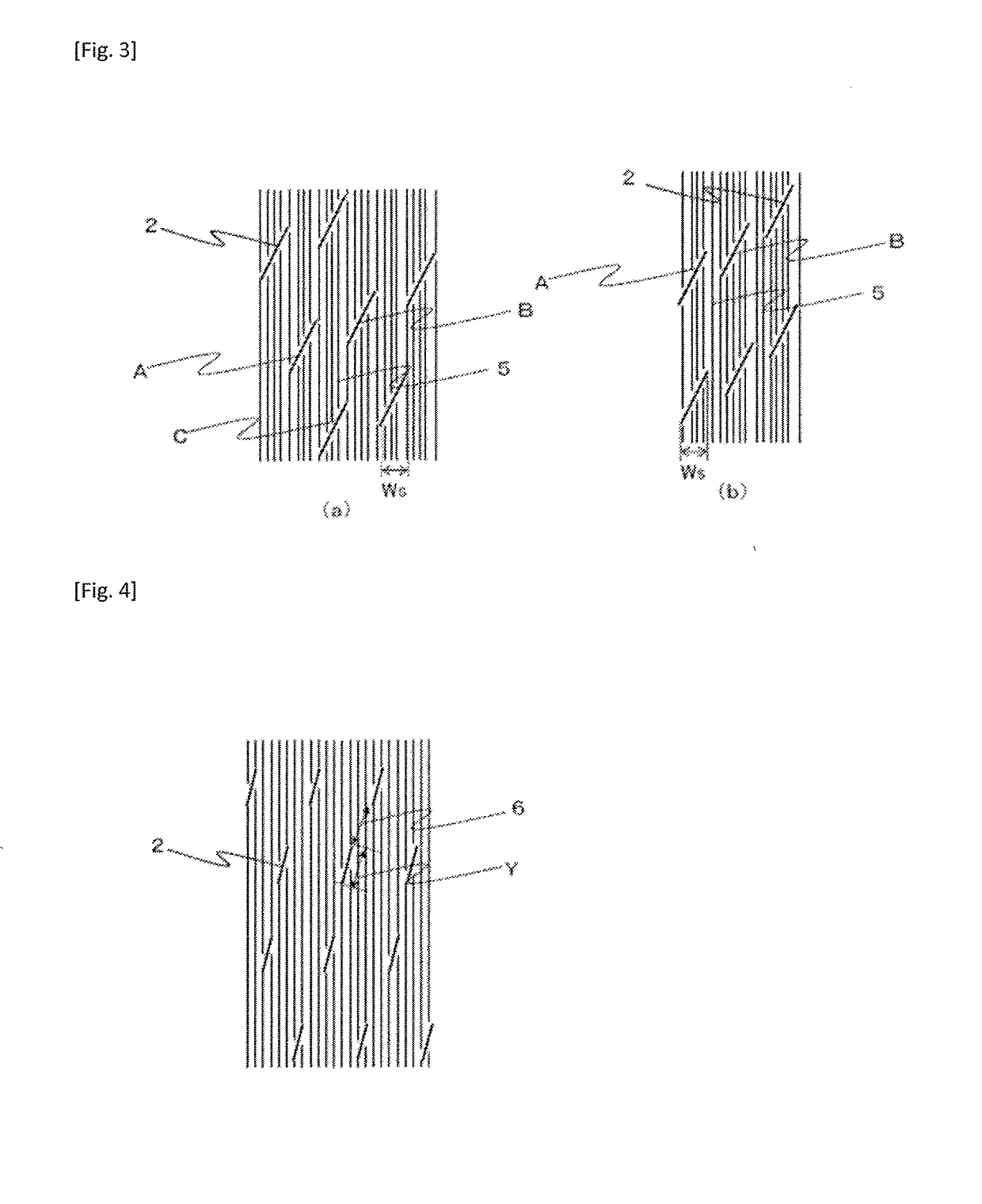
[0149]The incision pattern of incised prepregs was an incision pattern as in FIG. 15(b). The length of divided reinforcing fibers was 12 mm, the projected length Ws of the incisions projected to a plane perpendicular to the orientation direction of reinforcing fibers was 0.64 mm, and the angle formed between the incisions and the orientation direction of reinforcing fibers was 40°. The incisions were substantially of the same length Y=1 mm, and the distance between most proximate incisions was 1.7 mm, which was longer than 0.5 time Y. Reinforcing fiber bundles divided by incisions were shifted by ⅙ of the reinforcing fiber length L from the adjacent reinforcing fiber bundles.
[0150]As for press molded articles, openings of incisions were seen on the surfaces. The tensile elastic modulus was substantially equal to that in Example 1 but the tensile strength improved over Example 1.
example 3
[0151]The incision pattern of incised prepregs was an incision pattern as in FIG. 15(c). A given incision and another incision that was the most proximate to that incision did not divide the same reinforcing fiber. The incisions were substantially of the same length Y=1 mm, and the distance between most proximate incisions was 1 mm, which was substantially equal to Y. The length of divided reinforcing fibers was 20 mm, the projected length Ws of the incisions projected to a plane perpendicular to the orientation direction of reinforcing fibers was 0.34 mm, and the angle formed between the incisions and the orientation direction of reinforcing fibers was 20°. A plurality of incisions formed dashed straight lines.
[0152]The surface quality of press molded articles was substantially equal to that in Examples 1 and 2, but the tensile elastic modulus and the tensile strength thereof were even higher in value than in Examples 1 and 2.
PUM
| Property | Measurement | Unit |
|---|---|---|
| diameter | aaaaa | aaaaa |
| volume fraction Vf | aaaaa | aaaaa |
| length | aaaaa | aaaaa |
Abstract
Description
Claims
Application Information
 Login to View More