
Operating method for push authentication system and device
a technology of authentication system and push button, applied in the field of information security, can solve the problems of slow authentication speed and authentication process, and achieve the effect of speeding up the transmission of data
- Summary
- Abstract
- Description
- Claims
- Application Information
AI Technical Summary
Benefits of technology
Problems solved by technology
Method used
Image

Examples
embodiment 1
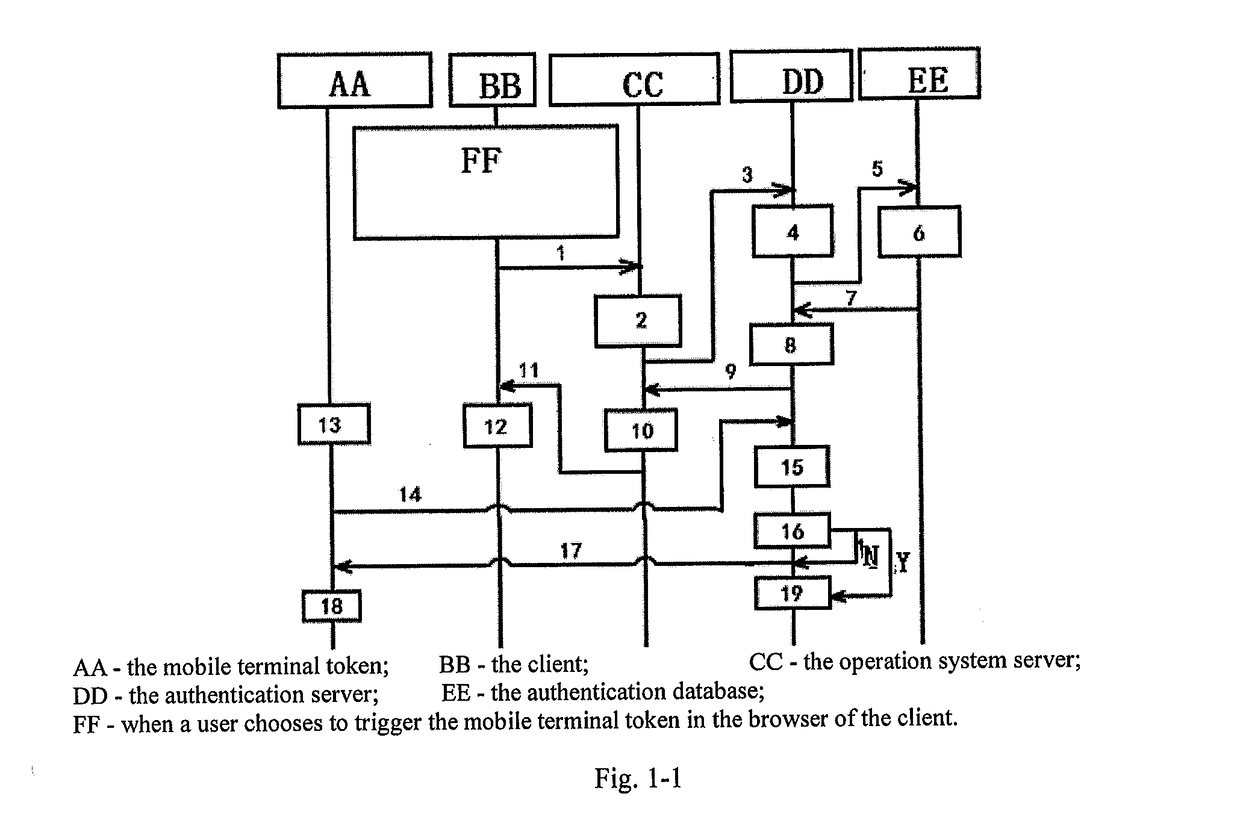
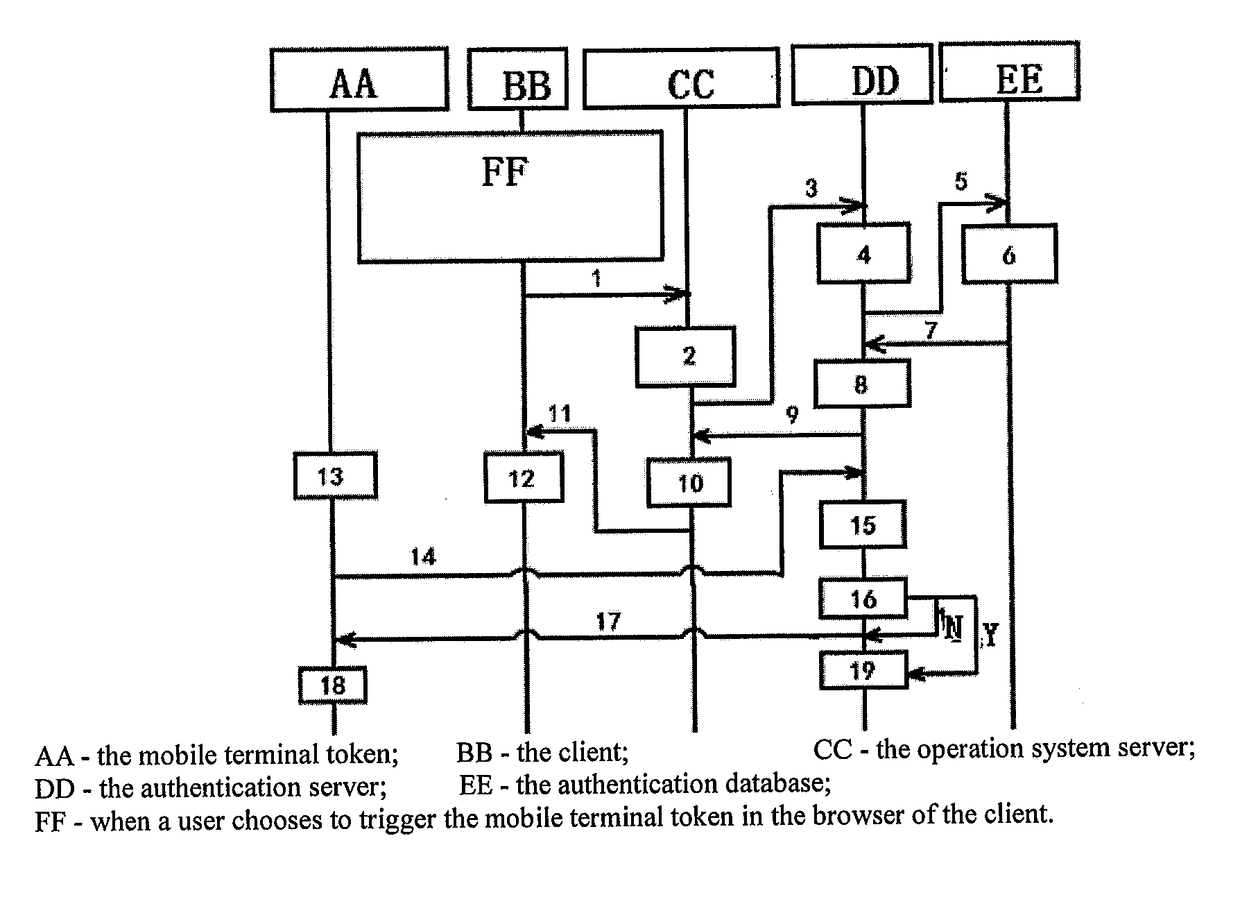
[0055]The Embodiment 1 of the present invention provides a method for realizing pushing, which applies to a system including a mobile terminal, a client, an operation system server, an authentication server, and an authentication database, in which, the mobile terminal is equipped with a mobile terminal token, such as a cellphone token; as shown in FIG. 1-1 and FIG. 1-2, when a mobile terminal token is triggered by a user in a website of the client, the method includes:
[0056]Step 1) the client sends an obtaining-trigger-two-dimension-code request to the operation system server;
[0057]Step 2) the operation system server receives the obtaining-trigger-two-dimension-code request, and obtains a user ID from the obtaining-trigger-two-dimension-code request, and generates a triggering request according to the user ID;
[0058]Step 3) the operation system server sends the triggering request to the authentication server;
[0059]Step 4) the authentication server receives the triggering request, an...
embodiment 2
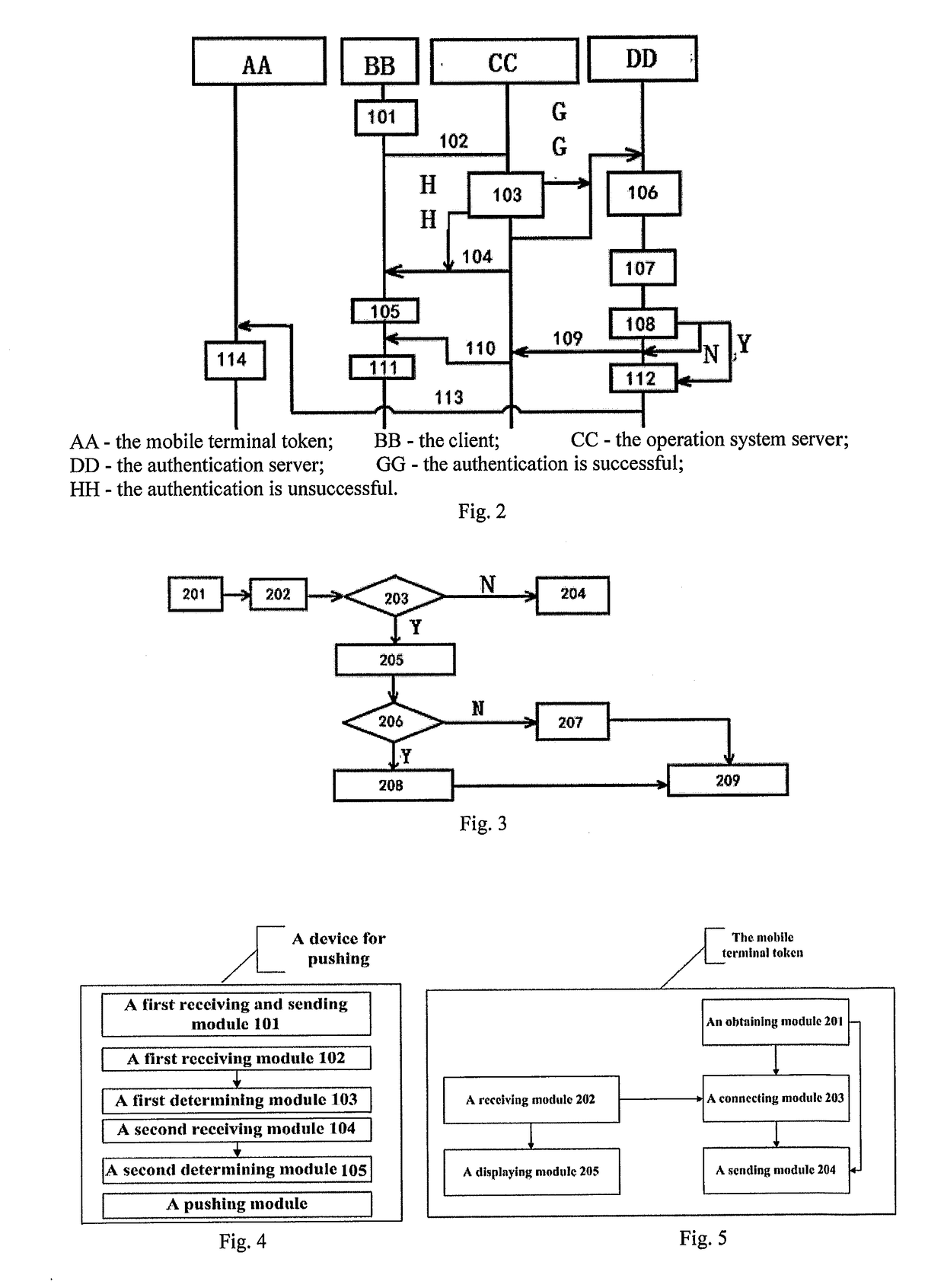
[0126]The present Embodiment 2 provides a flow diagram of a method for realizing pushing, specifically, the work flow of the authentication server in Embodiment 1 is made as an example, as shown in FIG. 3, the work flow includes the following steps:
[0127]Step 201, the authentication sever receives the triggering request from the operation system server, generates a request identification, and obtains the user ID from the triggering request, and binds the request identification with the user ID and stores them into the cache, the authentication server obtains user information from the authentication server according to the user ID, and generates a triggering request response according to the user information and the request identification, and sends to the operation system server;
[0128]furthermore, Step 201 can be instituted with: the authentication server receives an obtaining-trigger-two-dimension-code request from the client, obtains the user ID from the obtaining-trigger-two-dime...
embodiment 3
[0139]It provides a device for realizing pushing in the present Embodiment 3, as shown in FIG. 4, which includes:
[0140]a first receiving and sending module 101, which is configured to receive a triggering request sent from an operation system server, to obtain a user ID from the triggering request, to generate a request identification, to bind the request identification with the user ID and store them into the cache, to obtain user information from an authentication database according to the user ID, and to generate a triggering-request response according to the user information and the request identification and return the triggering-request response to the operation system server;
[0141]a first receiving module 102, which is configured to receive an obtaining-trigger-information request sent from the mobile terminal token, and to obtain the device identification and the request identification from the obtaining-trigger-information request;
[0142]a first determining module 103, which...
PUM
 Login to View More
 Abstract
Description
Claims
Application Information
 Login to View More