
Vehicle seat member and vehicle seat
- Summary
- Abstract
- Description
- Claims
- Application Information
AI Technical Summary
Benefits of technology
Problems solved by technology
Method used
Image

Examples
example 1
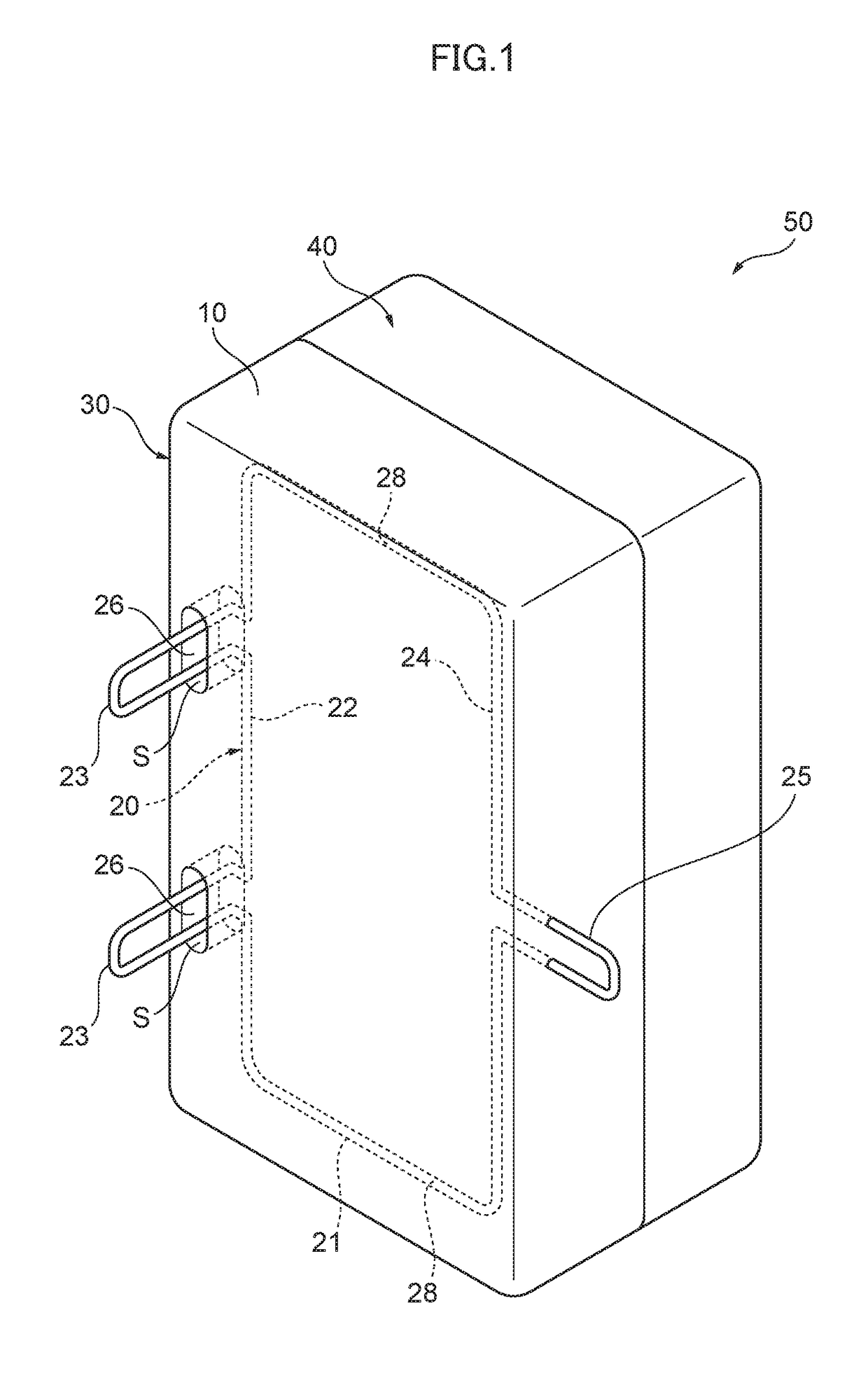
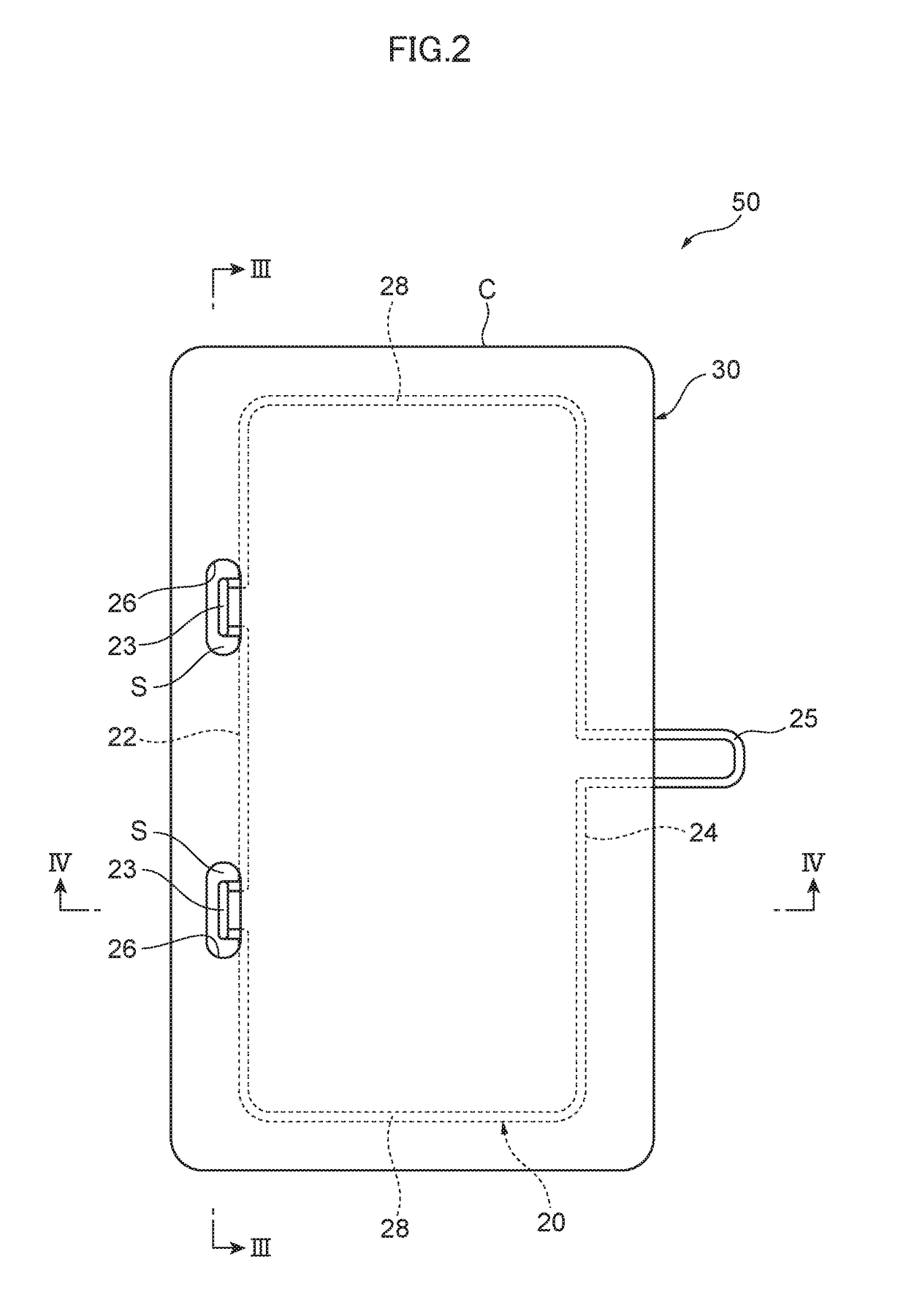
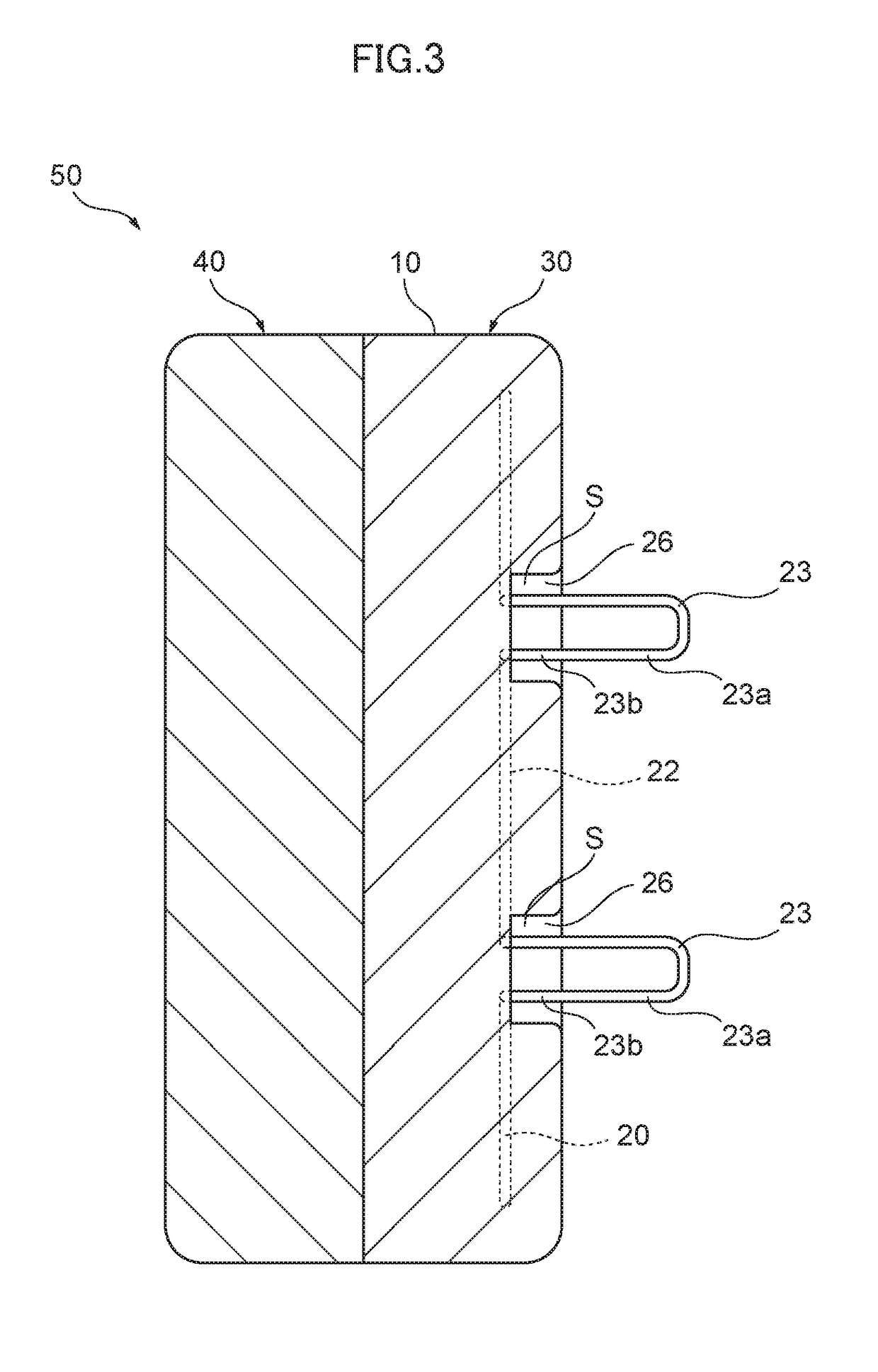
[0044]A vehicle seat member 30 with the configuration illustrated in the embodiment was produced through in-mold foam molding. The widths in the longer-side direction and the shorter-side direction of the vehicle seat member 30 were set to 1260 mm and 550 mm, respectively, and the thickness was set to 160 mm. Foamable composite resin including polystyrene resin and polyolefin resin (Piocelan (registered trademark): OP-30EU, produced by SEKISUI PLASTICS CO., Ltd.) was used as the foamable resin, and the expansion rate was set to 30 times. An iron wire (SWM-B) with a diameter of 4.5 mm was used as the frame member 20. It should be noted that the shrinkage factor of Piocelan is about 8 / 1000.
[0045]The iron wire was arranged around the entire periphery of the foamed resin molded body 10 at a position recessed inward from a peripheral side surface of the foamed resin molded body 10 by 30 mm, in almost the middle portion of the foamed resin molded body 10 forming the vehicle seat member 30...
example 2
[0048]Foamable polystyrene resin (ESLEN beads: FDK-40LV, produced by SEKISUI PLASTICS CO., Ltd.) was used as the foamable resin, and the expansion rate was set to 40 times. Then, as illustrated in the enlarged view of FIG. 5, a punched portion 26, which has a clearance of 4 mm on each side of the first protrusion 23 in the longer-side direction W of FIG. 5, and has a clearance of 2 mm on each side of the first protrusion 23 in the shorter-side direction L of FIG. 5, was formed. The other conditions were set the same as those in Example 1 to obtain a vehicle seat member 30. After the obtained molded body was demolded and 24 hours elapsed, the distance between the vertices of the two first protrusions 23, 23 was measured. Then, the distance was found to be 699.5 mm, and the amount of change in the position was found to be 0.5 mm. It should be noted that the shrinkage factor of the foamable polystyrene resin used is about 3 / 1000.
example 3
[0050]Foamable polypropylene resin was used as the foamable resin, and the expansion rate was set to 30 times. Then, as illustrated in the enlarged view of FIG. 5, a punched portion 26, which has a clearance of 18 mm on each side of the first protrusion 23 in the longer-side direction W of FIG. 5, and has a clearance of 10 mm on each side of the first protrusion 23 in the shorter-side direction L of FIG. 5, was formed. The other conditions were set the same as those in Example 1 to obtain a vehicle seat member 30. After the obtained molded body was demolded and 24 hours elapsed, the distance between the vertices of the two first protrusions 23, 23 was measured. Then, the distance was found to be 699.5 mm, and the amount of change in the position was found to be 0.5 mm. It should be noted that the shrinkage factor of the foamable polypropylene resin used is about 18 / 1000.
PUM
| Property | Measurement | Unit |
|---|---|---|
| Length | aaaaa | aaaaa |
| Compressive strength | aaaaa | aaaaa |
Abstract
Description
Claims
Application Information
 Login to View More