
Inverse class-f power amplifier
a power amplifier and class-f technology, applied in amplifiers, amplifiers with coupling networks, amplifiers with semiconductor devices/discharge tubes, etc., can solve the problems of power loss, dissipation of dc power that is not converted into rf power,
- Summary
- Abstract
- Description
- Claims
- Application Information
AI Technical Summary
Benefits of technology
Problems solved by technology
Method used
Image

Examples
Embodiment Construction
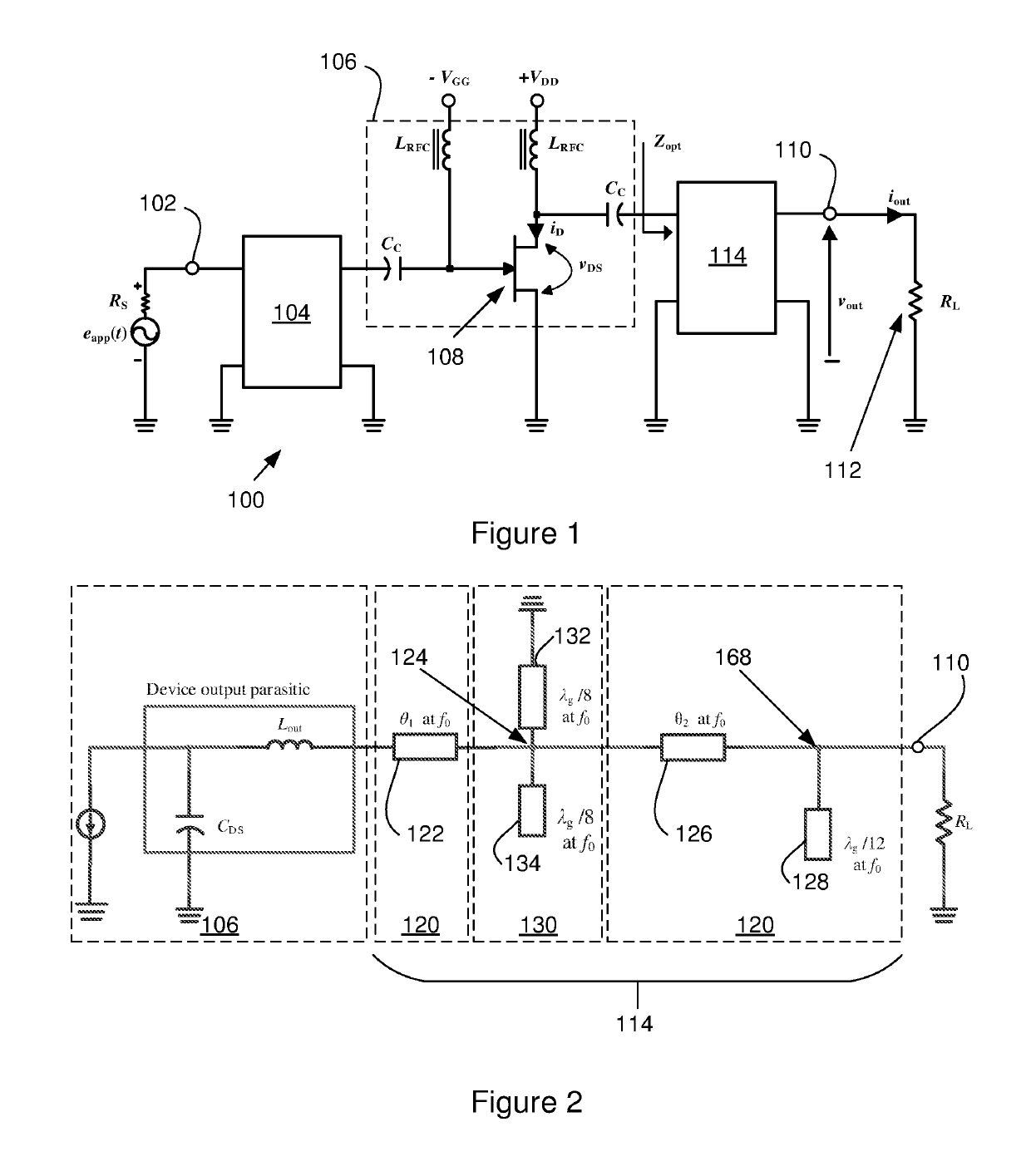
[0047]FIG. 1 illustrates one embodiment of an inverse Class-F power amplifier (PA) (100). The PA (100) includes an input (102) which is arranged to receive a signal to be amplified from a source. The signal supplied to the input (102) of the PA (100) is a high-frequency signal, such as a radio-frequency (RF) signal, and is associated with a fundamental frequency (f0). The PA (100) described herein is designed for use in the final stage of a transmitter in a wireless communication system and is configured to convert direct current (DC) power into RF power while being driven by a RF input signal. It should however be appreciated that the PA (100) may be adapted for use in other applications and for operation in other frequency bands, such as microwave frequencies.
[0048]The PA (100) may include an input matching network (104) which is arranged to match the input impedance of the PA (100) to the source impedance. The input matching network (104) may be provided by a suitable arrangement...
PUM
 Login to View More
 Abstract
Description
Claims
Application Information
 Login to View More