
Tintable abrasion resistant compositions
a technology of abrasion resistance and composition, applied in the field of tintable abrasion resistance composition, can solve the problems of reducing abrasion resistance, affecting the appearance of the surface, so as to improve the abrasion resistance, and reduce the uv energy
- Summary
- Abstract
- Description
- Claims
- Application Information
AI Technical Summary
Benefits of technology
Problems solved by technology
Method used
Image

Examples
example 1
on of Mar Resistant Coatings
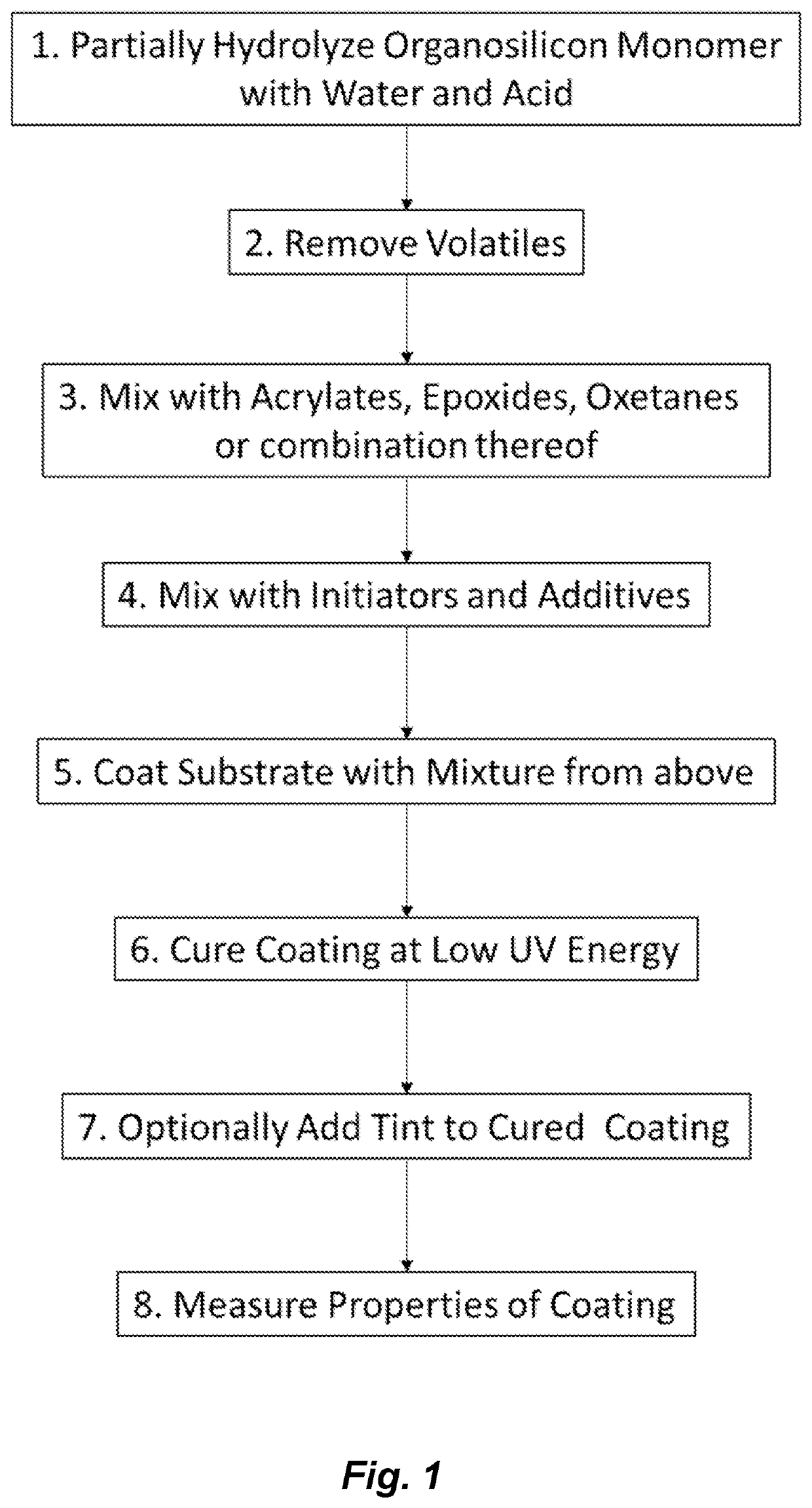
[0095]The hydrolyzed epoxy silane is prepared by adding 3-glycidoxypropyltrimethoxysilane, deionized water and concentrated HCL in the amounts according to Table 2 in a round bottom flask and immersing the flask in a water bath at room temperature. The flask rotated to agitate the mixture. The mixture is heated to 60-65° C. and held for one hour. While the temperature is held at 60−65° C., a slight vacuum is applied carefully to prevent boil over until 90-99% of the theoretical mass of volatiles are removed. The volatiles are primarily methyl alcohol. The low viscosity oligomer is then cooled to room temperature.
TABLE 2Composition of silane oligomers 1-4 based on% of hydrolyzed methoxy groupsWt.Total hydrolyzedReagents and Silane Products*(gm)Molesmethoxy (%)3-Glycidoxypropyltrimethoxysilane472.02.0Deionized water42.02.33Conc. HCl (37%)0.250.0068Silane 138.93-Glycidoxypropyltrimethoxysilane472.02.0Deionized water31.91.77Conc. HCl (37%)0.250.0068Silane 229...
example 2
ble Coating Compositions
[0096]Coating compositions 1 and 2 (Table 3) were applied on a polycarbonate lens by spin coating and curing the coated lens at 0.385-0.395 mJ to give a final film thickness of 4.5-5.0 microns. The coatings had an excellent boiling water resistance with a value of 5B.
TABLE 3Compositions 1 and 2ReagentsWt. (gm)Wt. (gm)Silane 160.00Silane 2071.6Hexanediol diacrylate20.014.3Tris[2-(acryloyloxy)ethyl] isocyanurate15.09.52-Hydroxy-2-methyl-1-phenyl-propan-1-one1.750.75Triarlylsulfonium hexafluorine antimonate3.03.6salt mixtureBYK 300 Polyether modified0.250.25polydimethylsiloxaneComposition12Curing UV Intensity (mJ)0.3850.395
[0097]The coated lenses were compared (Table 4) to the reference sample AST 1 from Ultra Optics, which is the hardest UV curable and solvent free coating in the optical coating market.
TABLE 4Sample Properties for non-tintable coatingsSamplePropertiesComposition 1Composition 2AST 1Curing UV Intensity (mJ)0.3850.3950.6ASTM D3359 Adhesion*5B5B4-5...
example 3
Coating Compositions
[0099]Coating compositions 3, 4 and 5 (Table 5) were applied on a polycarbonate lens by spin coating and curing the coated lens at 0.385-0.395 mJ to give a final film thickness of 4.5-5.0 microns.
TABLE 5Compositions 3, 4 and 5Wt.Wt.Wt.Reagents(gm)(gm)(gm)Silane 153.653.60Silane 30014.0Silane 40040.0Hexanediol diacrylate24.824.824.9Trimethylolpropane triglycidyl ether15.9408.0Xylene oxetane (XDO)07.80Dioxetanyl ether (DOX)07.70Cyclohexanedimethanol diglycidyl ether008.02-Hydroxy-2-methyl-1-phenyl-propan-1-one1.241.241.25Triarlylsulfonium hexafluorine4.174.173.6antimonate salt mixtureBYK 300 Polyether modified0.250.250.25polydimethylsiloxaneComposition345Curing UV Intensity (mJ)0.3850.3850.395
[0100]The coated lenses were compared (Table 6) to two reference samples from Ultra Optics. One tintable coating is referred to as UV87, and the other is UV NV. The latter coating is the bestselling solvent free tintable coating on the market.
TABLE 6Sample properties for tinta...
PUM
| Property | Measurement | Unit |
|---|---|---|
| cure energy | aaaaa | aaaaa |
| cure energy | aaaaa | aaaaa |
| cure energy | aaaaa | aaaaa |
Abstract
Description
Claims
Application Information
 Login to View More