Most of the existing eye trackers only extract the 2D gaze point of the human eyes for psychological research and simple human-computer interaction, and do not extract a 3D gaze point, and thus, the extracted amount of information and its role are limited.
A few of the existing eye trackers with the 3D gaze point positioning function have low positioning accuracy, and do not have a head positioning module, resulting in that the user must keep the head fixed when in use, and it is difficult to use in a real-life
scenario.
However, the above prior art still has the following problems: 1) the positioning of the
human head cannot be realized, so that the gaze point cannot be converted into the world coordinate system for further operation, and the head attitude must be fixed during use, which greatly limits the user's usage
scenario and reduces the comfort of use; 2) only one eye camera is used, so that the binocular information cannot be extracted, which reduces the accuracy of the gaze point recognition; 3) the recognition and pose
estimation of the object of interest cannot be realized, so that these devices cannot be used for 3D actual working scenes (helping disability and 3D interaction); and 4) CN107773248A utilizes multiple scene cameras, which increases the cost while consuming space resources, and U.S. Pat. No. 10,007,336B2 uses a depth camera, resulting in a cumbersome and costly device.
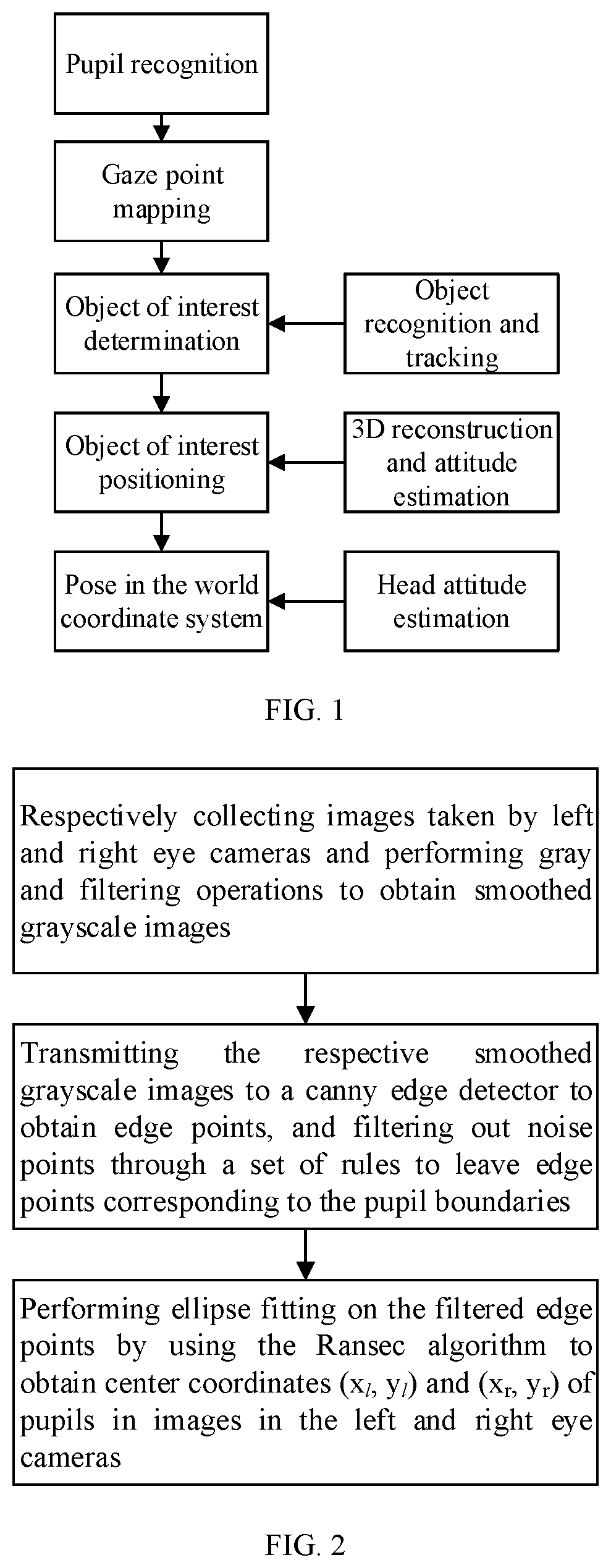
1. In the method of the present disclosure, centers of the pupils of both eyes are extracted to determine a gaze point of the user, which effectively ensures the accuracy of gaze point recognition, and then ensures the accuracy of the pose determination of the object of interest.
2. In the present disclosure, two scene cameras and two eye cameras are used to achieve the recognition and pose estimation of the object of interest to a user, and in the actual working
scenario, the
robot arm is controlled with the user's binocular information to grasp the object of interest for the user, which facilitates the disabled.
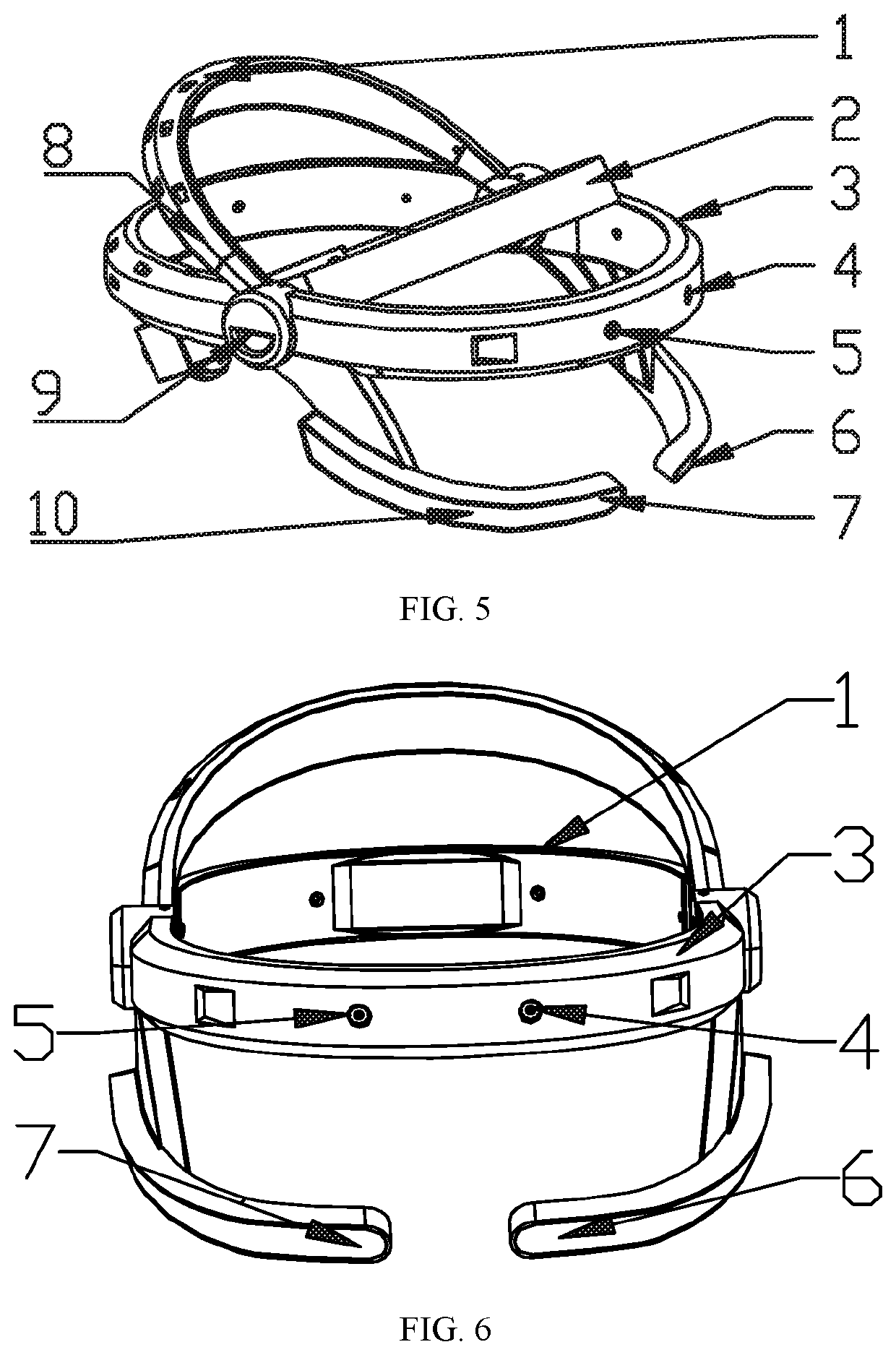
3. In the present disclosure, by designing a plurality of
infrared receivers uniformly distributed on the eye tracker, it can be ensured that the
infrared light is still be received when the user's head moves in a wide range, and in combination with the position of the
infrared emitter, the position of the
human head can be realized, so that when in use, there is no need to ensure that the head attitude is fixed, which widens the usage scenario and improves the comfort of use. In addition, the gaze point can be converted into the world coordinate system for the subsequent further operation.
4. The existing devices generally use an object
recognition algorithm to extract the object in the camera, and since the actual working background is complicated and the acquired image is unstable due to the camera shake, the recognition rate is low. In the present disclosure, the object in the left scene camera is extracted by combining the target
recognition algorithm with the tracking
algorithm, in which the bounding box of the object is obtained by the target
recognition algorithm to reinitialize the tracking
algorithm, thereby greatly improving the recognition success rate of common objects in the scene camera.
5. In the present disclosure, a random sample
consensus algorithm (RANSEC algorithm) is preferably adopted to obtain center coordinates of the left and right pupils, and the extraction efficiency and accuracy of the
pupil centers are greatly improved by defining inliers of the
ellipse and designing the support function
6. In the present disclosure, a
Gaussian process regression algorithm is preferably used to map center coordinates of the pupils to the scene camera so as to obtain a 2D gaze point, which has good stability and high precision.
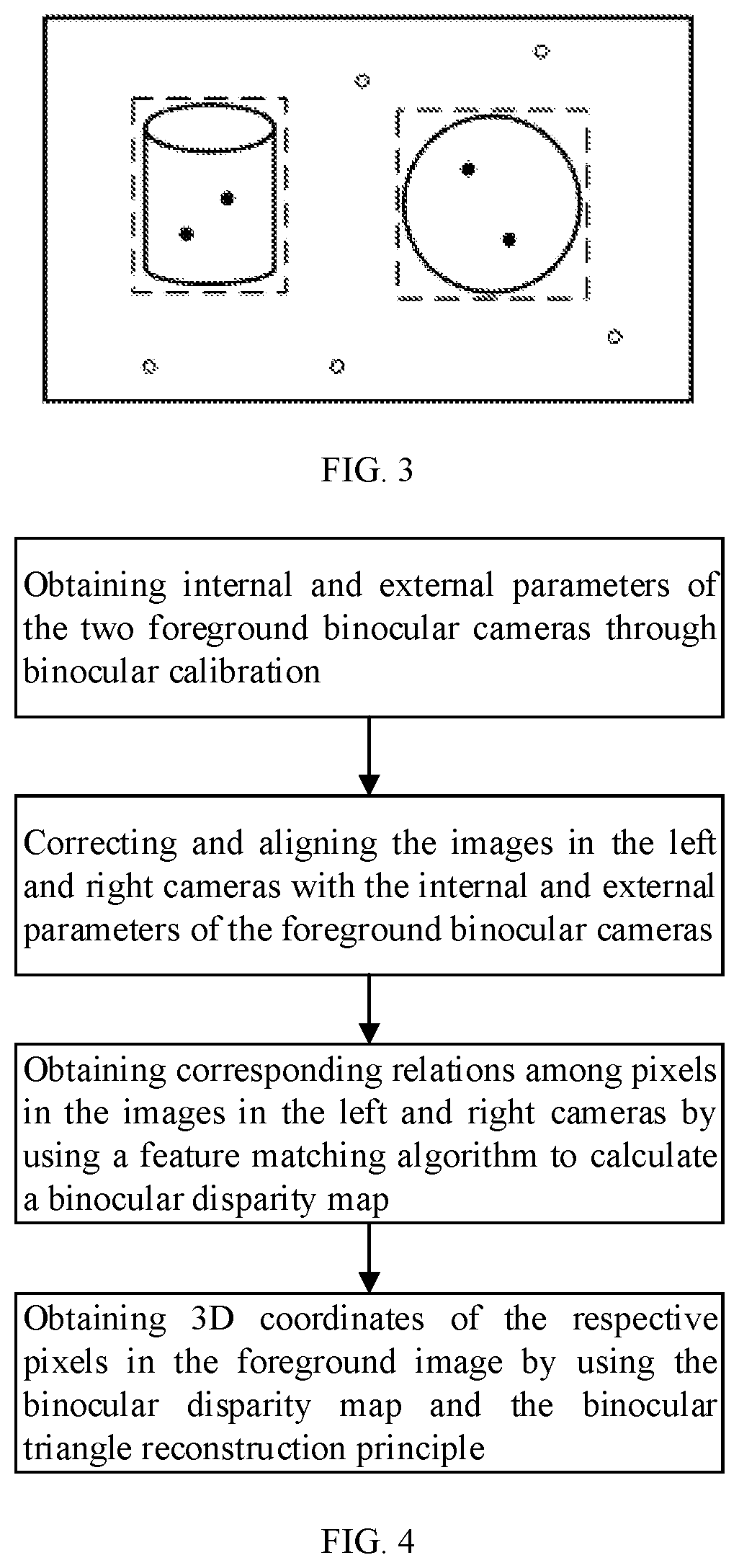
7. In the present disclosure, 3D reconstruction of the object of interest to the user is performed with a 3D
reconstruction algorithm, so that the coordinate of the target object in the scene camera coordinate system can be accurately positioned, and the pose of the target object can be obtained in combination with the pose recognition of the target object.
8. In the present disclosure, through combining the 2D coordinate of the infrared
receiver on the
virtual plane of the infrared generator with the 3D coordinate of the infrared
receiver in the eye tracker coordinate system to construct a PnP problem, a pose of the eye tracker in the world coordinate system is obtained by solving the PnP problem, thereby achieving the positioning of the user's head attitude.



 Login to View More
  Login to View More