Process for the preparation of rucaparib and novel synthesis intermediates
a technology of rucaparib and synthesis intermediate, which is applied in the field of process for the preparation of rucaparib and novel synthesis intermediate, can solve the problems of not being valuable in industrial scale production, and achieve the effect of less reaction steps
- Summary
- Abstract
- Description
- Claims
- Application Information
AI Technical Summary
Benefits of technology
Problems solved by technology
Method used
Image

Examples
example 1
[0115]Preparation of 7-bromo-3-(2-(1,3-dioxoisoindolin-2-yl)ethyl)-6-fluoro-2-(4-((2,2,2-trifluoro-N-methylacetamido)methyl)phenyl)-1H-indole-4-carboxylic acid
[0116]A mixture of N-(4-(4-(1,3-dioxoisoindolin-2-yl)butanoyl)benzyl)-2,2,2-trifluoro-N-methylacetamide (8.71 g, 20.1 mmol) and 4-bromo-3-fluoro-5-hydrazineylbenzoic acid hydrochloride (5.75 g, 20.1 mmol) was diluted in glacial acetic acid (200 mL). Boron trifluoride diethyl etherate (16.4 mL, 133 mmol) was added and the mixture heated to 90° C. under an atm of N2 for 18 h. The mixture dissolved after ˜5 min. of heating. The reaction was allowed to cool to room temperature and concentrated in vacuo to give a black tar. The residue was chromatographed on silica gel (330 g Isco column, 0 to 100% EtOAc in heptane over 36 min.) to give 9.84 g of 7-bromo-3-(2-(1,3-dioxoisoindolin-2-yl)ethyl)-6-fluoro-2-(4-((2,2,2-trifluoro-N-methylacetamido)methyl)phenyl)-1H-indole-4-carboxylic acid that was used as is in the next reaction.
[0117]LC...
example 2
[0118]Preparation of 9-bromo-8-fluoro-2-{4-[(methylamino)methyl]phenyl}-1,3,4,5-tetrahydro-6H-pyrrolo[4,3,2-ef][2]benzazepin-6-one
[0119]A solution of 7-bromo-3-(2-(1,3-dioxoisoindolin-2-yl)ethyl)-6-fluoro-2-(4-(2,2,2-trifluoro-N-methylacetamido)methyl)phenyl)-1H-indole-4-carboxylic acid (9.84 g, 79% AUC at 254 nm.) and hydrazine (1.70 mL, 54.4 mmol) in 1:1 EtOH / THF (110 mL) was transferred to a 1 L stainless steel pressure reactor and heated under pressure to 110° C. for 9 h. The reaction was allowed to cool to room temperature, transferred to a round bottom flask and concentrated in vacuo. The residue was chromatographed on silica gel (120 g gold Isco column, 0 to 40% MeOH in DCM with 1% NEt3 in the eluents over 35 min.) to give 1.63 g of 7-bromo-8-fluoro-5-(4-((methylamino)methyl)phenyl)-2,3,4,6-tetrahydro-1H-azepino [5 ,4,3-cd]indol-1-one as a tan solid which was used without further purification. LC / MS RT=1.27 min., 403.8 [M+H]+, 89% AUC at 254 nm.
example 3
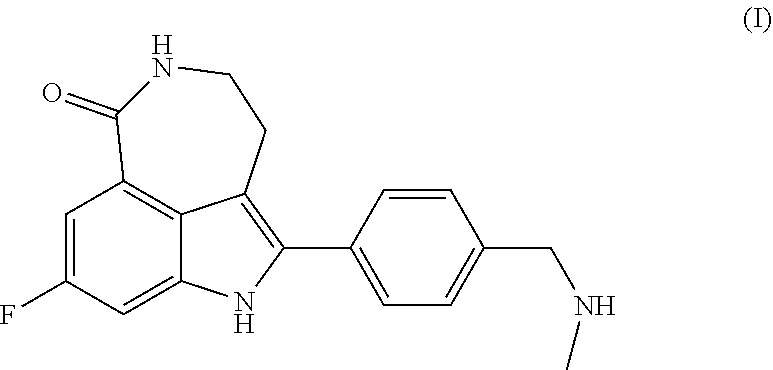
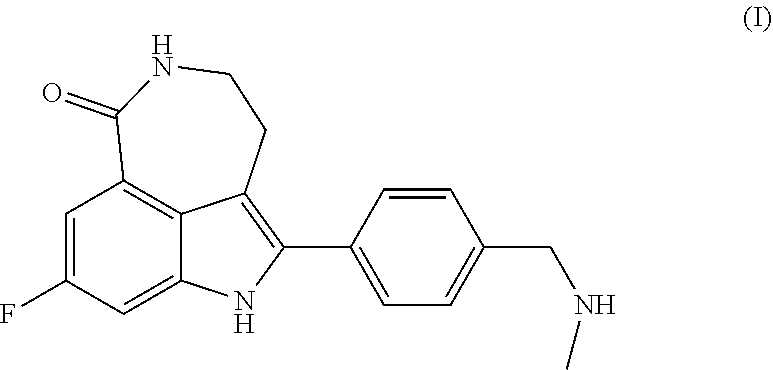
[0120]Preparation of Rucaparib
[0121]A suspension of 9-bromo-8-fluoro-2-{4-[(methylamino)methyl]phenyl}-1,3,4,5-tetrahydro-6H-pyrrolo[4,3,2-ef][2]benzazepin-6-one (1.61 g, 89% AUC at 254 nm) in MeOH (80 mL) was heated to reflux for ˜5 min. until a solution was obtained. Solution was allowed to cool to room temperature over 30 min. before 5% Pd / Carbon (Degussa type E101 NO / W, 800 mg) and concentrated HCl (1.00 mL, 12 mmol) was added. Hydrogen gas (˜3-5 L) was bubbled through the reaction before it was allowed to vigorously stir at room temperature under an atmosphere of hydrogen for 18 h. Nitrogen (˜3-5 L) was bubbled through the reaction before it was filtered through celite under an inverse funnel of nitrogen. The celite was rinsed with 200 mL of MeOH and NEt3 (7 mL) was added to the mother liquor obtained before it was concentrated in vacuo. The residue (3.6 g) was dissolved in MeOH and split into 3 equal batches that were independently concentrated in vacuo and chromatographed on ...
PUM
| Property | Measurement | Unit |
|---|---|---|
| temperature | aaaaa | aaaaa |
| temperature | aaaaa | aaaaa |
| temperature | aaaaa | aaaaa |
Abstract
Description
Claims
Application Information
 Login to View More
 - R&D
- Intellectual Property
- Life Sciences
- Materials
- Tech Scout
- Unparalleled Data Quality
- Higher Quality Content
- 60% Fewer Hallucinations
Browse by: Latest US Patents, China's latest patents, Technical Efficacy Thesaurus, Application Domain, Technology Topic, Popular Technical Reports.
© 2025 PatSnap. All rights reserved.Legal|Privacy policy|Modern Slavery Act Transparency Statement|Sitemap|About US| Contact US: help@patsnap.com