
Glue-Down Decorative Floor Covering System
a decorative floor covering and glue-down technology, applied in the direction of flooring, coatings, synthetic resin layered products, etc., can solve the problem of clicking lock between tiles
- Summary
- Abstract
- Description
- Claims
- Application Information
AI Technical Summary
Benefits of technology
Problems solved by technology
Method used
Image

Examples
Embodiment Construction
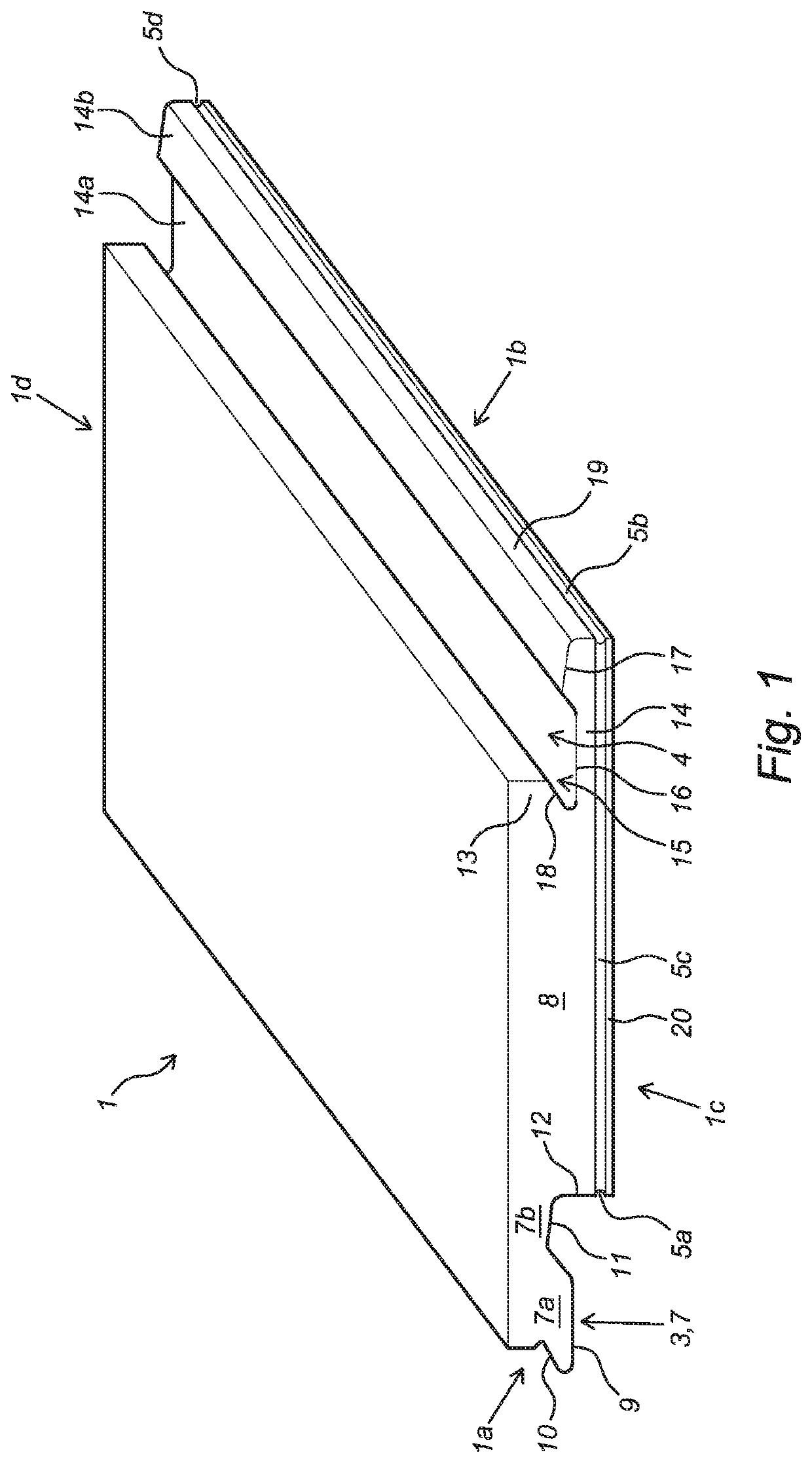
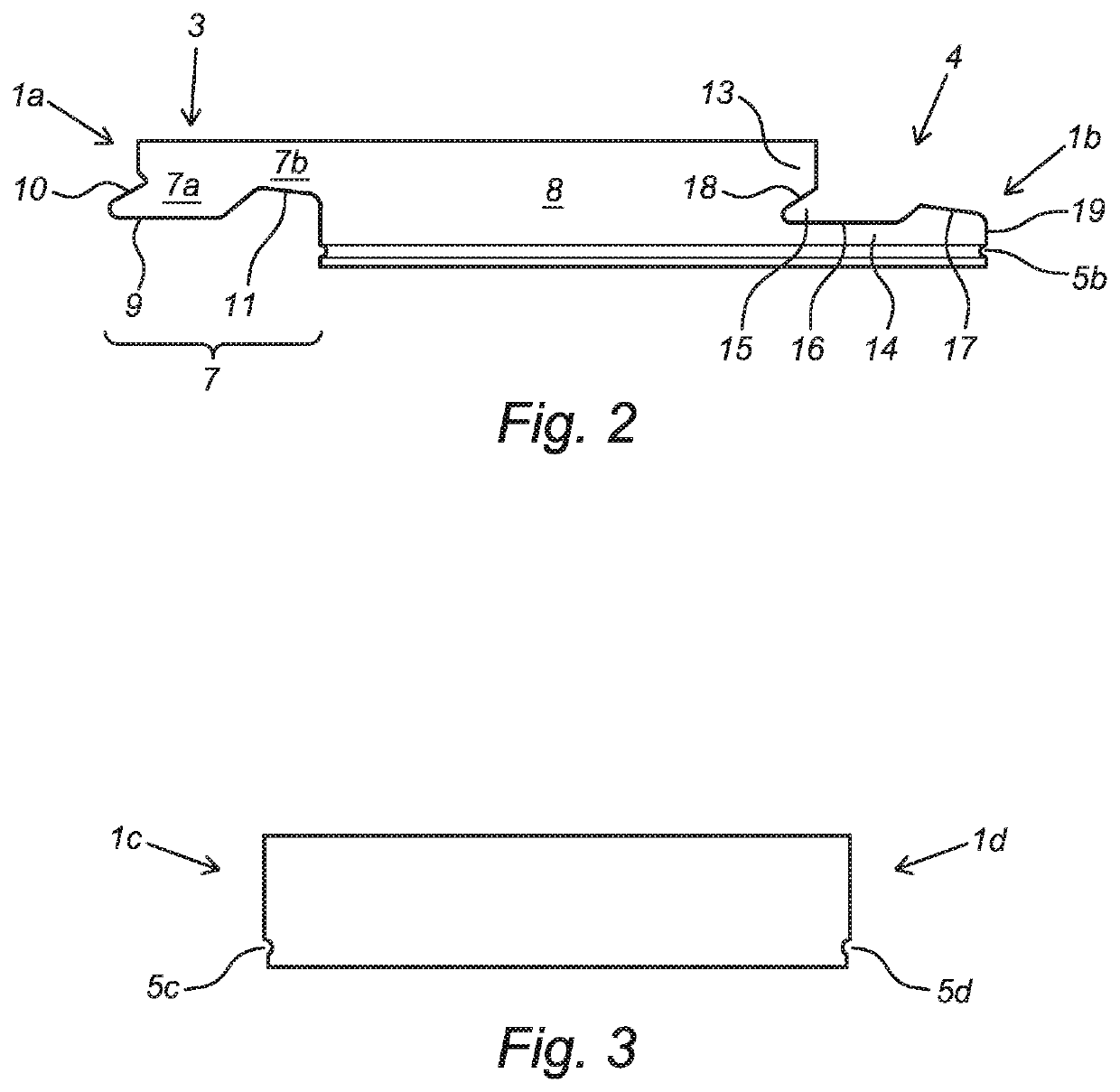
[0032]FIG. 1 shows a perspective view of a rectangular glue-down tile 1 of a glue-down floor covering system 2 (see FIGS. 4-8) according to the invention, FIG. 2 shows a lateral cross-section of the tile according to FIG. 1, and FIG. 3 a longitudinal cross-section of the tile according to FIG. 1. The tile 1 is mechanically interconnectable with two similar tiles for forming said covering 2. The tile 1 comprises a first pair of opposing long edges 1a, 1b, identified as the first edge 1a and the second edge 1b, and second pair of opposing short edges 1c, 1d, identified as the third edge 1c and the fourth edge 1d. The first pair of opposing edges 1a, 1b comprises complementary mechanical coupling parts 3, 4, identified as the male coupling part 3, and the female coupling part 4 to allow the tile 1 to be mechanically coupled with two other tiles 1. The second pair of opposing edges 1c, 1d is free of any mechanical coupling parts, which makes the tile 1 suitable to be mechanically couple...
PUM
| Property | Measurement | Unit |
|---|---|---|
| Length | aaaaa | aaaaa |
| Length | aaaaa | aaaaa |
| Distance | aaaaa | aaaaa |
Abstract
Description
Claims
Application Information
 Login to View More