Check patentability & draft patents in minutes with Patsnap Eureka AI!

Method and architecture for accelerating deterministic stochastic computing using residue number system

Pending Publication Date: 2021-08-05
UNIVERSITY OF LOUISIANA AT LAFAYETTE
View PDF0 Cites 0 Cited by
  • Summary
  • Abstract
  • Description
  • Claims
  • Application Information

AI Technical Summary

Benefits of technology

The patent describes a new way to improve the processing time of deterministic methods by integrating them with a technique called RNS. RNS breaks down numbers into smaller parts that can be processed independently, resulting in faster and more efficient operations. The new design uses RNS to reduce the size of bit-streams and achieve better performance compared to other number systems. It also utilizes an FSM-based reverse converter to directly convert RNS-based bit-streams to binary numbers. Overall, this approach offers a more efficient and compact solution for resource-limited applications.

Problems solved by technology

The disclosed design outperforms prior designs on time and energy consumption.

Method used

the structure of the environmentally friendly knitted fabric provided by the present invention; figure 2 Flow chart of the yarn wrapping machine for environmentally friendly knitted fabrics and storage devices; image 3 Is the parameter map of the yarn covering machine
View more

Image

Smart Image Click on the blue labels to locate them in the text.
Viewing Examples
Smart Image
  • Method and architecture for accelerating deterministic stochastic computing using residue number system
  • Method and architecture for accelerating deterministic stochastic computing using residue number system
  • Method and architecture for accelerating deterministic stochastic computing using residue number system

Examples

Experimental program
Comparison scheme
Effect test

Embodiment Construction

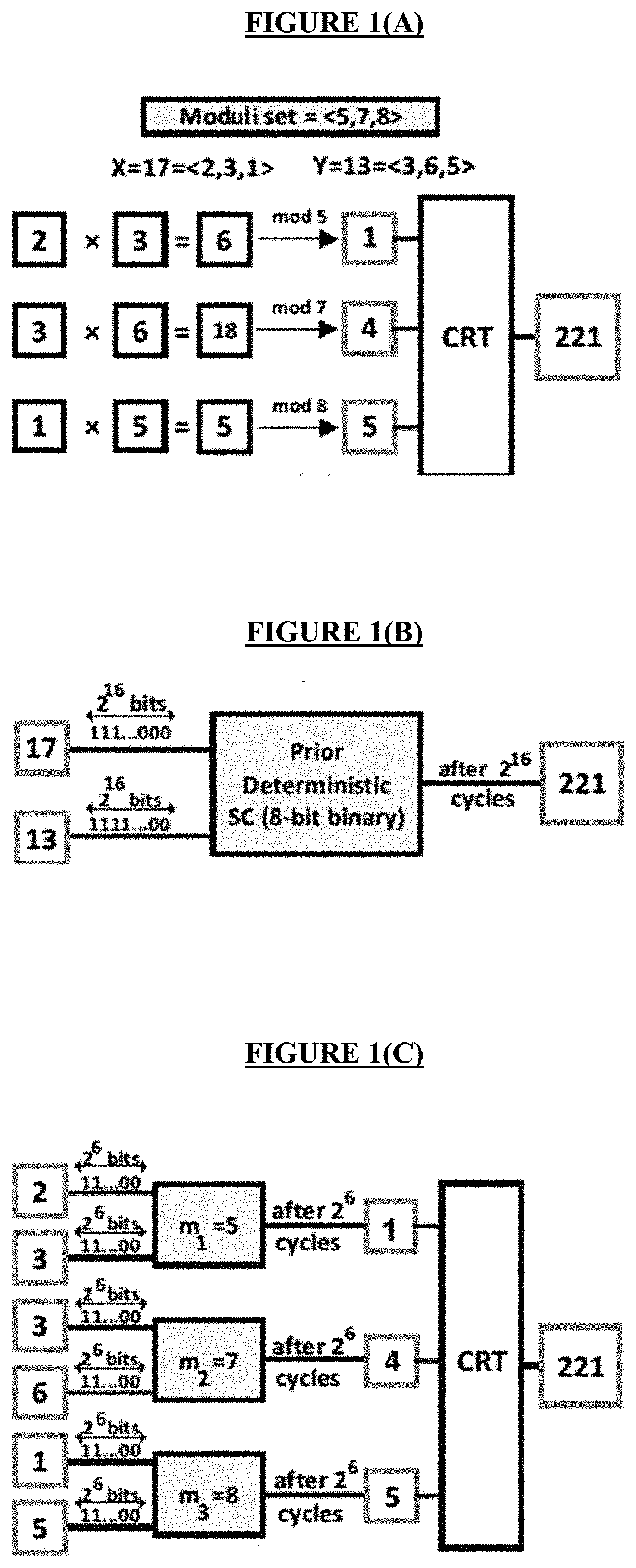
terministic methods, the number of clock cycles required to perform an operation follows an exponential function of the binary bit-width of the operands. Multiplying two n-bit precision data takes 22n clock cycles as 22n-bit bit-streams must be processed. Using high-bit-width binary numbers as the operands of the operations leads to very long processing time and consequentially energy consumption. By exploiting the parallel nature of the RNS, the high-bit-width operands of the computations can be split into operands (residues) with low bit-width. While the idea is presented based on the multiplication operation, the disclosed methodology is also applicable to the deterministic scaled addition / subtraction.

[0026]Precise SC in RNS Domain. Dividing the computation into several parallel lanes, each lane processing low bit-width operands, decreases the complexity of the computation. Decreasing the bit-width of the operands means exponentially shorter bit-streams to represent each data. FI...

the structure of the environmentally friendly knitted fabric provided by the present invention; figure 2 Flow chart of the yarn wrapping machine for environmentally friendly knitted fabrics and storage devices; image 3 Is the parameter map of the yarn covering machine
Login to View More

PUM

No PUM Login to View More

Abstract

Inaccuracy of computations is an important challenge with the Stochastic Computing (SC) paradigm. Recently, deterministic approaches to SC are proposed to produce completely accurate results with SC circuits. Instead of random bit-streams, the computations are performed on structured deterministic bit-streams. However, current deterministic methods take a large number of clock cycles to produce correct result. This long processing time directly translates to very high energy consumption. This invention proposes a design methodology based on the Residue Number Systems (RNS) to mitigate the long processing time of the deterministic methods. Compared to the state-of-the-art deterministic methods of SC, the proposed approach delivers improvements in terms of processing time and energy consumption.

Description

CROSS REFERENCE TO RELATED APPLICATIONS[0001]This application claims priority to U.S. Provisional Application No. 62 / 969,872 titled “ACCELERATING DETERMINISTIC STOCHASTIC COMPUTING USING RESIDUE NUMBER SYSTEM”, filed on Feb. 4, 2020.STATEMENT REGARDING FEDERALLY SPONSORED RESEARCH OR DEVELOPMENT[0002]Not applicable.REFERENCE TO A“SEQUENCE LISTING”, A TABLE, OR COMPUTER PROGRAM[0003]Not applicable.DESCRIPTION OF THE DRAWINGS[0004]The drawings constitute a part of this specification and include exemplary examples of the METHOD AND ARCHITECTURE FOR ACCELERATING DETERMINISTIC STOCHASTIC COMPUTING USING RESIDUE NUMBER SYSTEM, which may take the form of multiple embodiments. It is to be understood that in some instances, various aspects of the invention may be shown exaggerated or enlarged to facilitate an understanding of the invention. Therefore, drawings may not be to scale.[0005]FIG. 1(a) provides a drawing of the known method of Residue Number System (RNS) multiplication.[0006]FIG. 1...

Claims

the structure of the environmentally friendly knitted fabric provided by the present invention; figure 2 Flow chart of the yarn wrapping machine for environmentally friendly knitted fabrics and storage devices; image 3 Is the parameter map of the yarn covering machine
Login to View More

Application Information

Patent Timeline
no application Login to View More
IPC IPC(8): G06N3/063G06N3/08G06F1/3234G06F9/38H03K19/173
CPCG06N3/063G06N3/08H03K19/1737G06F9/3877G06F1/3234G06F7/729G06N3/045
Inventor NAJAFI, MOHAMMADHASSANGIVAKI, KAMYARHOJABROSSADATI, SEYED REZAGHOLAMREZAYI, M.H.KHONSARI, AHMADGORGIN, SAEIDRAHMATI, DARA
Owner UNIVERSITY OF LOUISIANA AT LAFAYETTE
Features
  • R&D
  • Intellectual Property
  • Life Sciences
  • Materials
  • Tech Scout
Why Patsnap Eureka
  • Unparalleled Data Quality
  • Higher Quality Content
  • 60% Fewer Hallucinations
Social media
Patsnap Eureka Blog
Learn More