Torque control (third
order control) has been, and continues to be, a major obstacle in orthodontic treatment regimens that has often caused very long and extended treatment times.
At the time, clinicians had not yet realized that tightly tied archwires generated significant binding and friction which made it difficult to move / translate bracketed teeth along the archwire.
Although elastic
ligature ties were very easy to place, elastic
ligature ties still created significant binding and friction that slowed
tooth movement and caused lengthened treatment times.
Unfortunately, ASL technology did not resolve the long felt need for achieving (third order) torque control, and ASL also required precise, and
time consuming, archwire bending (intentionally bending torque bends into the archwire) to accomplish third order tooth torque control.
Design improvements for each of these three separate technologies are applicable only to that specific technology because the
mechanics of one technology are not applicable to the
mechanics of the others.
Despite technologic improvements, the most challenging issue for clinical
orthodontics has remained the development of a bracket-archwire
assembly that not only achieves first order and second order tooth control, but also achieves third order torque control while utilizing low
biologic treatment forces throughout the
treatment regimen.
This prior art technology was utilized sparingly due to the challenges of accurately achieving three-dimensional control of the teeth.
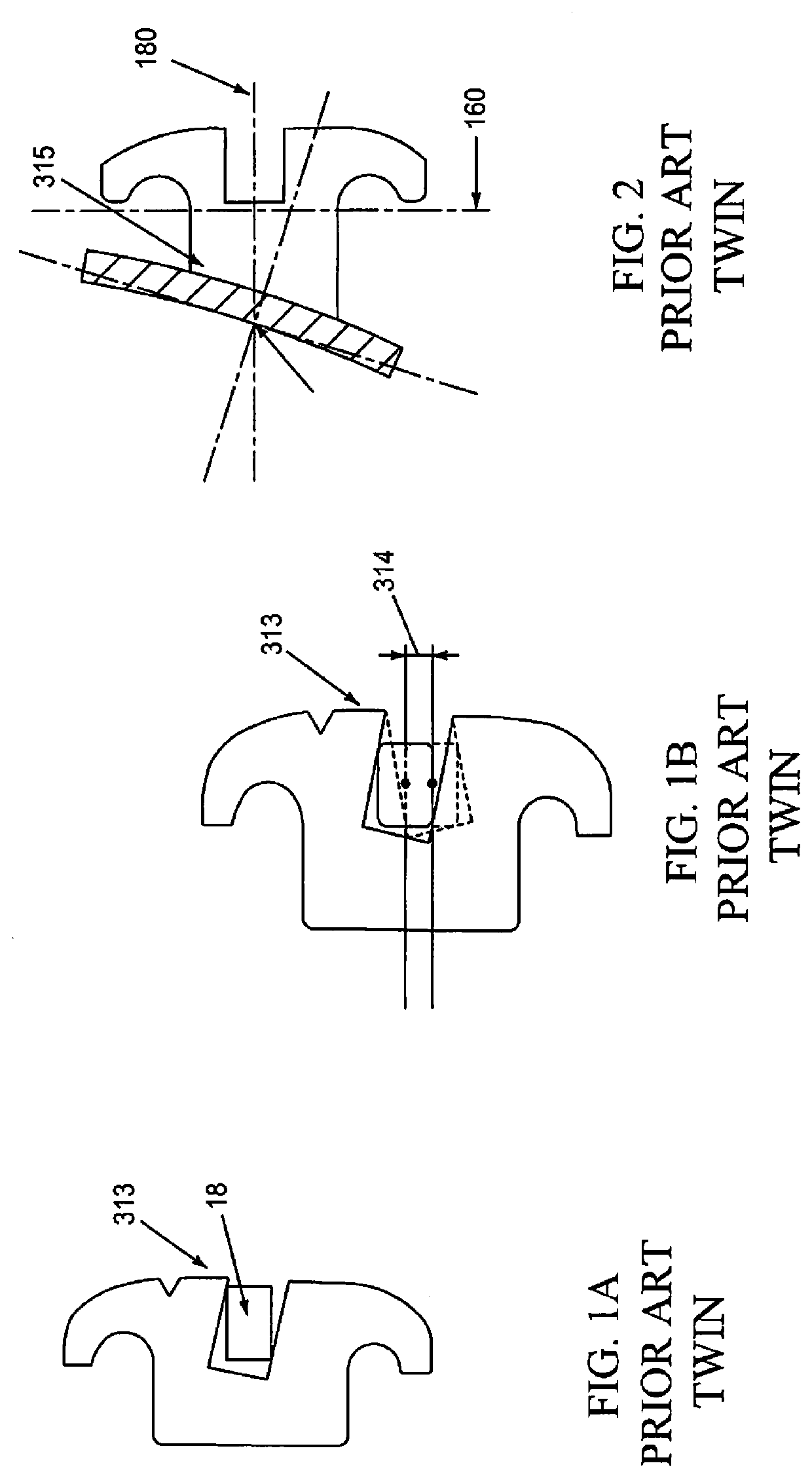
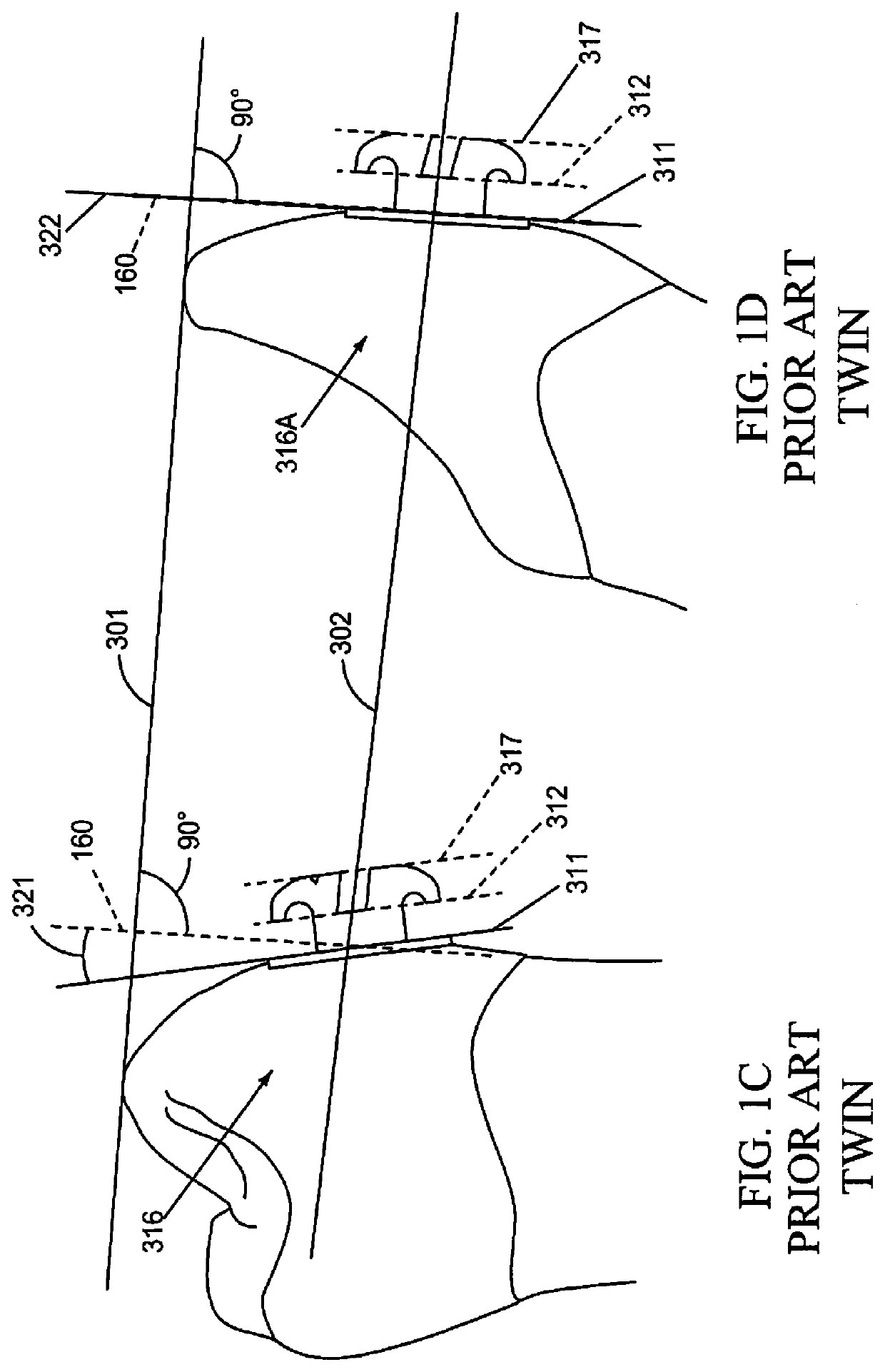
Different torques on adjacent teeth created a significant problem shown in FIG. 1B by lines drawn through the centers of high and low torqueing bracket slots highlighting how the centers of the slots move vertically a distance 314 which negatively impacts treatment
mechanics and final tooth positions.
Another challenge for Twin Technology is that archwires 18 are securely tied against the base of the bracket slot with wire ligatures or elastic ties that cause / generate binding and friction that requires significantly higher treatment forces to move teeth.
Over time, clinicians have widely come to recognize that exerting excessive clinical forces limits / slows
tooth movement; diminishes treatment planning options; dramatically lengthens treatment times; and can cause long-term
tissue damage to bone and tissue.
Experienced clinicians often state, “If I have to make more than one torque bend in an archwire, I cannot predict what the end result will be.”
A second recognized drawback to Twin Brackets is the “Tying-In” or positionally securing archwires 18 frictionally against the base of the bracket slot.
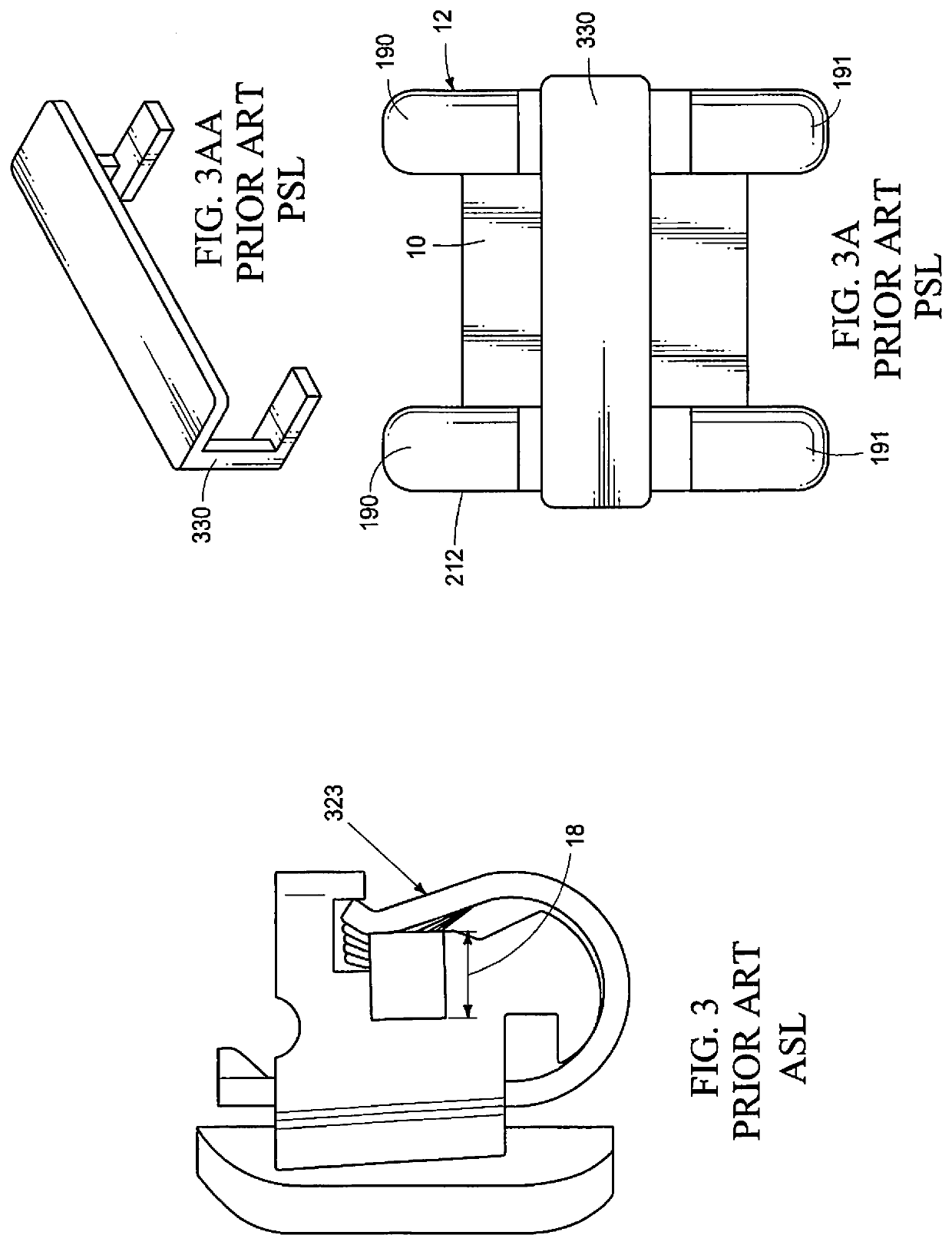
However, ASL still “seats” the archwire 18 directly and frictionally against the base of the bracket slot and still generates binding and friction, but to a lesser degree.
However, generating third order torque control still requires bending torque of bends into archwires by the clinician.
Although an improvement over Twin Technology, ASL did not resolve the need for third order tooth torque control.
However, utilizing known PSL brackets, during the last two-thirds of treatment still required significant time and effort to achieve final third Order “Torque Tooth Control” because finishing archwires still needed to be bent by clinicians to provide torque, which continued to lengthen treatment times more than desired by both patients and clinicians.
The Pletcher design provided improved strength, however, both the upper and lower
dental arch brackets opened vertically or in the “
sight-line” of the clinician making archwire positioning in the bracket slot challenging to visualize during door opening or closing.
This bracket did not resolve the need for clinicians to bend torque bends into archwires to accomplish third order Torque Control of the teeth.
Prior art FIGS. 5A, 53 and 5C of the PSL brackets of U.S. Pat. No. 5,464,347 show how the complexity of support for the door, while achieving standard or neutral torque in the bracket slot is challenging.
The result of installing an archwire 18 in these vertically misaligned slots is patient pain, and excessive biologic forces exerted on the teeth.


 Login to View More
  Login to View More