Annotating unlabeled images using convolutional neural networks
annotating unlabeled images and neural networks, applied in image enhancement, image data processing, instruments, etc., can solve the problems of limiting the applicability and scalability of these models in real world problems, difficult to collect large amounts of data, and in most cases impossible to collect data from the field
- Summary
- Abstract
- Description
- Claims
- Application Information
AI Technical Summary
Benefits of technology
Problems solved by technology
Method used
Image



Examples
Embodiment Construction
1. Supervised Learning of Deep CNNs with Annotated Data
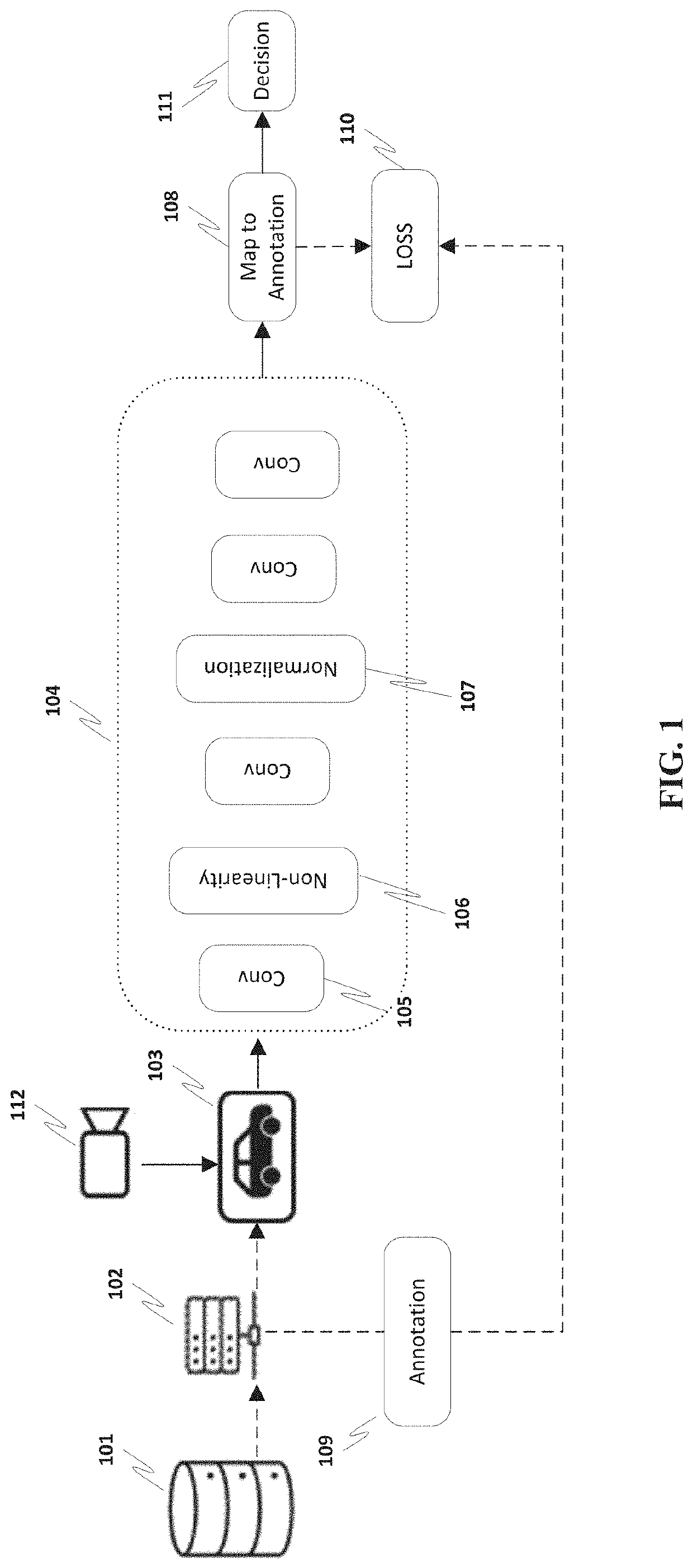
[0030]A feedforward Deep CNN (104FIG. 1), in its basic form, is composed by a large number of convolutional layers (105 in FIG. 1) stacked sequentially, towards a feedforward processing scheme, with some non-linearities (106 in FIG. 1) or normalization layers (107 in FIG. 1) in between. The network is trained in an end-to-end and online manner using typically a large number of annotated images (101 in FIG. 1) from which only a few images (103 in FIG. 1) and their annotations (109 in FIG. 1) are sampled (102 in FIG. 2) at every iteration. The Deep CNN model is trying to minimize a differentiable cost function or combination of differentiable cost functions (110 in FIG. 1) between the ground truth annotations and those predicted by the network (108 in FIG. 1) using forward and backward passes to make predictions and update the weights of the learnable modules respectively.
[0031]During inference, the network is getting only one ima...
PUM
 Login to View More
 Abstract
Description
Claims
Application Information
 Login to View More