
Method for controlling the speed of brushless motors
a brushless electric motor and speed control technology, applied in the direction of electronic commutation motor control, instrumentation, base element modification, etc., can solve the problems of parasitic inductance becoming significant, distorting the measurement of electric current, and ineffective sensors, so as to improve the performance and robustness of the motor control, improve the accuracy of measurement, and achieve the effect of precise determination of the real voltag
- Summary
- Abstract
- Description
- Claims
- Application Information
AI Technical Summary
Benefits of technology
Problems solved by technology
Method used
Image

Examples
Embodiment Construction
[0029]As indicated above, the invention is based on determining the voltage generated by the inductive part of a measuring resistor included in an electronic circuit.
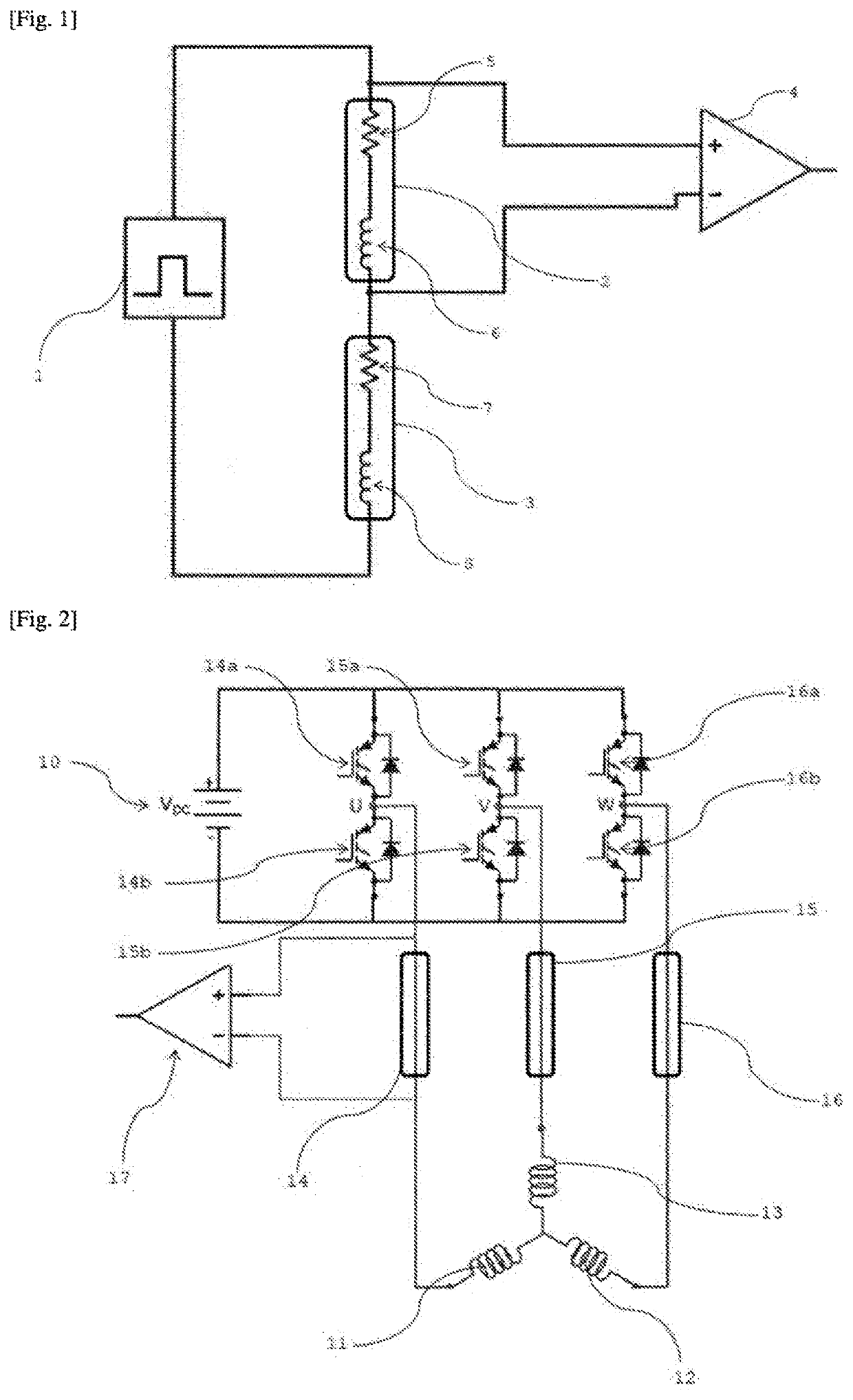
[0030]FIG. 1 shows an electronic circuit comprising a signal generator 1, a resistor 2, a coil or stator winding 3 and a differential amplifier 4 at the terminals of the measuring resistor 2. The resistor 2 is connected to the signal generator 1 and to the stator winding 3, which is itself connected to the signal generator 1.
[0031]The signal generator 1 is able to deliver a signal to the electronic circuit so as to energize the electronic circuit. The signal generator 1 according to the invention generates a DC voltage signal. According to one embodiment of the invention, the signal generator 1 delivers a DC voltage step VDC of known value for a known period of time t.
[0032]The stator winding 3 allows a current to be generated when it is energized. The stator winding 3 comprises a resistive part 7 of resistance RS and a...
PUM
 Login to View More
 Abstract
Description
Claims
Application Information
 Login to View More