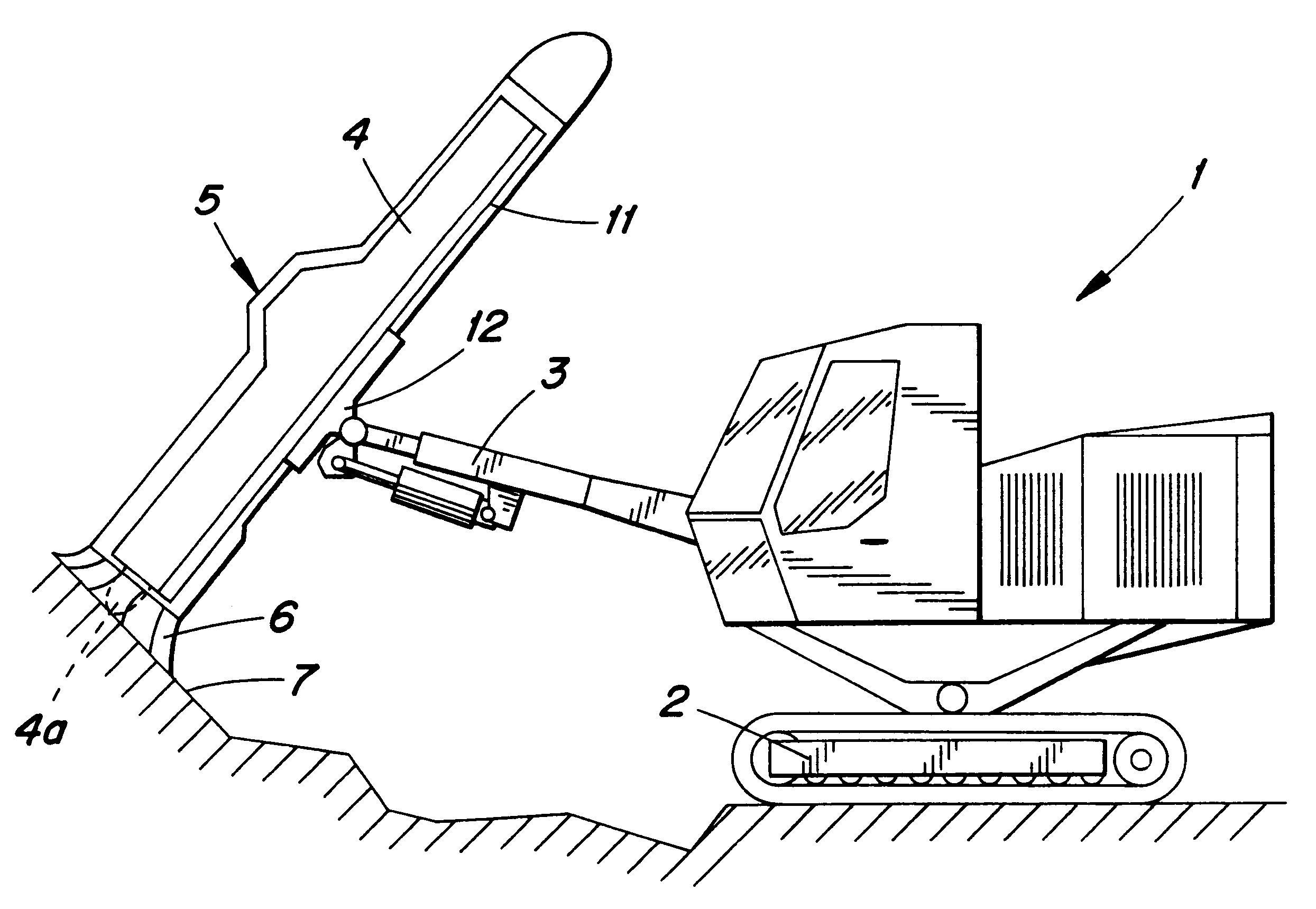
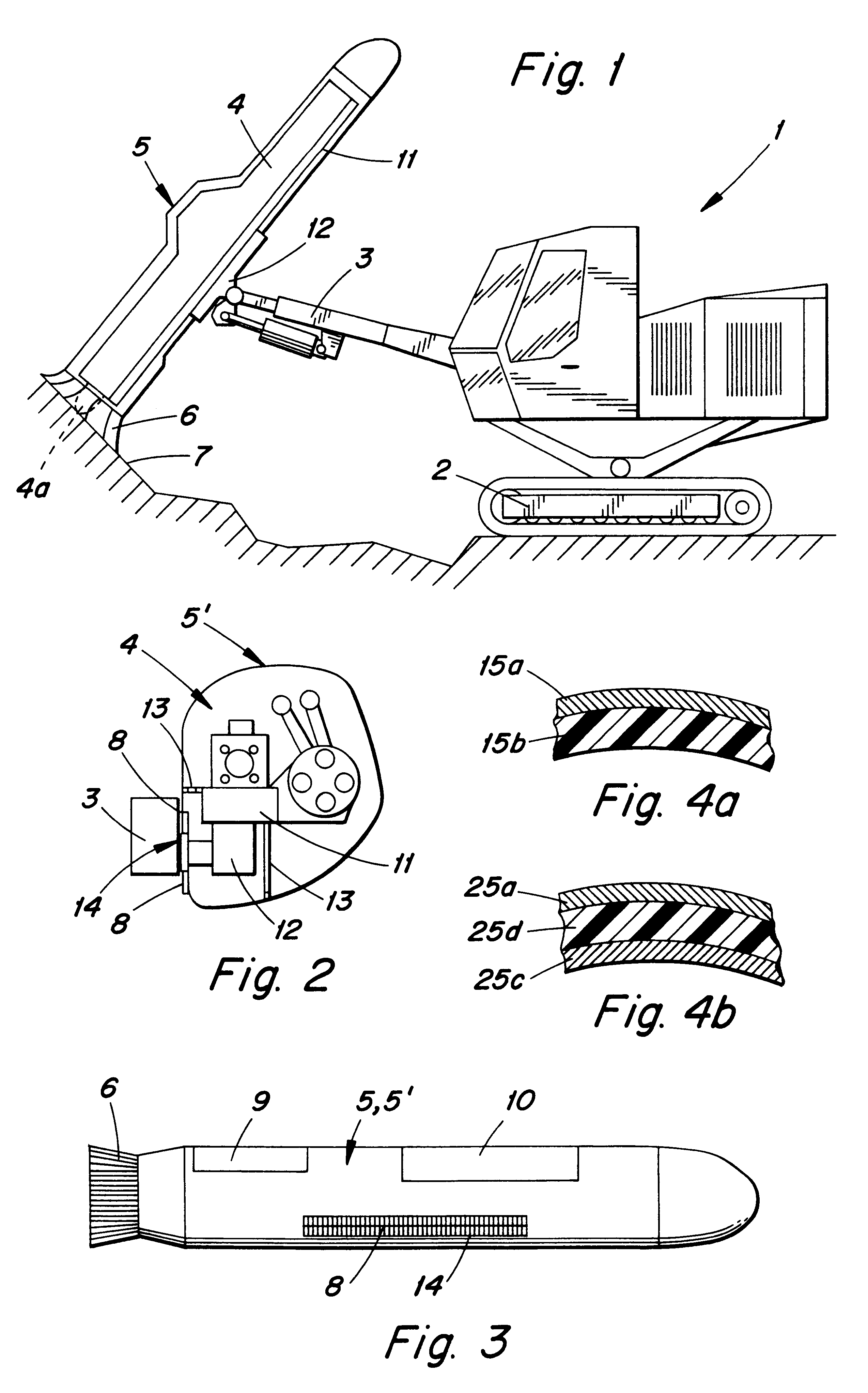
The basic idea behind the present invention is that around the drilling equipment mounted to the free end of the rock drilling rig's boom there is provided a casing structure that prevents the noise generated during drilling from spreading to the surroundings of the drilling site. The casing is arranged to cover both the drilling equipment and the feed beam substantially completely. The lower end of the casing is provided with an opening that allows the
drill rod to be extended therethrough. Essential in the present invention is also that the fastening of the casing is arranged so that the casing is mounted and supported to the feed beam, and the feed beam is movable in relation to the cradle attached to the free end of the boom. An essential point is also that the casing is intended to be mounted so that there is
free space between the casing and the drilling equipment as well as between the casing and the feed beam, whereby the vibrations and noise generated during drilling cannot be so easily transferred to the casing. The basic idea of a first aspect of the present invention is that also the cradle is enclosed by the casing. The basic idea of a second aspect of the present invention is that the opening that enables the movement between the casing and the cradle, or between the casing and the boom end, is provided with a noise curtain that seals the opening but allows casing movements. Further, the basic idea of a third aspect of the present invention is that the noise curtain is made of flexible bristles or strips. The basic idea of a fourth aspect of the present invention is that the casing is, at desired points, provided with hatches that can be opened and closed by
remote control for observing and controlling drilling or the operation of the drilling equipment. Further, the basic idea of a fifth aspect of the present invention is that the casing comprises two nested shells with insulating material between them. Still further, the basic idea of a sixth aspect of the present invention is that the lower and of the casing, i.e. the end that faces the surface to be drilled, is provided with a flexible section that during drilling seals the gap between the lower end of the casing and the surface to be drilled.
The
advantage of encapsulating is that the noise generated during rock drilling can be conveniently insulated and abated, whereby the noise no longer causes problems in the surroundings. This makes it possible to carry out drilling operations more freely even in residential areas, not restricted by the
time of day or day of the week. Therefore, the degree of utilization of drilling equipment can be raised and work projects completed in less time.
Noise protection pursuant to the present invention also improves working conditions, as unpleasant noise no longer exists.
Noise attenuation also increases safety at work, as those working in the area are better able to hear the various warning signals and approaching vehicles. A further
advantage of encapsulating is that it not only offers protection against noise but also serves as mechanical protection for the drilling equipment. The casing provides protection against
dirt and dust both during operation and while in storage, which diminishes faults occurring in the equipment. The casing makes it easier to keep the drilling equipment clean while the casing itself is simple to keep clean. In addition, maintenance and repairs are easier to carry out as the drilling equipment inside the casing is cleaner. Encapsulation also protects the drilling equipment against other external influences, such as
humidity and vandalism. A further
advantage of the casing is that it protects the surroundings and prevents severe
hazard situations in the event of sudden drilling equipment failure whereby broken fragments would fly to the surroundings. The casing also protects against persons getting caught in the
moving parts of the drilling equipment. All in all, encapsulating offers significant advantages in improving safety at work. A further advantage provided by the casing is that as it forms the visible part of the equipment attached to the boom end, it can be used for improving the
general appearance of the rig. The casing need not necessarily be made of any particularly strong material as it is not subjected to considerable forces. The casing does not have any role in the mounting and supporting of the drilling equipment, it merely forms a sound-proof shell around the drilling equipment. Therefore, the casing is easy to install and remove. A further advantage is that as the casing is connected to the drilling equipment only through vibration-dampened rubber bushings or equivalent dampeners, no frame noise and vibrations are transferred to the casing. A solution pursuant to the invention, with the feed beam also encapsulated, provides far better
noise attenuation than solutions where noise can freely spread to the surroundings via the feed beam.



 Login to View More
  Login to View More