
Soft-switched quasi-single-stage (QSS) bi-directional inverter/charger
a bi-directional inverter and charger technology, applied in the field of bi-directional converters, can solve problems affecting its performance and desirability
- Summary
- Abstract
- Description
- Claims
- Application Information
AI Technical Summary
Problems solved by technology
Method used
Image


Examples
Embodiment Construction
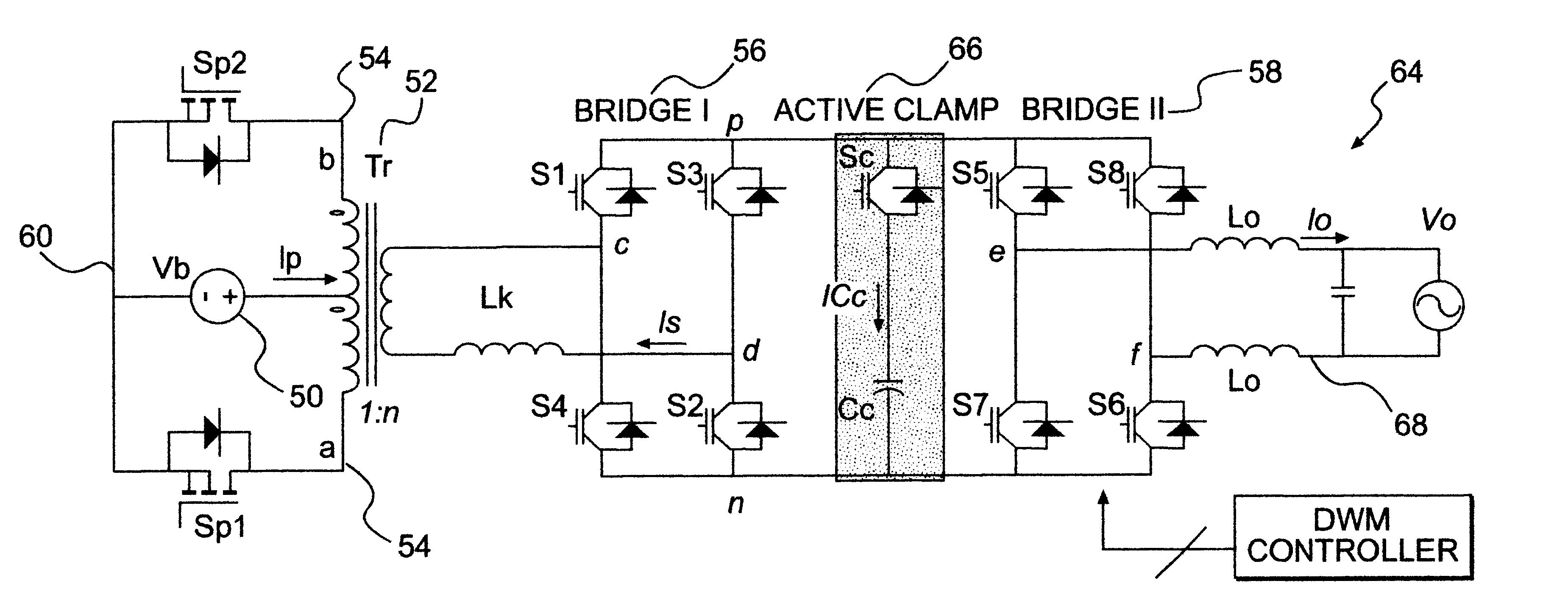
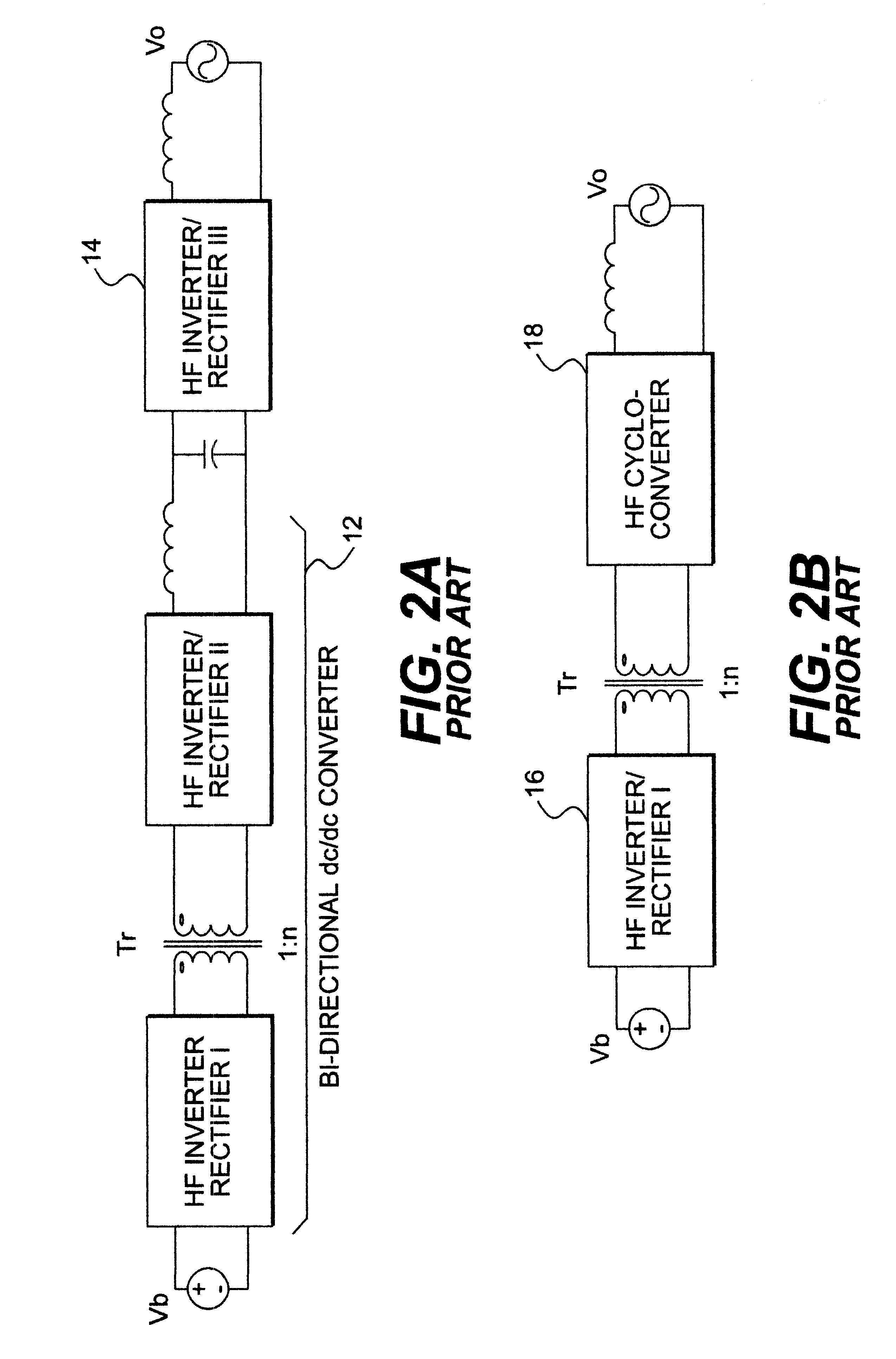
To facilitate discussion and comparison, a prior art bi-directional cycloconverter-based single-stage inverter / chargers with a bi-directional active clamp is drawn in FIG. 3. Considering the fact that the dc side 30 is usually a low voltage, e.g. 12 V or 24 V, battery, a voltage-fed push-pull topology is justified; the ac side 32 voltage is usually much higher, e.g. 110 V or 220 V, a full-bridge cycloconverter can be used, especially in cases where the power level is relatively high. Because it is desired to achieve rectification with power factor correction (PFC) when the converter operates in charger mode, the output side has to be current-fed to achieve the required boost action.
The bi-directional active clamp circuit 34 consists of four active switches, S.sub.C1 -S.sub.C4, four directing diodes, D.sub.1 -D.sub.4, and a clamp capacitor, C.sub.C. Coupled with suitable PWM scheme, it can suppress the otherwise high transient voltage in the cycloconverter and achieve secure operatio...
PUM
 Login to View More
 Abstract
Description
Claims
Application Information
 Login to View More