Unlock instant, AI-driven research and patent intelligence for your innovation.

Execution control for process task

a process task and task technology, applied in the field of processor task management, can solve the problems of prior art approach, task consuming a lot of processing bandwidth, and standard commercially available microcomputers that have not had the requisite processing power in order,

Inactive Publication Date: 2005-02-08
APPLE INC
View PDF6 Cites 29 Cited by
  • Summary
  • Abstract
  • Description
  • Claims
  • Application Information

AI Technical Summary

Benefits of technology

One of the objects of the present invention is to provide an efficient means for task organization which groups tasks by function.
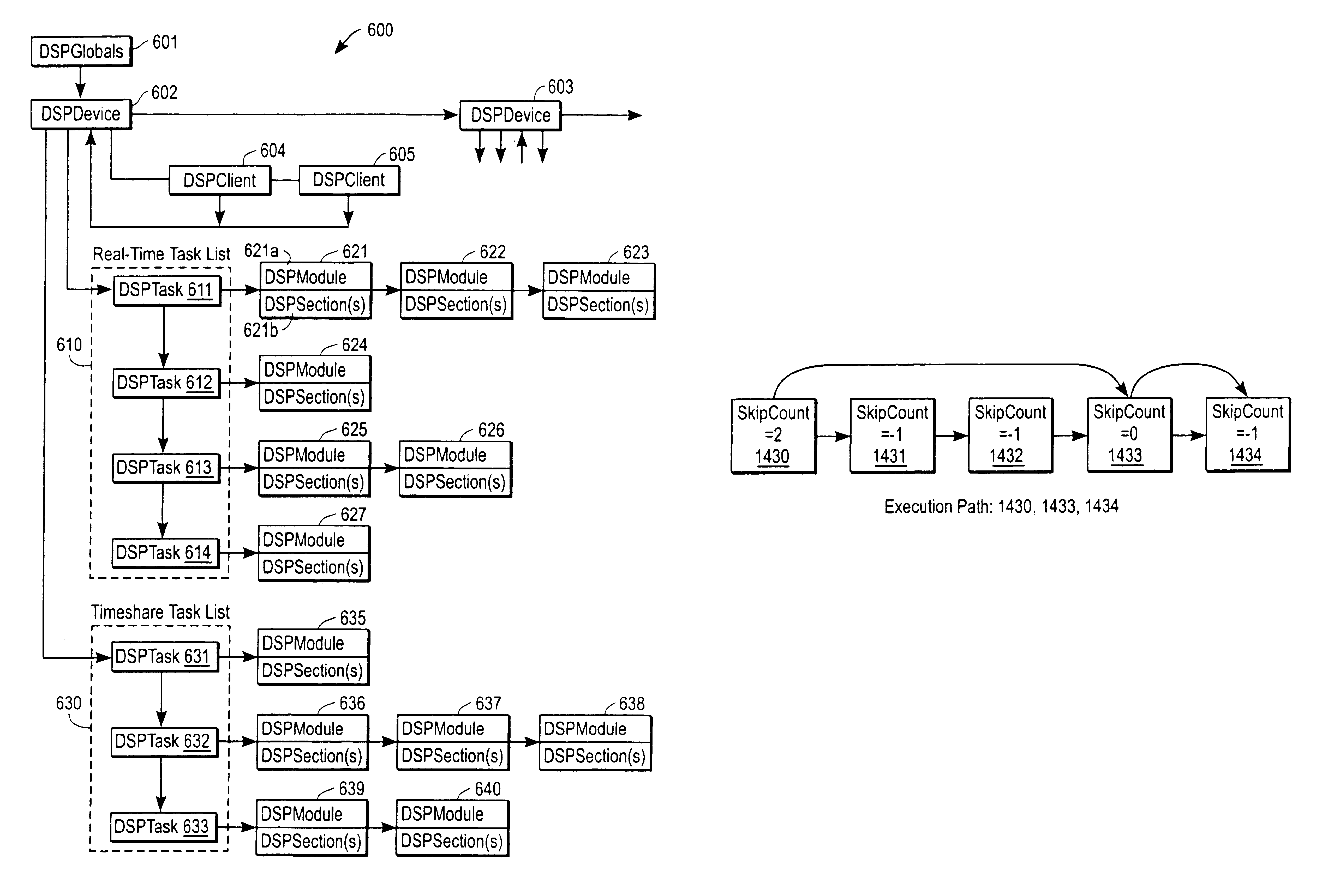
These and other objects of the present invention are provided for by a method and apparatus for controlling the activation of a set of tasks on one or more processors. In one embodiment, the tasks are stored in one or more execution task lists, one task list per processor, and the processors are digital signal processors. This method creates a list of tasks to be activated, including the timing relationship for the activation process. The list is then implemented as frame numbers for activation and requested state in the actual task list. Finally, the executing processor compares the requested state to the actual state for each task, and if different, compares the value of the activation frame with the current frame. If the current frame equals or exceeds the activation frame, then the requested active state is transferred to the actual state. This method eliminates any waiting for the client setting the activation process-up, and works well for activation and deactivation of tasks. Furthermore, task activation sequences are supported, allowing multiple processor functions to be created, where the producer task must start to generate data one frame prior to the consumer task starting to receive data.

Problems solved by technology

Standard commercially available microcomputers have typically not had the requisite processing power in order to perform all these tasks in a real-time environment.
However, even when using a digital signal processor, tasks consuming a lot of processing bandwidth still need to be managed in an efficient way in order for all the requisite processing to be done within specific intervals of time.
In addition, this prior art approach suffers from the defect that there is no distinction between tasks which require servicing at regular intervals and those which require servicing only occasionally.
Therefore, overall execution time of the processor may be hampered (and certain applications hindered, or not able to run at all) by executing both types of tasks without regard for the tasks' timing requirements.
In addition, because each of the tasks are linked sequentially, resource allocation may not be done optimally according to a function's activity which comprises one or more tasks.
For instance, certain of the tasks linked sequentially may be related and thus unnecessary or inefficient resource allocation for each of the tasks may be performed.
Yet another shortcoming of the prior art organization of tasks is that error conditions which are generated on one task may or may not necessarily abort other dependent tasks.
This will prevent the execution of the task because it will not function properly in the absence of the previous task completing normally.
This requires extra work for the programmer, plus extra overhead for the processing system.
In general, client or process management of tasks is difficult using the prior art sequential method of task servicing and execution.
The prior art sequential task execution list also fails to provide a means for performing certain groups of tasks in different sequences.
Certain tasks may be run unnecessarily even where a prior control task has ascertained that only limited number of related tasks need to be executed.
Again, needless overhead is consumed by calling each task for execution, even if not required, due to loading and saving the processor context and retrieving the requested resources from memory or non-volatile storage.
This requires that the programmer has a more in-depth knowledge of the underlying operating system and its organization of functions, as well as adds additional complexity to each of the tasks which are linked.
This results in difficulty in managing real-time resources, and may cause the failure of a real-time process due to incorrectly determining the required execution load.

Method used

the structure of the environmentally friendly knitted fabric provided by the present invention; figure 2 Flow chart of the yarn wrapping machine for environmentally friendly knitted fabrics and storage devices; image 3 Is the parameter map of the yarn covering machine
View more

Image

Smart Image Click on the blue labels to locate them in the text.
Viewing Examples
Smart Image
  • Execution control for process task
  • Execution control for process task
  • Execution control for process task

Examples

Experimental program
Comparison scheme
Effect test

Embodiment Construction

This application is related to the following co-pending patent applications filed concurrently herewith:

A patent application entitled INTERTASK BUFFER AND CONNECTIONS, whose inventors are A. Philip Sohn and Eric Anderson, which has been assigned Ser. No. 07 / 954,902, now U.S. Pat. No. 5,848,295.

A patent application entitled A METHOD AND MEANS FOR PROVIDING MULTIPLE CLIENTS SIMULTANEOUS ACCESS TO A SOUND DATA STREAM, whose inventors are Eric Anderson and Hugh Svendsen, which has been assigned Ser. No. 07 / 954,873, now U.S. Pat. No. 5,384,890.

A patent application entitled APPARATUS AND METHOD FOR HANDLING FRAME OVERRUNS IN A DIGITAL SIGNAL PROCESSING SYSTEM, whose inventors are Eric Anderson and Hugh Svendsen, which has been assigned Ser. No. 07 / 954,758, now U.S. Pat. No. 5,388,261.

A patent application entitled APPARATUS AND METHOD FOR ALLOCATING PROCESSING TIME IN A FRAME-BASED COMPUTER SYSTEM, whose inventors are Eric Anderson and A. Philip Sohn, which has been assigned Ser. No. 07 / 95...

the structure of the environmentally friendly knitted fabric provided by the present invention; figure 2 Flow chart of the yarn wrapping machine for environmentally friendly knitted fabrics and storage devices; image 3 Is the parameter map of the yarn covering machine
Login to View More

PUM

No PUM Login to View More

Abstract

Method and means for controlling the execution sequence of a first sequence of modules in a first task. The first sequence of modules are linked to one another and have at least one sequence of execution. The method stores in each of the first sequence of modules a skip value representing which of subsequent modules to execute. The method executes the first of the first sequence of said modules, and then executes the next of the modules indicated by the skip value. Conservation of processor bandwidth is accomplished by avoiding the loading of modules which will not be executed.Method and means are further provided for simultaneous activation / deactivation of a set of tasks by a processor, each of the tasks normally executed in a sequential fashion by one or more processors. A list of tasks to be activated / deactivated is stored, including the timing relationship for the activation process. The list is then implemented as frame numbers for activation and requested state in the actual task list. The executing processor compares the requested state to the actual state for each task, and if different, compares the value of the activation frame with the current frame. If the current frame equals or exceeds the activation frame, then the requested active state is transferred to the actual state.

Description

BACKGROUND OF THE INVENTION1. Field of the InventionThe present invention relates to processors in computer systems. Specifically, the present invention relates to task management in a processor.2. Background InformationModern applications, such as multimedia applications where text, audio, speech, video, and data communications are all processed in real-time, have special requirements. Standard commercially available microcomputers have typically not had the requisite processing power in order to perform all these tasks in a real-time environment. Modern architectures which are designed to handle the load associated with operating these types of tasks in real-time has sometimes dictated the use of a digital signal processor (DSP). However, even when using a digital signal processor, tasks consuming a lot of processing bandwidth still need to be managed in an efficient way in order for all the requisite processing to be done within specific intervals of time.One approach to task man...

Claims

the structure of the environmentally friendly knitted fabric provided by the present invention; figure 2 Flow chart of the yarn wrapping machine for environmentally friendly knitted fabrics and storage devices; image 3 Is the parameter map of the yarn covering machine
Login to View More

Application Information

Patent Timeline
no application Login to View More
IPC IPC(8): G06F9/48G06F9/46
CPCG06F9/4887
Inventor ANDERSON, ERIC C.SVENDSEN, HUGH B.
Owner APPLE INC