Check patentability & draft patents in minutes with Patsnap Eureka AI!

Dental drill system and method of use

Inactive Publication Date: 2005-03-08
EVOLLUTION IP HLDG
View PDF15 Cites 53 Cited by
  • Summary
  • Abstract
  • Description
  • Claims
  • Application Information

AI Technical Summary

Benefits of technology

The present invention provides a new dental drill system, and a method of use therefor, adapted for the preparation of osteotomys. The inventive dental drill system comprises a series of dental drills that are adapted to quickly and accurately allow a dentist or a doctor to efficiently form an osteotomy of a predetermined depth and diameter within a patient, for example within the patient's 's jawbone for receiving a dental implant of known construction therein.
A method of using a dental drill system to form an osteotomy opening of a predetermined depth and diameter is also disclosed, the method comprising using a starter drill to define at least a portion of the osteotomy opening, using at least one elongate depth drill of a first diameter to drill the osteotomy opening to the predetermined depth, and using at least one elongate width increasing drill of a second greater diameter greater than the first diameter to increase the diameter of the osteotomy opening to the predetermined diameter.
Once the osteotomy opening is drilled to the desired depth, at least one width increasing drill, and possibly a series of width increasing drills, each of progressively greater diameter, is used by the dental surgeon to open or widen the osteotomy to the desired diameter corresponding to the diameter of the dental implant to be placed therein. Each respective width increasing drill is passed into the opening created by the depth drill, and together the width increasing drills are used to progressively and accurately increase the width of the osteotomy so that it closely corresponds to the diameter of the dental or surgical implant being placed therein.
In a preferred embodiment, the diameter of the respective width increasing drills may begin with a diameter of 2.0 millimeters, and extend in increments less than or equal to 0.5 millimeters, up to 5.0 millimeters in diameter, or until the final and desired osteotomy diameter is attained. Using this sequence of drills, therefore, the dental surgeon has much improved control over the angulation of the osteotomy. Additionally, the incremental steps of the width increasing drills used in the drilling sequence described above act to reduce any excess heat that may be generated by the process, and to also help to prevent thermal necrosis of the surrounding tissues.
Among the advantages of the inventive dental drill system, therefore, to include the depth drill and the width increasing drills thereof, when compared to conventional dental drills is that the dental surgeon is now provided with the means to greatly improve their control over the formation of the osteotomy. No longer is there a need for the surgeon to rely on estimated depth markings placed or marked on the drill or drills being used in order to reach the desired osteotomy depth, which markings are generally difficult to see during surgery. Rather the disclosed drill system performs this function and removes the imprecision and guesswork, from the process of forming an osteotomy, and permits much greater control of the process and the finished osteotomy.

Problems solved by technology

Although the use of crowns is well known and accepted, problems may persist with the health of the underlying tooth structure and thus the durability of both the tooth and the crown.
Some of the known problems that arise with the preparation of the osteotomy are that it is being prepared within the limited confines of a patient's mouth, and as such the dental surgeon is oftentimes required to estimate the depth of the opening being drilled into the patient's jawbone, as well as estimating the size, i.e., the diameter, of the opening being formed so that the opening has the necessary width and / or diameter for receiving and seating the base portion of the dental implant therein.
This is an imprecise method, however, of responding to an exacting requirement for ensuring that the implant is properly seated within the patient's jaw, and for avoiding anatomic landmarks such as the patient's mandibular nerve or sinus cavities.

Method used

the structure of the environmentally friendly knitted fabric provided by the present invention; figure 2 Flow chart of the yarn wrapping machine for environmentally friendly knitted fabrics and storage devices; image 3 Is the parameter map of the yarn covering machine
View more

Image

Smart Image Click on the blue labels to locate them in the text.
Viewing Examples
Smart Image
  • Dental drill system and method of use
  • Dental drill system and method of use
  • Dental drill system and method of use

Examples

Experimental program
Comparison scheme
Effect test

first embodiment

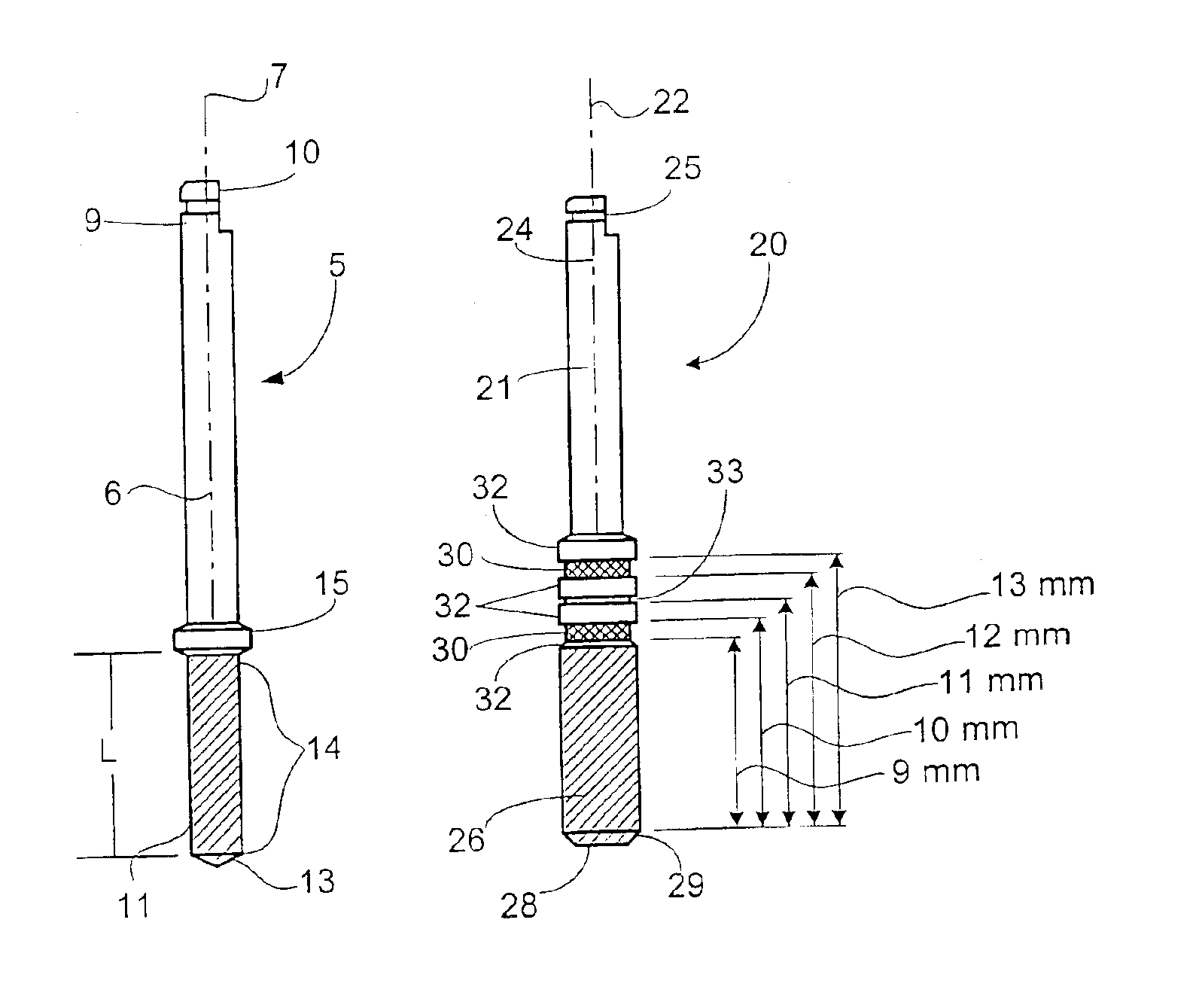
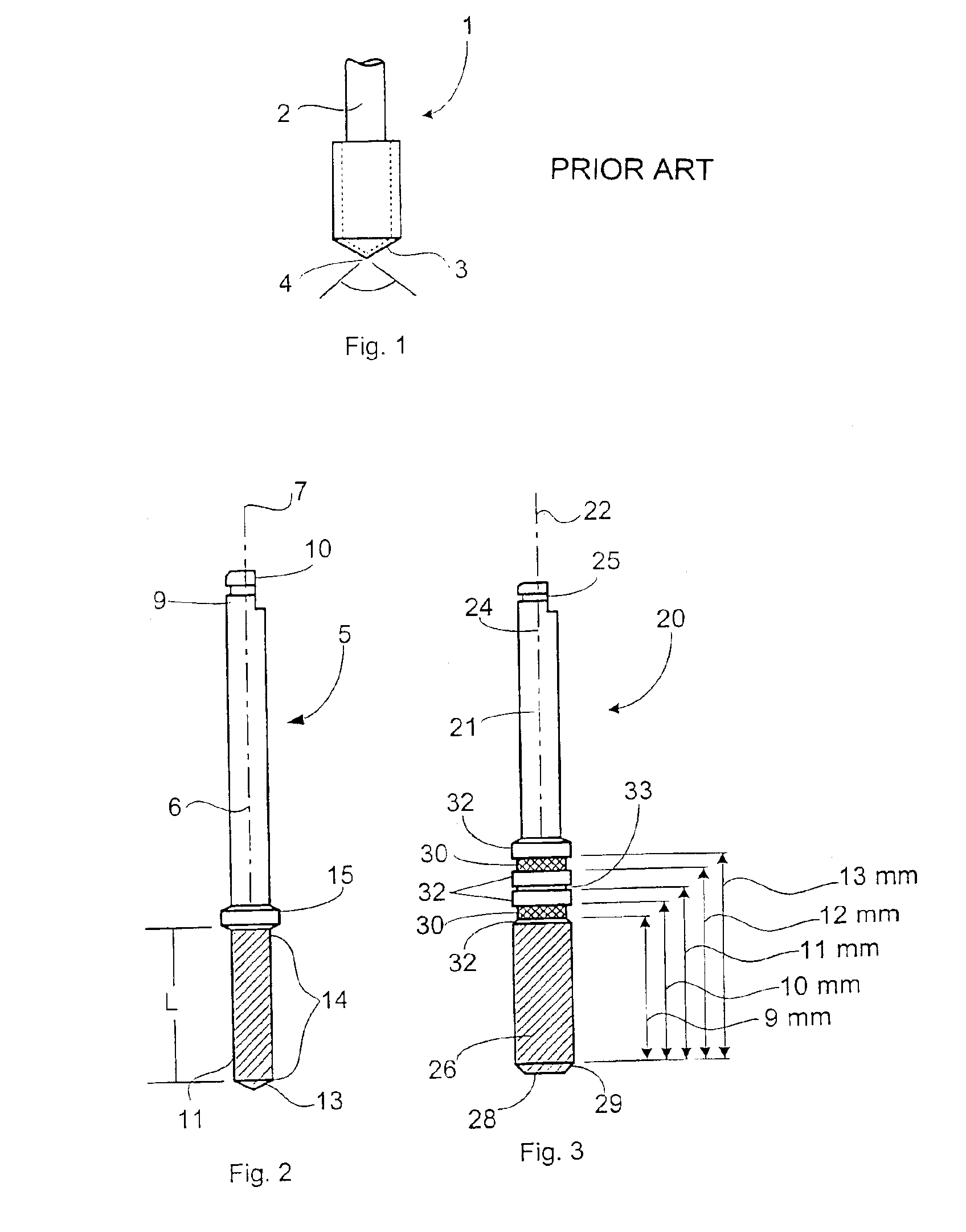
Referring now to FIGS. 3 and 8, a width increasing drill 20 of the dental drill system is illustrated. The width increasing drill has an elongate body 21 formed about a longitudinal axis 22, with a first end 24 at which a conventional right angle latch or chuck 25 is formed. Although a right angle latch is illustrated, as known to those of skill in the art, any known type of latch, chuck, or drive connection may be used in place of the right angle latch or chuck, as desired, for any of the several embodiments of the depth and width increasing drills of the invention. So constructed, the right angle latch, or other drive connection, for both of the depth and the width increasing drills can be readily affixed to any of the known types of dental drill handpieces currently in use, and as may be developed in the future.

The width increasing drill 20 has a second end 26, at which a flat, a straight, or a “blunt” drill tip 28 is defined. The cutting geometry 29 of the drill tip is defined a...

second embodiment

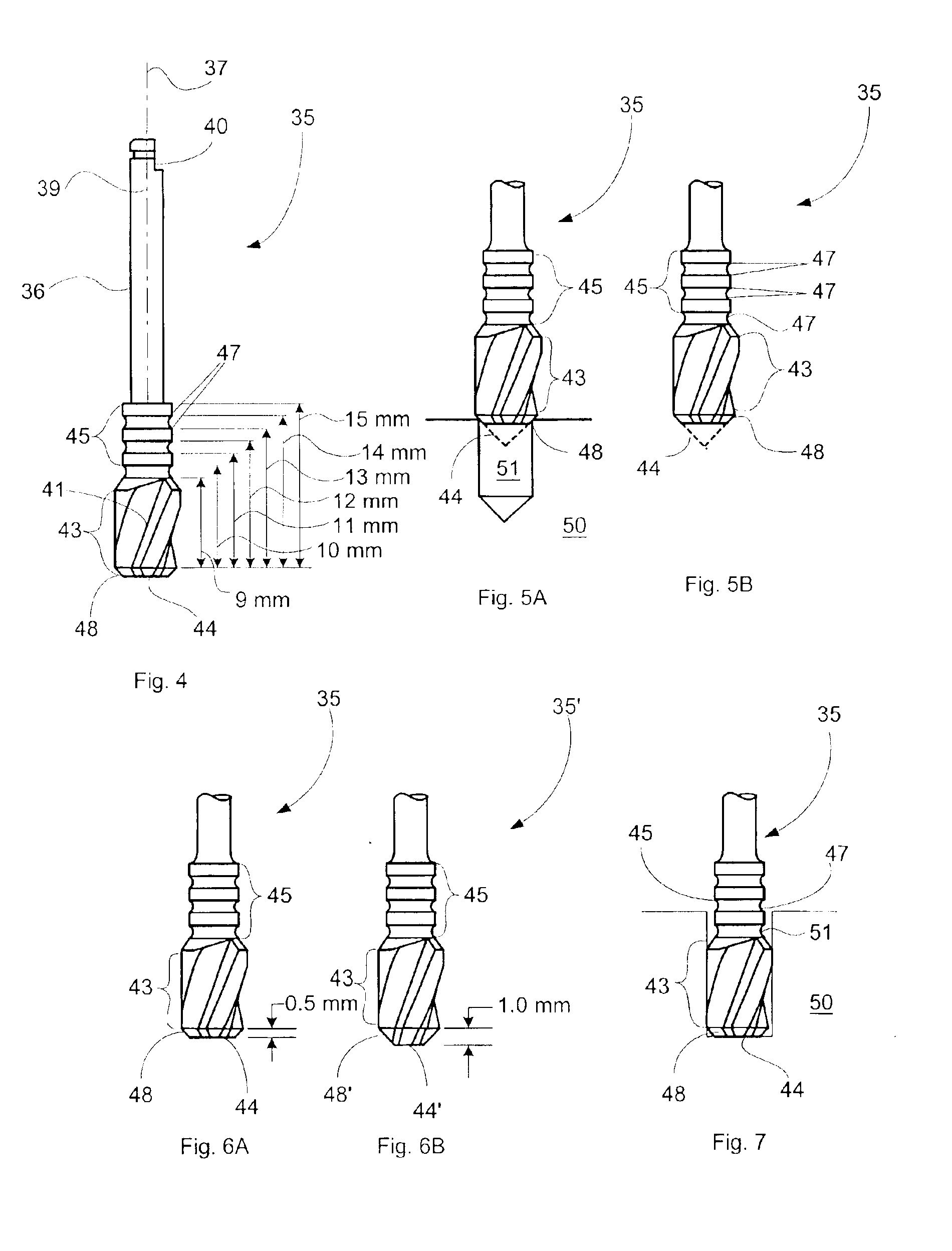
a width increasing drill 35 of the dental drill system is illustrated in FIGS. 4 through 7. The width increasing drill 35 has an elongate body 36 formed about a longitudinal axis 37, with a first end 39 at which a conventional right angle latch or chuck 40, or other desired drive connection / construction, is formed. The width increasing drill 35 has a second end 41, at which a flat drill tip 44 is defined.

A cutting geometry 43 is defined about the exterior periphery, and at the second end of the drill, i.e., the drill tip, extending in the lengthwise direction thereof, and is constructed as described herein such that the width increasing drill acts to remove material only from the sides of the osteotomy opening, and not to otherwise increase the depth of the osteotomy, as discussed above. The cutting geometry 43 can again be of any desired and / or conventional cutting geometry, for example it may comprise a spiral, a helical, or a spade bit, or any other known type of cutting geometry...

third embodiment

the width increasing drill 20′ is illustrated in FIG. 8. The width increasing drill 20′ is formed identically to the width increasing drill 20 described above, with the exception that the diameter of the width increasing drill 20′ is progressively greater than that of the drill 20. A third embodiment of a width increasing drill 75 is also illustrated in FIG. 8. Referring now to FIG. 8, the width increasing drill 75 has an elongate body 76 formed about a longitudinal axis, with a first end 77 at which a conventional right angle latch, or chuck, or a suitable or drive connection 78 is formed. The width increasing drill 75 also has a second end 79 at which a flat blunted drill tip 80 is defined.

As for the other embodiments of the width increasing drill 20, 35, respectively, the width increasing drill 75 also has a series of spaced and recessed annular depth grooves 82 extending in the lengthwise direction of the drill body, each depth groove being formed in and about the drill body at ...

the structure of the environmentally friendly knitted fabric provided by the present invention; figure 2 Flow chart of the yarn wrapping machine for environmentally friendly knitted fabrics and storage devices; image 3 Is the parameter map of the yarn covering machine
Login to View More

PUM

No PUM Login to View More

Abstract

A dental drill system for use in preparing an osteotomy of a predetermined depth and diameter sized to receive a dental implant therein is disclosed. The drill system comprises at least one elongate depth drill of a first diameter adapted to drill the osteotomy opening to the predetermined depth, and at least one elongate width increasing drill of a second greater diameter adapted to size the diameter of the osteotomy opening to the predetermined diameter. The invention also teaches a method of using the dental drill system to form the osteotomy opening, the method comprising the steps of using a starter drill to define at least a portion of the osteotomy opening, using at least one elongate depth drill of a first diameter to drill the osteotomy opening to the predetermined depth, and using at least one elongate width increasing drill of a second greater diameter greater than the first diameter to increase the diameter of the osteotomy opening to the predetermined diameter.

Description

FIELD OF THE INVENTIONThe invention relates in general to drills used in dental surgical procedures. More particularly, the invention relates to improved dental drills, a dental drill system, and a method for using same by a dental surgeon in preparing a properly sized osteotomy within a patient's jaw for the receipt of a dental implant therein.BACKGROUND OF THE INVENTIONThe use of dental implants is well known, and dental implants have proven to be a durable and efficient means of replacing a lost tooth. Typically, when a patient breaks a tooth their options are either to have the tooth pulled or crowned. In order to crown a tooth, the root structure of the tooth must be undamaged and properly seated within the jawbone. Thereafter a permanent crown is fabricated by a dental laboratory for being received on and cemented to a prepared portion of the tooth extending above the gum line. Although the use of crowns is well known and accepted, problems may persist with the health of the u...

Claims

the structure of the environmentally friendly knitted fabric provided by the present invention; figure 2 Flow chart of the yarn wrapping machine for environmentally friendly knitted fabrics and storage devices; image 3 Is the parameter map of the yarn covering machine
Login to View More

Application Information

Patent Timeline
no application Login to View More
IPC IPC(8): A61C8/00
CPCA61C8/0089
Inventor STRONG, J. TODDMISCH, CARL E.BECK, GEORGE
Owner EVOLLUTION IP HLDG
Features
  • R&D
  • Intellectual Property
  • Life Sciences
  • Materials
  • Tech Scout
Why Patsnap Eureka
  • Unparalleled Data Quality
  • Higher Quality Content
  • 60% Fewer Hallucinations
Social media
Patsnap Eureka Blog
Learn More