
Digital signal conversion apparatus, digital signal conversion method, and computer-readable recording medium in which digital signal conversion program is recorded
a digital signal and conversion method technology, applied in pulse conversion, pulse technique, instruments, etc., can solve the problems of difficult to practically perform 3-value pwm of a digital signal using together with the interpolation method, and the non-linear distortion becomes higher than the case, so as to reduce the quantization noise, reduce the non-linear distortion, and reduce the effect of non-linear distortion
- Summary
- Abstract
- Description
- Claims
- Application Information
AI Technical Summary
Benefits of technology
Problems solved by technology
Method used
Image

Examples
first embodiment
(First Embodiment)
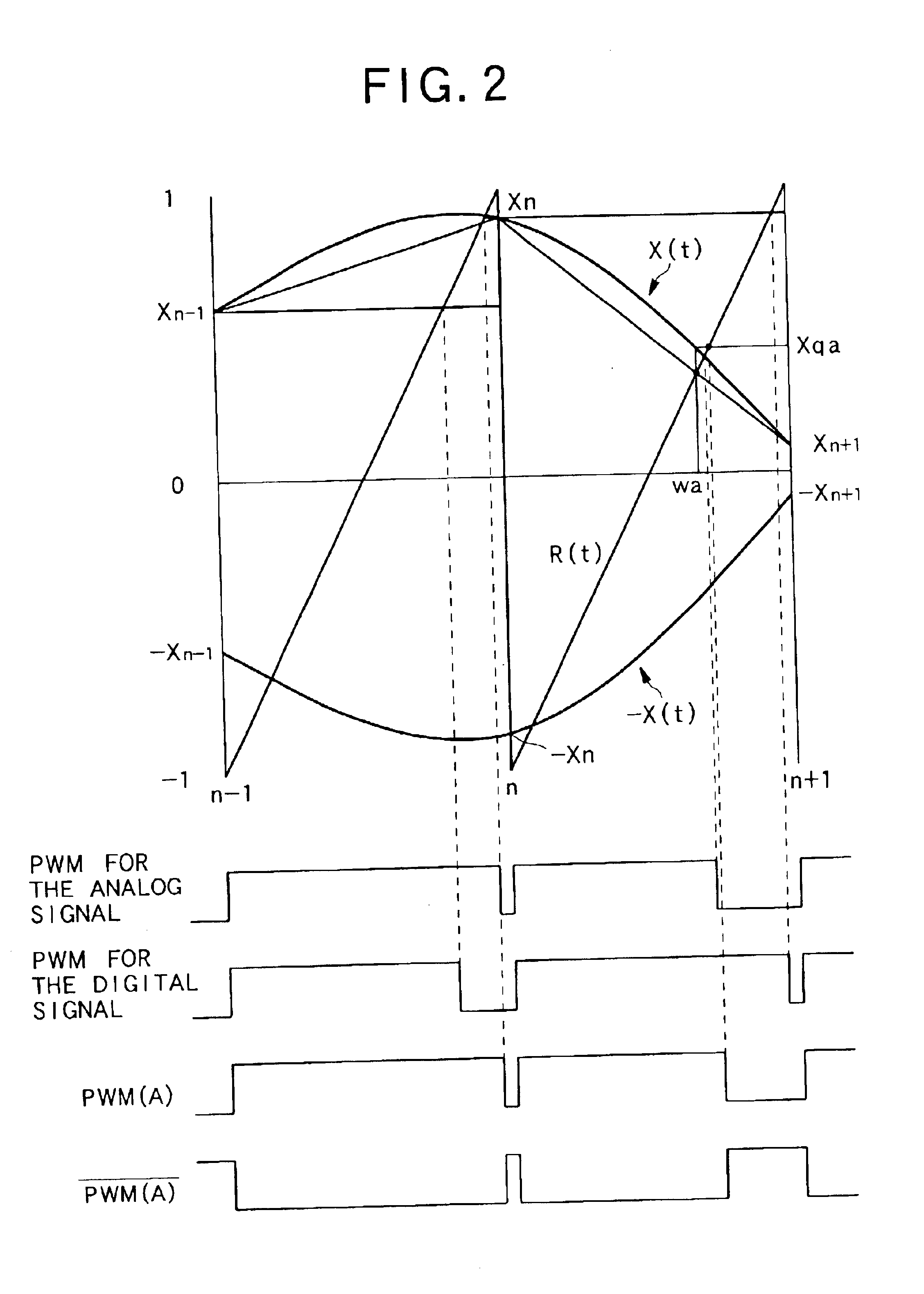
A first embodiment of the digital signal conversion apparatus of this invention will be explained by using FIG. 1 to FIG. 9.
This embodiment is a digital signal conversion apparatus that drives a load using a three-value PWM signal, and together with increasing the accuracy of interpolation and reducing non-linear distortion. It is an example of a digital signal conversion apparatus that has good power efficiency since an output is zero when on input digital signal is zero.
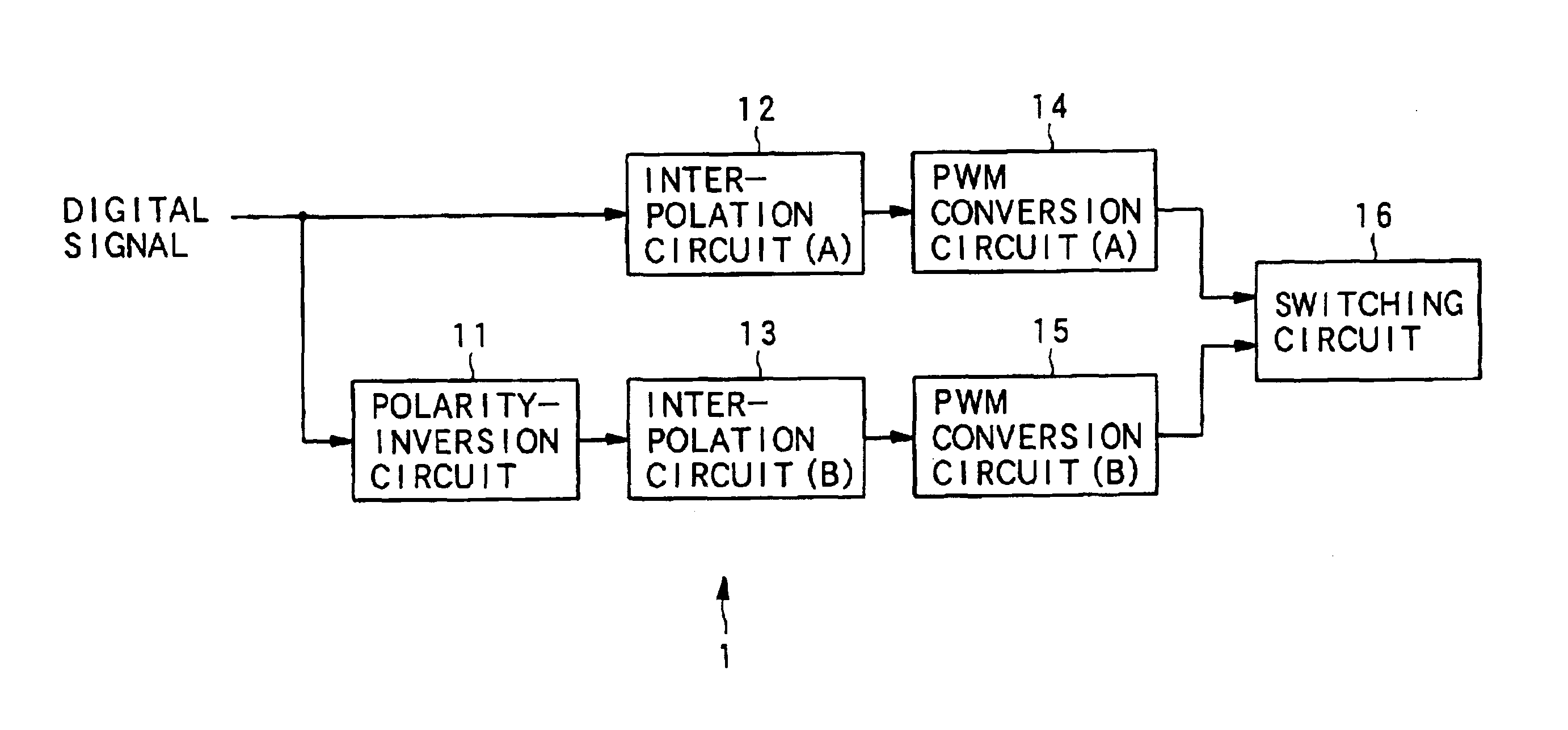
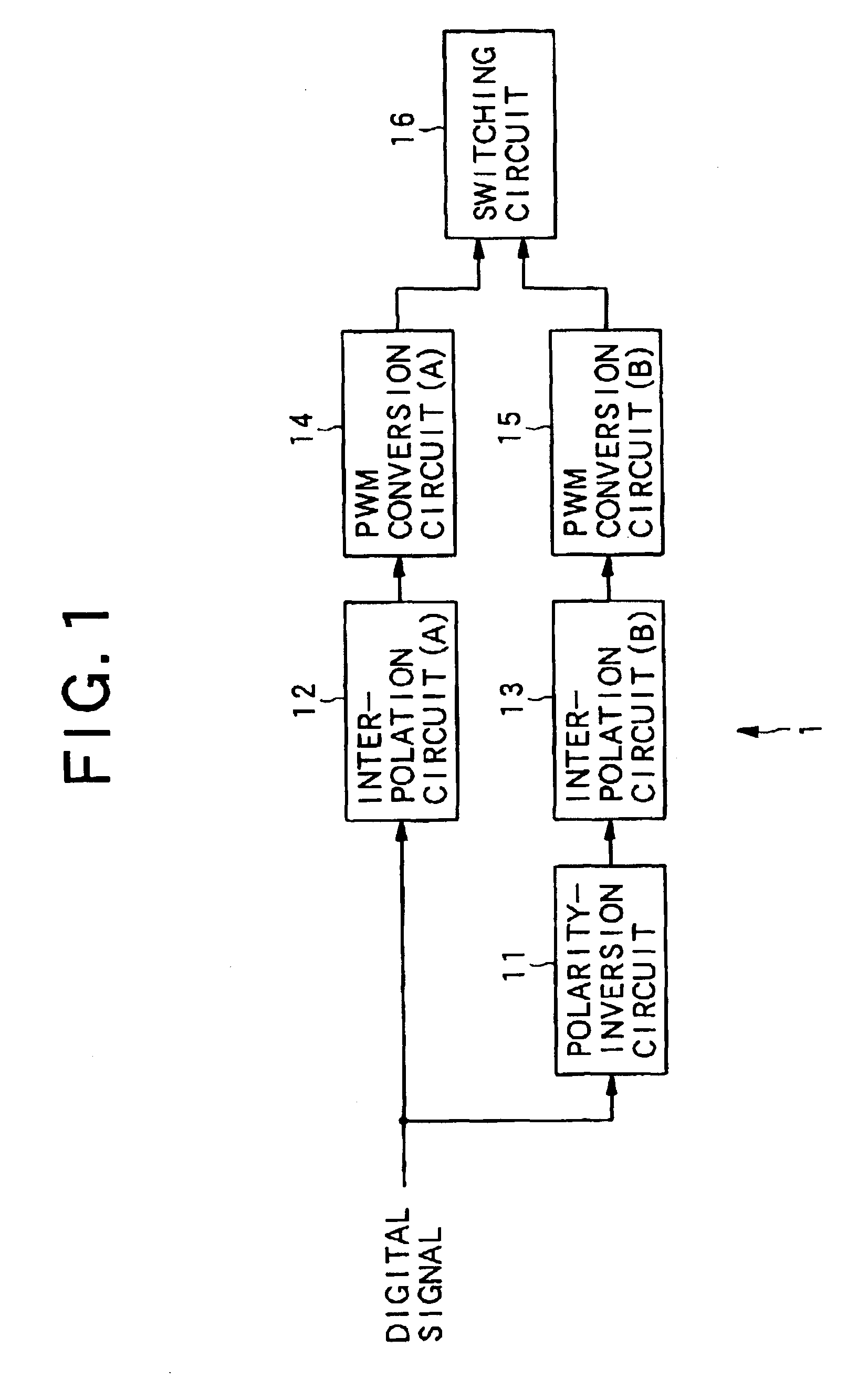
FIG. 1 is a block diagram showing the construction of the digital signal conversion apparatus of a first embodiment of the invention.
As shown in FIG. 1, the digital signal conversion apparatus 1 of this embodiment comprises: a polarity-inversion circuit 11 that inverts the input digital signal; an interpolation circuit (A) 12 that performs interpolation (described later) of the input digital signal; an interpolation circuit (B) 13 that performs interpolation (described later) of the inverted digit...
embodiment 2
(Embodiment 2)
Next, a second embodiment of the digital signal conversion apparatus of this invention will be explained by using FIG. 12 to FIG. 14.
In this embodiment, a digital signal conversion apparatus drives load using a three-value PWM signal, and together with improving the accuracy of approximation by interpolation and reducing non-linear distortion, it improves power efficiency since the output is zero when the input digital signal is zero, and furthermore it has little quantization noise in the audible range.
FIG. 12 is a block diagram showing the construction of the digital signal conversion apparatus of this second embodiment of the invention.
As shown in FIG. 12, the digital signal conversion apparatus of this embodiment comprises: a over-sampling circuit 21 that samples the input digital signal at high frequency; a polarity-inversion circuit 22 that inverts the polarity of the digital signal sampled by the over-sampling circuit 21; an interpolation circuit (A) 23 that per...
PUM
 Login to View More
 Abstract
Description
Claims
Application Information
 Login to View More