[0043]points positions can be slightly and randomly displaced relatively to their underlying grid, for example in the case of slight random local distortions or random bending
attack (RBA), without loss in robustness while estimating the globally applied
distortion;
[0045]Preferred embodiments are: embedding synchronization data or a template with some regularity, or the periodical data, either in the
spatial domain or in any transform domain like DFT, DCT, DWT, or video time axis; extracting a representation of the synchronization data such as maxima peaks, using a transformation like ACF or MS, or any template with the required regularity, either in the
spatial domain or in the transformed domain; converting the obtained structure to HT, RT, or any robust parametric representation, possibly generalized to any a priory known function of coordinates; the possibility to extend the method to other kind of geometrical transform, not only affine, as well as the robustness in estimating global parameters in the case of RBA, which introduces slight local displacements but does not introduce significant
distortion at the global level; and the possibility to introduce key-dependant predistortions before embedding to defeat attacks based on averaging.
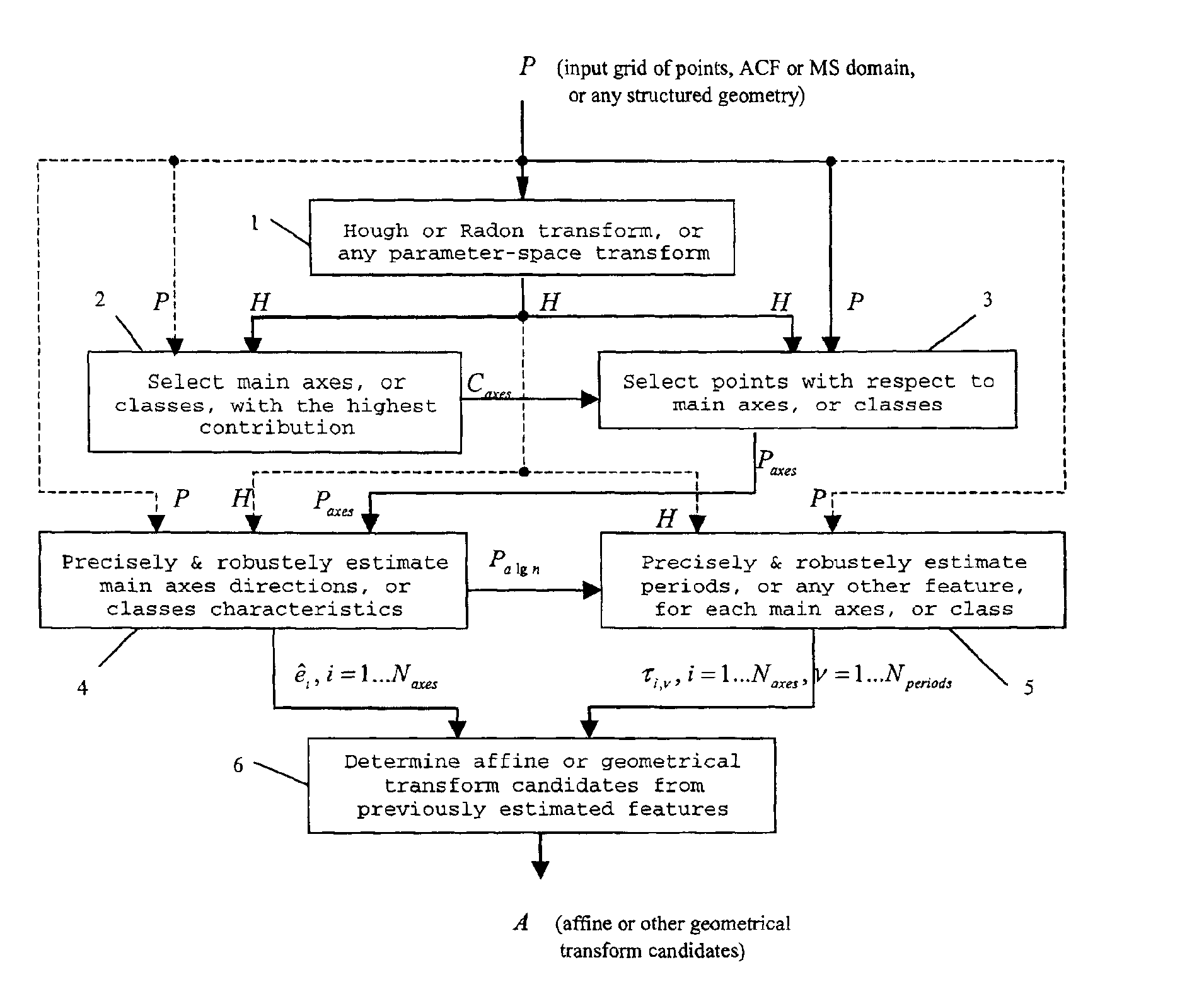
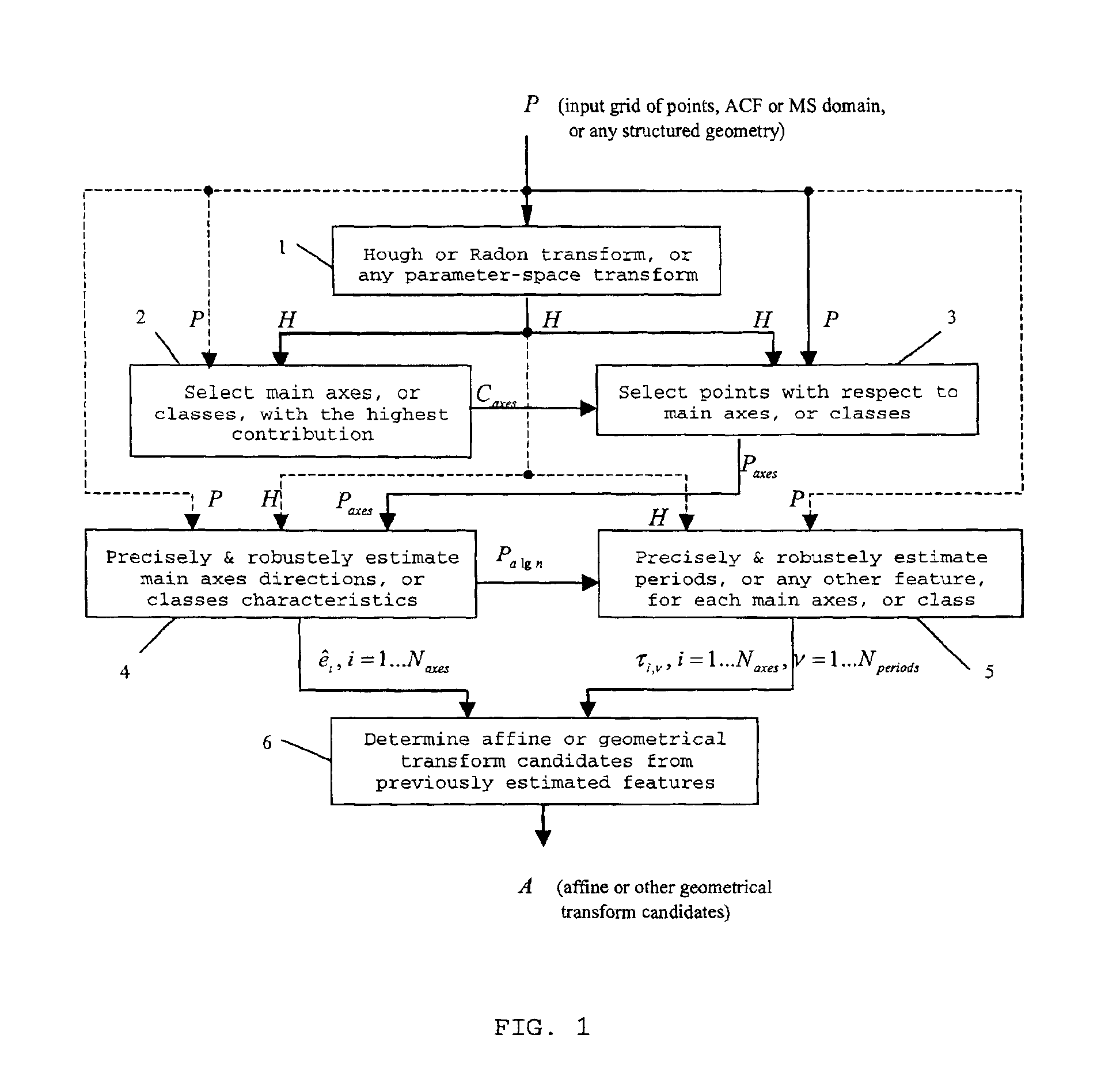
[0048]The invention further resides in possibly refining the estimated parameters by directly using the input points, since the computation of the robust parametric transform can show a lack in precision due to interpolation errors. Therefore a
record of which points have been projected into each class in the parametric transform is kept, in order to fit curves, a grid, or parameters directly to these points, for each class of points. Any robust fitting method can be used. In the case of HT or RT, lines are fitted to points belonging to each alignment, helping us in precisely estimating the main axes. To increase the accuracy of the parameter
estimation, any point manipulation, such as outliers removal or redundancy reduction, can further be used.
[0049]Preferred embodiments are: possibly keeping track of which points have been projected in the robust parametric transform; fitting lines, curves, grid, or parameters directly to these points for each identified class, using any lines, curves, grid, or parameters robust fitting approach; the fact that such fit directly done with the original points can increase the precision of the parameters estimation; the use of any point manipulation in order to enhance the accuracy and the precision of the parameters estimation.
[0050]The invention further resides in estimating the remaining parameters, if needed, which were not estimated in the previous steps. Such parameters can be estimated either from the robust parametric transform representation, or estimated and / or refined directly based on the input points for each identified class. In the case of HT or RT, the most probable period repetition of points along each main axis should be estimated (5); any robust estimation method such as distances
histogram, matching function of a given period with points, correlation, another robust parametric transform, etc. can be used for this purpose. Any point manipulation, such as outliers removal or redundancy reduction, can further be used to increase the accuracy and the precision of the estimation.


 Login to View More
  Login to View More