
Thermo-optic wave-guide switch
a technology of thermo-optic waveguide switch and waveguide, which is applied in the direction of optical waveguide light guide, instruments, optics, etc., can solve the problems of analog optical switch being susceptible to wavelength, huge variation of cross-talk, and periodic output intensity of heat power, so as to reduce the cross-talk value of thermo-optic waveguide switch and the effect of extensive temperature rang
- Summary
- Abstract
- Description
- Claims
- Application Information
AI Technical Summary
Benefits of technology
Problems solved by technology
Method used
Image

Examples
first embodiment
[0035]The optical switch of the invention utilizes a multimode interference (MMI) structure. The incident field is coupled into several waveguide modes when launched into the multimode region. For each waveguide mode, the coupling efficiency is proportional to the overlap integral field and incident filed. Each waveguide mode has different effective refractive index, i.e., each waveguide mode has different phase change while propagating the same path length. Under a certain length of propagation, every waveguide mode can have the same phase change and interference of all the modes, forming a mirror image of the incident field with respect to the center of the multimode waveguide. This phenomenon is called “self-image.” Thus, a cross-state switch in an optical waveguide can be simply implemented, and the incident field launched from an input port thereof can be received by an output port in opposite position with respect to the center of the multimode waveguide.
[0036]Because effectiv...
second embodiment
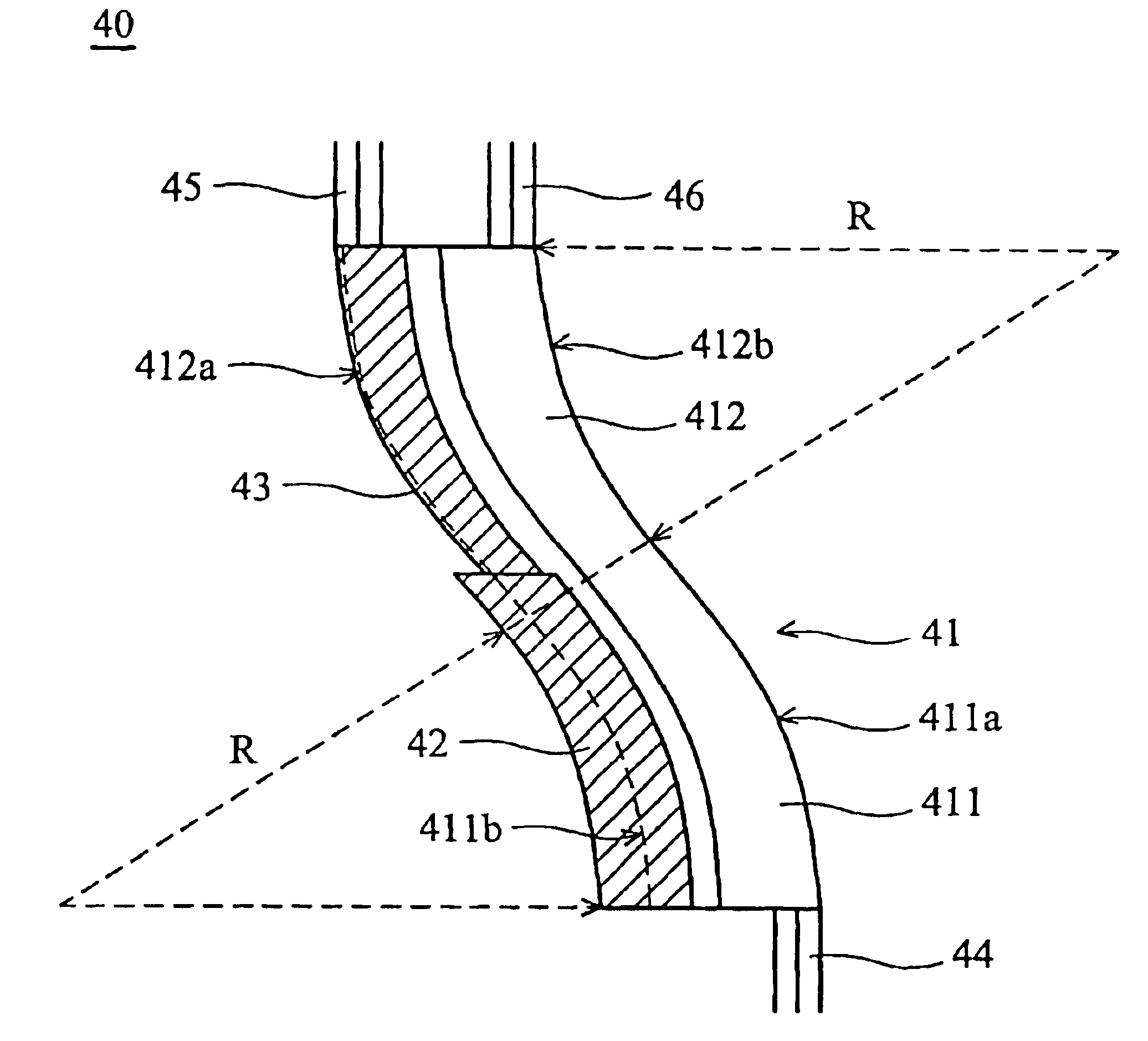
[0041]FIG. 5 schematically shows a thermo-optic wave-guide switch according to the second embodiment of the invention. As shown in FIG. 5, the thermo-optic wave-guide switch 40 of the second embodiment of the invention is a bent structure and has a multi-mode wave-guide 41, wherein the multi-mode wave-guide 41 further includes a first crooked portion 411 and a second crooked portion 412. In the second embodiment of the invention, the first crooked portion 411 has a first outer curve 411a and a first inner curve 411b with a predetermined curvature radius R, and the second crooked portion 412 has a second outer curve 412a and a second inner curve 412b with the same curvature radius R. The first crooked portion 411 connects the second crooked portion 412 whereby the first outer curve 411a connects the second inner curve 412b and the first inner curve 411b connects the second outer curve 412a. In the second embodiment of the invention, the multi-mode wave-guide 41 has a thermo-optic pro...
PUM
| Property | Measurement | Unit |
|---|---|---|
| operating wavelength | aaaaa | aaaaa |
| operating temperature | aaaaa | aaaaa |
| switch response time | aaaaa | aaaaa |
Abstract
Description
Claims
Application Information
 Login to View More