Extending a register file utilizing stack and queue techniques

a register file and queue technology, applied in the field of register usage, can solve the problems of increasing local storage requirements, memory access is much slower than register-to-register operations, and the number of internal registers available for local storage is often limited

US7203820B2Active Publication Date: 2007-04-10ORACLE INT CORP
15 Cites 2 Cited by

Patent Information

Authority / Receiving Office
US · United States
Patent Type
Patents(United States)
Current Assignee / Owner
Publication Date
2007-04-10

Smart Images

  • Figure 1
    Figure 1
  • Figure 2
    Figure 2
  • Figure 3
    Figure 3
Patent Text Reader

Abstract

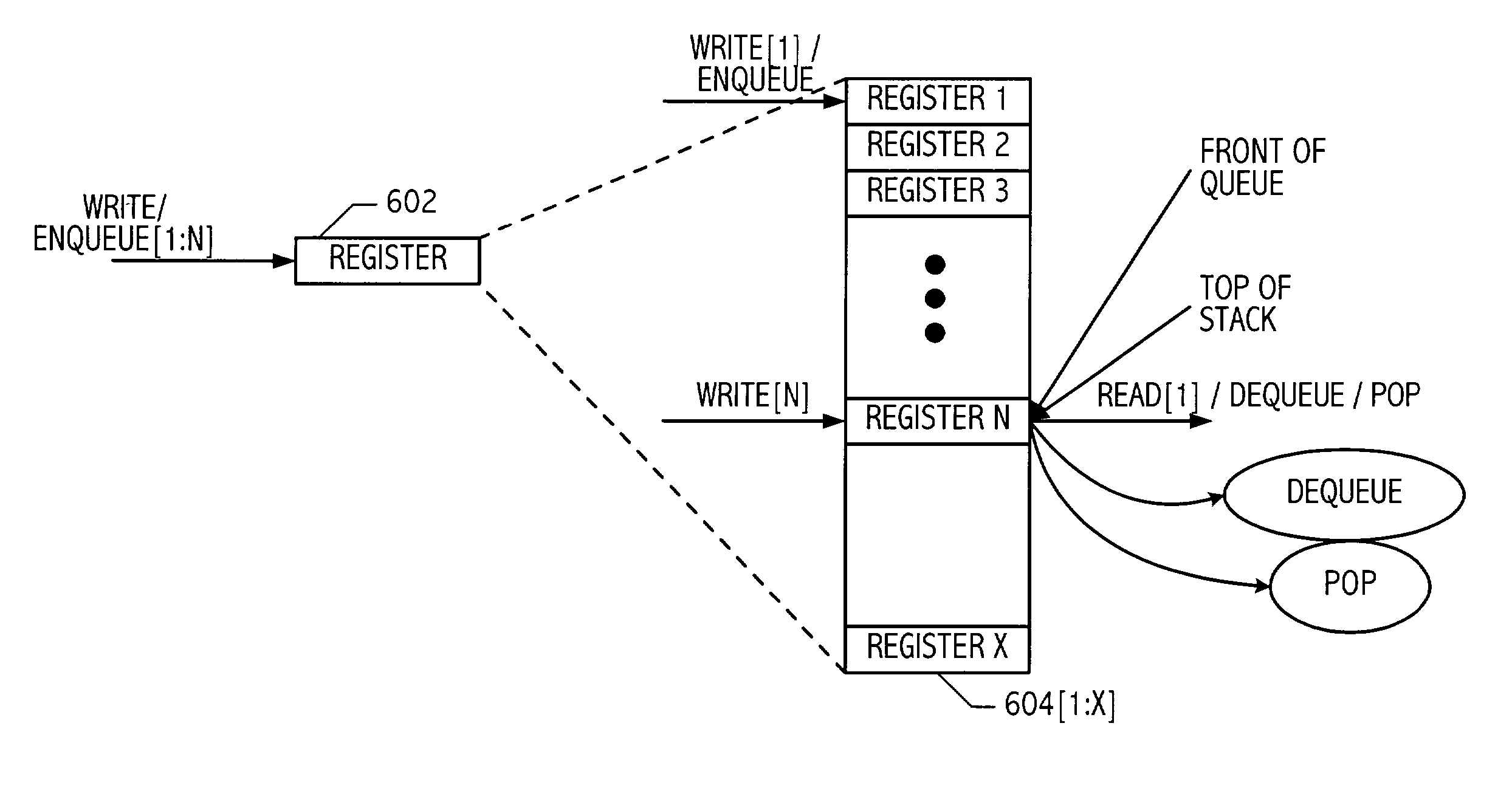
In a set of registers, each individually addressable by register operations using a corresponding register identification, at least one register of the set of registers is an extended register having multiple storage locations. Values stored in the multiple storage locations are accessed, for example, according to the order in which they have been stored. Less than all of the multiple storage locations are accessible by a register operation at a given time. Older versions of software that do not recognize extended registers identify the extended register as having only one storage location. An extended register can be, for example, a stack register, a queue register, or a mixed register and values stored in the multiple storage locations are read and stored according to the characteristics of the register.
Need to check novelty before this filing date? Find Prior Art

Description

BACKGROUND

[0001] 1. Field of the Invention

[0002] The invention relates to register usage in a processor, and in particular, the expansion of a register set through the use of stacks and / or queues.

[0003] 2. Description of the Related Art

[0004] Computer systems typically include, amongst other things, a memory system and one or more processors and / or execution units. The memory system serves as a repository of information, while a processor reads information from the memory system, operates on the information, and stores results to the memory system.

[0005] Processors have a large number of internal registers, with the objective of providing enough registers that most program data can be supplied from this high-speed, local storage. Register usage is an important resource allocation issue for compilers. A compiler is responsible for translating a high-level-language program into code that can be efficiently executed by the processor. This requires that the compiler allocate registers to pro...

Examples

Embodiment Construction

)

[0034]The description that follows presents a series of systems, apparati, methods and techniques that facilitate additional local register storage through the use of a an extended register set in a processor. While much of the description herein assumes a single processor, process or thread context, some realizations in accordance with the present invention provide expanded internal register capability customizable for each processor of a multiprocessor, each process and / or each thread of execution. Accordingly, in view of the above, and without limitation, certain exemplary exploitations are now described.

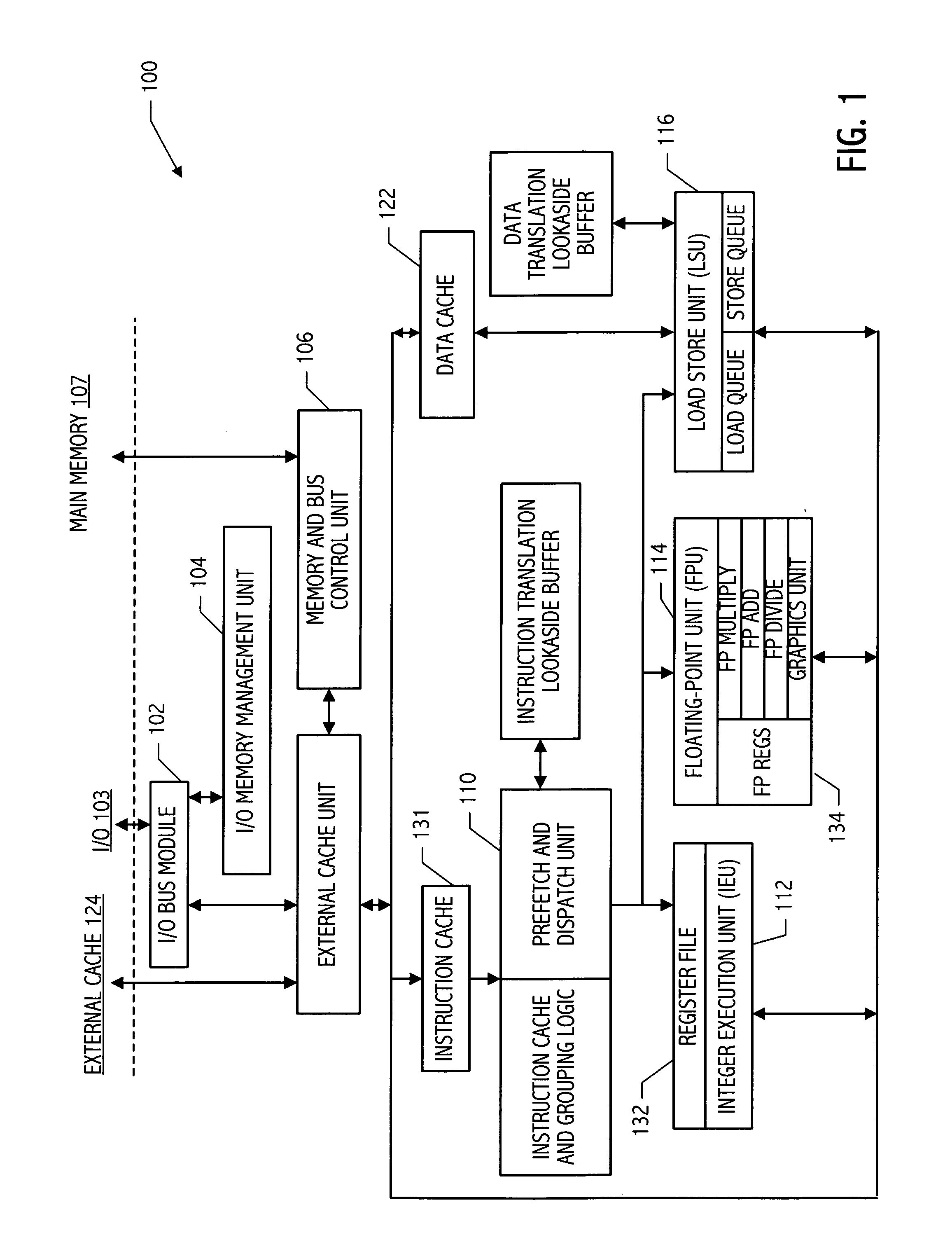
[0035]FIG. 1 is a block diagram depicting an illustrative processor architecture that includes various internal register sets and in which techniques of the present invention can be employed to provide additional internal register storage in accordance with some embodiments of the present invention. Processor 100 integrates an I / O bus module 102 to interface directly with an I / O...