
Method of joining coiled sucker rod in the field
a technology of coiled sucker rods and welding methods, applied in the field of welding with hydrocarbon gas, can solve the problems of limited life and huge electric power requirements, and achieve the effect of small size and less cos
- Summary
- Abstract
- Description
- Claims
- Application Information
AI Technical Summary
Benefits of technology
Problems solved by technology
Method used
Image

Examples
Embodiment Construction
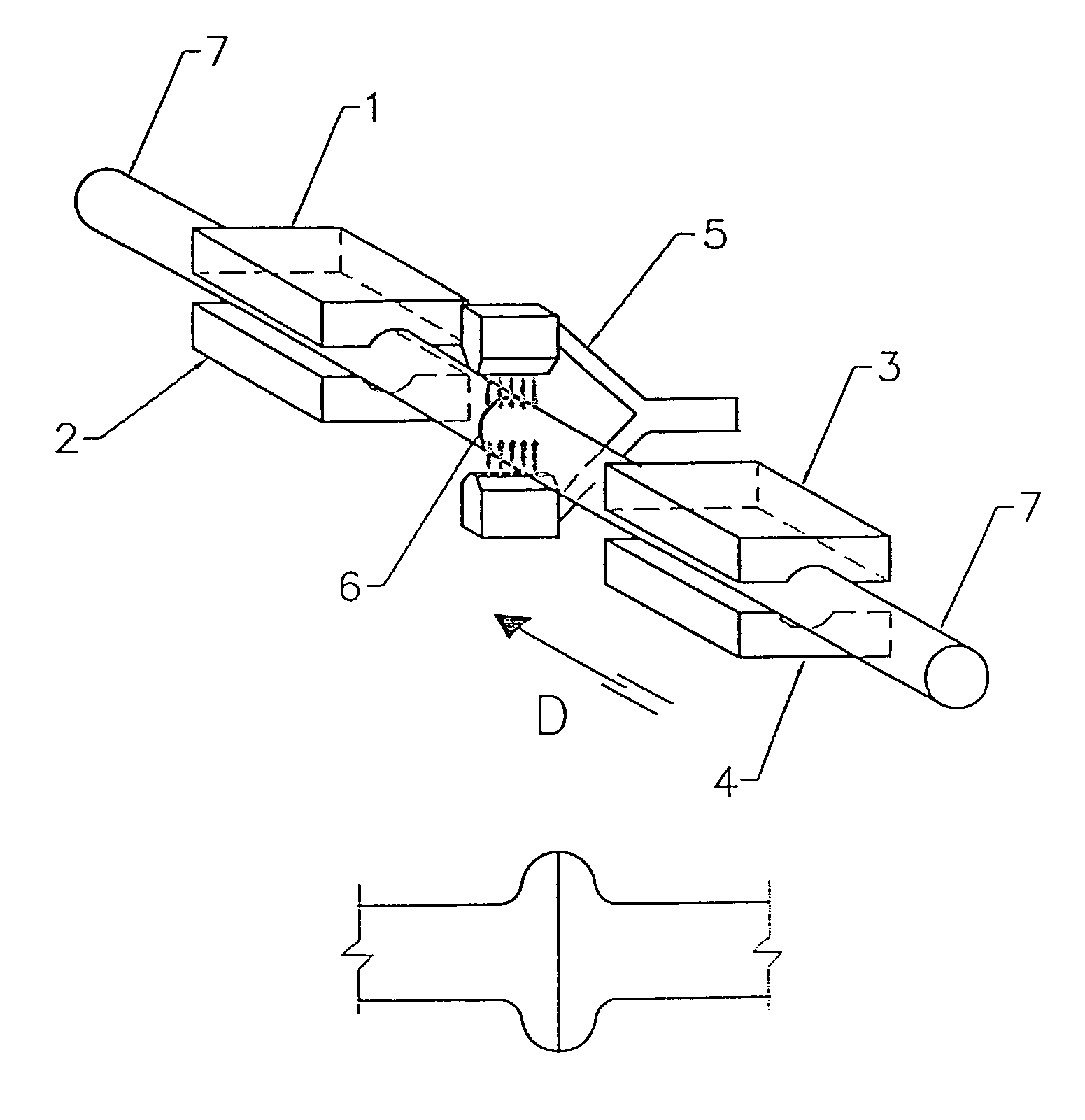
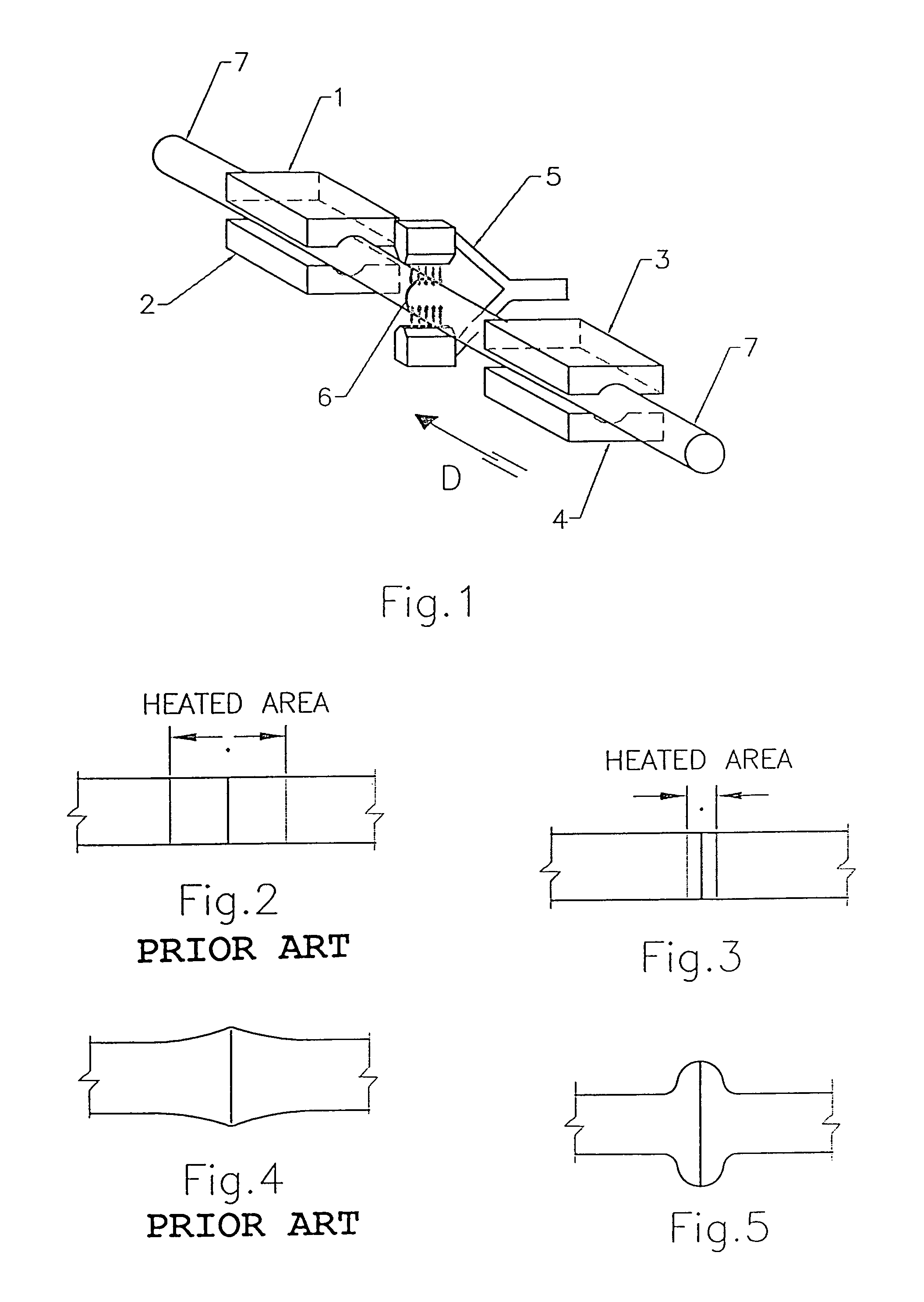
[0014]The preferred method will now be described with reference to FIGS. 1 through 5.
[0015]Referring to FIG. 1 two ends of coiled sucker rod 7 are held between stationery jaws 1, 2 and movable jaws 3, 4. Abutting ends 6 of rods 7 are in full contact, and multi-nozzle burner 5 is in position for heating rod ends 6. After the desired temperature is reached, movable jaws 3, 4 will start moving toward stationery jaws 1, 2 in direction D, compressing ends of rods 6, and welding two parts of rod 7 in to one rod.
[0016]FIG. 2 shows heated area of welded rods when welded using known methods, in contrast, FIG. 3 shows heated area of welded rods when welded using new method. FIG. 4 shows the bulge formed on a welded rod when welded using known methods, in contrast, FIG. 5 shows the bulge formed on welded rod when welded using new method.
[0017]The method, as will be hereinafter described, provides a reliable method of joining parts of a coiled sucker rod in the field without the need for expens...
PUM
| Property | Measurement | Unit |
|---|---|---|
| length | aaaaa | aaaaa |
| temperature | aaaaa | aaaaa |
| temperature | aaaaa | aaaaa |
Abstract
Description
Claims
Application Information
 Login to View More